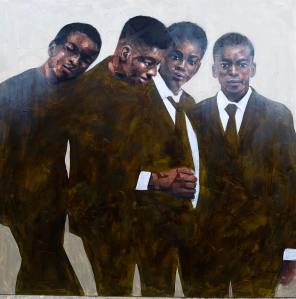
There was something deeply refreshing about watching Oluwaseun Odeyemi speak about his paintings on Lagos television. He was not simply showing paintings to an audience; rather, he was taking the presenter through a journey shaped by ideas, memories, experiences, discipline and an unmistakable belief in what art can become. As he moved from one work to another, explaining the inspirations and stories behind them, another story emerged, the story of an artist who has spent years learning how to transform observation and experience into a language of his own.
Oluwaseun Odeyemi joins iBAND Magazine in an engaging conversation about his art, his journey, his international ambitions, the challenges he has encountered and what he is still searching for as an artist. That conversation brings us closer to the person behind the paintings and makes Oluwaseun Odeyemi our Cover Feature this week.
Words Ireho Aito | Don’t Keep Your Art in the Finger! Photographs and images courtesy Oluwaseun Odeyemi
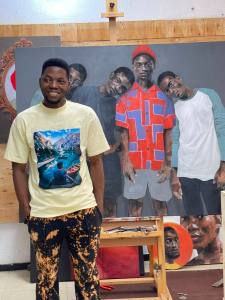
His journey began with curiosity, simply because there was a young boy who was fascinated by the possibility of making images. Oluwaseun Odeyemi remembers using whatever materials he could find, including nails to make marks on walls and coloured clay dug from a well to create colour. Comic books, including Super Strikers, also became part of his early visual education. After secondary school, Odeyemi enrolled with a local roadside artist, where he learned printing, design, engraving and the basics of painting. As he recalled earlier on the TV show, he never knew that there were schools for creative endeavours.
The experience with the artisan in his formative years only strengthened his desire to understand art more deeply. He wanted more than the ability to draw. He wanted something personal, emotional and connected to his inner self. He got to know about tertiary institutions offering art courses after his visit to Yaba College of Technology, Lagos, and it stayed with him that schools were available for his kind of special talent. He did not stop believing; instead, he continued searching.
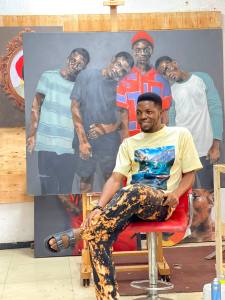
That search took him to The Polytechnic Ibadan, where he obtained his National Diploma in Fine Art in 2015, and later gained admission to Obafemi Awolowo University, Ile-Ife, where he earned his Bachelor of Arts degree in Fine Art in 2020. For Odeyemi, however, education was never simply about certificates. It was part of the longer process of becoming an artist.
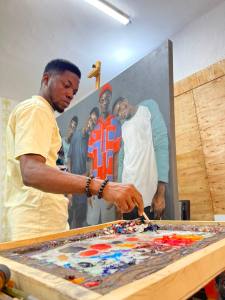
“Becoming an artist is not something that happens overnight. It is a continuous process of learning, mentorship, workshop, experimenting, questioning yourself, and most importantly, finding your own voice,” he says.
During his National Diploma years, the encouragement of lecturers and mentors helped him recognise something special in his talent, while his industrial training at Universal Studio of Art, under the tutelage of established masters, further widened his understanding of the profession and exposed him to different artists, mentors and colleagues. But technical ability was never going to be enough.
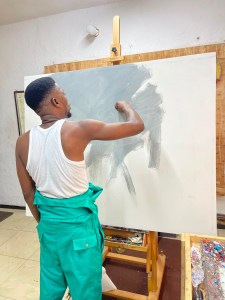
His development was also not confined to the classroom or studio. Along the way, Odeyemi worked on mural projects that took his practice into public and commercial spaces, including the Lagos @ 50 mural at the National Stadium Bridge in Surulere, as well as mural projects in Ojota, Ilorin and Ile-Ife. He also worked on a mural design on metal with artist Dotun Popoola and contributed to a mural at Yaba Psychiatric Hospital. These experiences expanded his understanding of scale, public space and the relationship between art and everyday life, while strengthening the practical discipline behind the painter he was becoming.
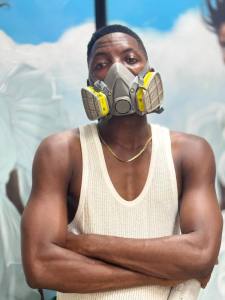
That development also brought early recognition. In 2015, he was named Most Talented in Art and Design at The Polytechnic Ibadan, followed by first prize in the student category of the Union Bank Art Challenge in 2017. At Obafemi Awolowo University, his draughtsmanship earned further recognition in 2019. These milestones were important, not simply as awards, but as affirmations that the discipline he was building around his talent was beginning to find its own voice.
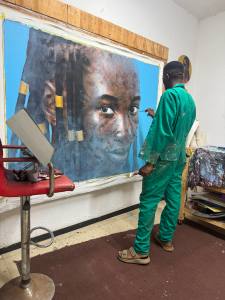
As he grew personally and professionally, questions began to emerge around his figurative paintings. Why was he painting a particular person? What was he trying to say through that person’s presence? What should an audience feel or think when standing before the work? Those questions changed his practice, as he explains;
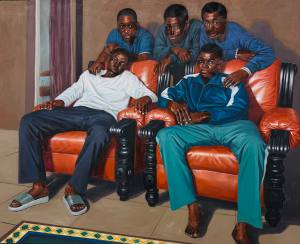
“As I grew both personally and as an artist, I began to realise that being able to draw and paint beautifully is not enough for me.”
Odeyemi began looking beyond the surface of the human figure and became increasingly interested in human experience and the quiet relationships between people, identity, memory and the individuals who shape our lives.
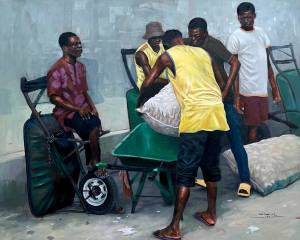
“Technique is a tool, but the real substance of the work comes from the idea, experience, emotion, and stories behind it,” he shares.
For him, art has become a language.
“Art has become the way of understanding life and communicating things that I have not always been able to express in words,” Odeyemi states in his response.
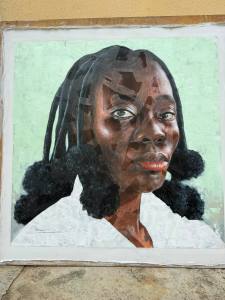
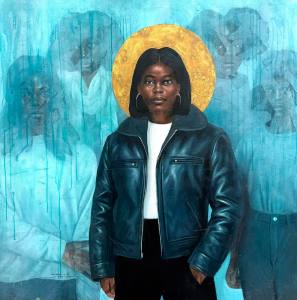
That understanding is central to his paintings. His figures are not simply demonstrations of draughtsmanship. For the uninitiated, they carry moods, memories, relationships and questions. His visual language is equally important to experience. Non-continuous lines intersect across his compositions, while textured surfaces create layers of movement and depth. Yet the lines and textures are not merely decorative.
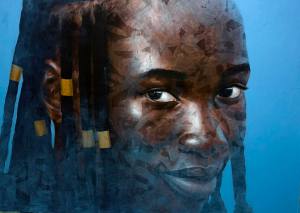
“My visual language comes from my interest in people and the complexity of human experience,” he says.
Odeyemi does not see people as simple surfaces. In fact, he explains:
“When I look at someone, I don’t just see the surface. Behind the surface there are many layers of memories, emotions, struggle, relationship and experience that have shaped who that person has become.”
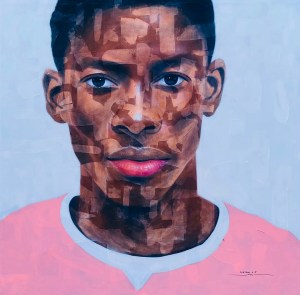
For him, the intersecting lines therefore become a metaphor for life. They cross, separate and sometimes almost disappear into one another.
“The intersecting lines and the texture are not just decorative. They suggest connection, movement, tension and different parts that make up a person’s life.”
Texture is integral to his work because human beings themselves are not smooth or perfect. He believes we carry traces of where we come from, where we have been and what we have experienced.
“I think of the surface of my painting almost like the surface of a person’s life, something that has been built gradually through different emotions and experiences.”
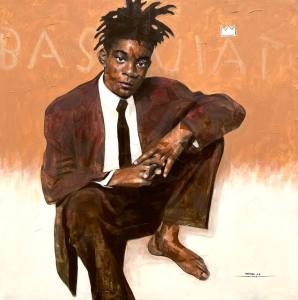
The exhibition history tells the story of that progression. From student and emerging-artist exhibitions at Obafemi Awolowo University and platforms such as Life in My City, Mydrim Affordable Art Fair and the Union Bank Art Challenge, his practice gradually moved into wider contemporary art spaces. He exhibited at Alliance Française Lagos, Ogirikan Gallery, Kokopelli Gallery and other platforms before entering a more international chapter that included the 70th International Cultural Exchange of Art in 2019, virtual and contemporary exhibitions in 2020 and a growing series of exhibitions from 2021 onward. By 2022, his work had reached Spectrum Miami Art Fair, followed by solo and group exhibitions including Resilience, The Duality of Existence, Beyond Onaism, Strength in Unity and other presentations in Nigeria and the United States. In 2024, he was also represented at the Atlanta Art Fair through the Mitochondria booth, while Tracing the River Back followed in 2025. The journey is significant because it shows that his international presence was not a sudden arrival; it was built gradually, exhibition by exhibition.
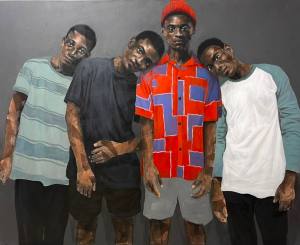
“Exhibiting outside Nigeria has broadened the way I understand both my work and myself as an artist.”
International audiences gave him a different perspective on his paintings. People from different backgrounds connected with aspects of the work in ways he had not anticipated. It taught him that once a painting leaves the studio, it begins to develop a life beyond the artist’s original intention.
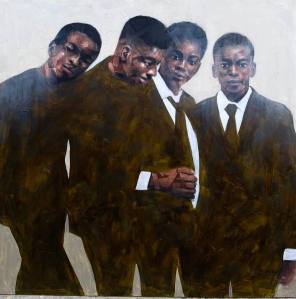
“The work leaves the studio. It begins to have a life beyond my original intention,” Odeyemi submits.
That experience has also made him appreciate his Nigerian background even more. International exposure has brought confidence, but also a sense of responsibility and a reminder that there is still much to learn.
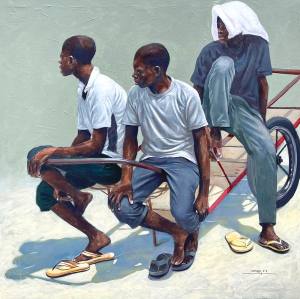
His journey, however, has not been without setbacks. At one point, after receiving an invitation to attend an art fair in Miami, Odeyemi began the visa process with excitement. He had prepared himself mentally and emotionally and had even informed some collectors that he would be in the United States. Then the visa was refused. The disappointment was painful. He still remembers that moment and shares the way he felt with candour.
“When the visa was refused, I was deeply pained and disappointed.”
For an artist building an international career, such an experience could easily become a reason to stop. Odeyemi chose instead to see it as another test of his determination.
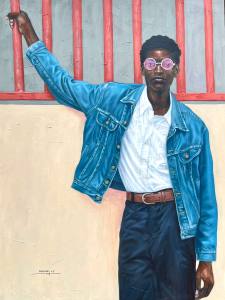
“At times there are things beyond our control,” he believes.
He also found comfort in one important reality which is, his work could travel even when he could not.
“What gave me strength was knowing that although I could not travel, my work could.”
The experience taught him patience and resilience. “An international career is not built for one exhibition,” he maintains.
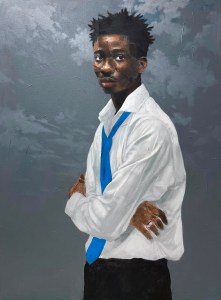
Looking back, he no longer sees the visa refusal only as a disappointment. He sees it as one of those experiences that tested his belief in his journey, as he remarks without regret:
“Sometimes the artist may face boundaries, but the work itself can cross the boundary.”
That resilience is central to how Odeyemi understands his career. There have been moments when things did not go as planned, but he has learned not to treat those moments as the end.
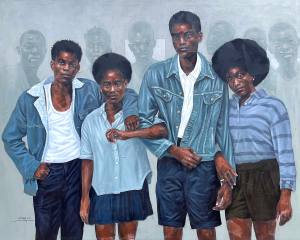
“Success and growth are self-made decisions. Your momentum and determination towards them will determine your next move towards life.”
What keeps him moving is not only recognition, exhibitions or collections. It is curiosity. Receiving emails from galleries, collectors and art lovers has encouraged him and shown him that something meaningful may be emerging from his exploration. But Odeyemi remains interested in what the work can become. There are still ideas, stories, memories and experiences he has not fully explored.
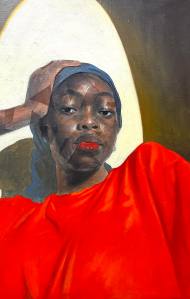
“I still have a strong curiosity and momentum about what my work can become.”
He describes the combination of curiosity, discipline, patience, positive drive, ambition and belief in the process as the force that keeps him moving.
At this stage of his career, he says he is searching for depth. That search is taking him increasingly towards questions of presence, particularly the presence of people who shape our lives in ways we sometimes take for granted. Who nurtures us? Who carries us through certain stages of life? How do those relationships influence who we eventually become?
These questions have led him towards a new body of work focused on women and their place in individual and collective existence.
“Before we understand the world, many of us first experience it through the care, protection and presence of a woman,” he says with utmost conviction.
It is a subject that feels deeply personal, particularly when considered alongside his own family story. Odeyemi comes from a family of eight, his parents and six children, three boys and three girls. He is the second-to-last child. His father, the late Mr. Sunday Odeyemi, was the first Chief Executive Baale of Onihale town in Ifo, Ogun State. His mother is Mrs. Muinat Odeyemi.
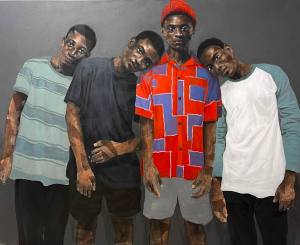
When he speaks about his journey, however, it is his mother’s sacrifice that comes into sharp focus. He remembers hearing that she once learned architectural drawing in a local setting and sometimes wonders what she might have become if she had been given the opportunity to study formally. He believes she could have become a great draughtsperson and wonders whether some part of his own creative ability came through her.
But her influence extends far beyond creativity. After his father passed away, his mother carried the responsibilities of widowhood. Through her relationship with Professor Adesegun Fatusi, who became a guardian, mentor and father figure during Odeyemi’s academic journey, she was presented with a choice: support could go towards improving her own business and circumstances, or towards the education of one of her children. She chose his education. That decision changed the direction of his life.
Odeyemi remains deeply grateful to Professor Fatusi for the role he played, but he speaks with particular admiration for his mother’s decision.
“Sometimes we speak about an artist’s journey through exhibitions, awards, collections and achievements, but behind those visible things are often people whose sacrifices nobody sees.”
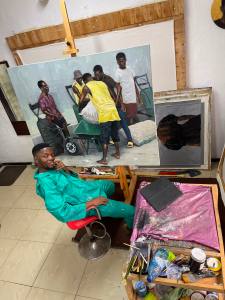
For him, his mother is one of those people.
“Going to school transformed my journey, but her decision made that journey possible,” he celebrates.
Then comes perhaps the most powerful reflection of all from the young and focus driving artist;
“Before I understood what it meant to believe in myself, my mother had already believed in what I could become,” he claims with appreciation.
Today, Odeyemi’s works have found their way into private, institutional and international collections. Among the collectors and collections he identifies are Mr Akeem Adedeji, Prof. Segun Aina, Mr Jubril Enakele, Lester Marks Art Collection, The Wright Art Collection, Julius Baba’s Collection, NAACP Museum, Ashleigh Camilla, Mr Ayo Olashoju, Petrov Collection, Mr Elijah Rasheed, Mr Emeka Nweze, Ammazing Series Collection, Herb Gray, Robert Peterson, Edlgordon, Vandele Kerckhof, Patrick Lathouwers and Maison Anna Heylen.
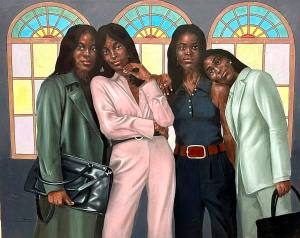
Yet even here, Odeyemi’s understanding goes beyond ownership. And he comments;
“For me, collecting goes beyond owning a painting, as it creates a relationship between the collector and the work.”
That relationship mirrors the central concern of his practice, which is human connection. The painting leaves the studio, enters another space and encounters another person. Its meaning continues.
There is a temptation to measure an artist’s progress through exhibitions, international fairs, galleries, collectors and recognition. Odeyemi has accumulated many of these markers, but he does not speak like an artist who believes he has arrived. He is still questioning, still experimenting, still pushing the human figure, still exploring the layers beneath the surface and still thinking about the people whose presence shapes us.
Perhaps that is why When Ambition Finds Its Own Lines speaks so closely to his journey. The lines in his paintings intersect, disappear, return and create relationships between different parts of the composition. His career has followed a similar path through opportunities, setbacks, closed doors, new possibilities and constant movement.
He is grateful for how far his walk has travelled, but he remains conscious that the journey is not finished.
“I still see myself as an artist who is learning, evolving and building something that I hope will move beyond the present moment,” he reveals.
The ambition is still alive. The questions are still growing. The work is still travelling. And Oluwaseun Odeyemi is still marching forward, stronger, bolder and more certain with every mark on canvas.
iBAND Magazine, Celebrating Visual Art from the Original.
Africa | Visual Art | Lifestyle | Culture

