Photo credit Uche James Iroha. Courtesy of Omenka Gallery
Power and Powers stands as a record of a nation’s long struggle with power, political and electric and a reminder that artists can preserve truths that institutions often fail to confront.
Words Ireho Aito | Don’t Keep Your Art in the Finger! Photographs credit Uche James Iroha
When Lagos-based writer Ireho Aito decided to write about this epoch-making exhibition in 2014, it was written from the soul of a witness to Nigeria’s electricity problems. Nigeria was then 54 years old as an independent nation. Today, in 2026, Nigeria is 65 and approaching 66, while the photographer Uche James Iroha has relocated to America, the writer still lives in Nigeria. This exhibition therefore comes back to us as a commemorative reminder that artists are the mirror of society, and that some works continue to speak long after the gallery doors have closed.
Uche James Iroha’s Power and Powers was an exhibition born from a subject Nigerians had lived with for generations, complained about for generations and somehow learned to laugh about: electricity.
In Nigeria, the first spoken words coming from a toddler or infant while trying to mutter words and languages can almost be imagined as “Up NEPA!” The phrase became more popular than, and has outlived, many Nigerian presidents, living or dead. It became so synonymous with our modern lexicon that for decades it captured the excitement of electricity returning after an absence.
For over 54 years, the phrase remained with us as a nation, despite the change of name, logo and institutional identity from ECN to NEPA, then PHCN, followed by the legendary privatisation process and more promises of reform. Yet the script refused to change. The role and function of the electricity-generating parastatal corporation had been ridiculed, even by unlettered locals who would warn their wards whenever there was relatively stable electricity; “please, don’t celebrate it too loudly.” Which means, don’t give too much credit to the power company. Once it is praised, they joked, the light may disappear.
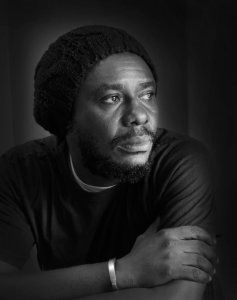
That was the Nigeria Iroha photographed.
Nigerian-born photographer Uche James Iroha is a child of the 1970s. He belongs to the generation born after the Civil War and grew up during the years of General Yakubu Gowon’s post-war development plans, the oil boom, massive salary structures in the civil service, financial profligacy, new development plans, a new national anthem, Nigeria’s big-brother role across Africa and the cultural optimism surrounding FESTAC ’77. Yet despite all those dreams of national development, the power problem persisted.
And unfortunately, it is still with us today.
It becomes a difficult venture for an artist to see and feel truth and later explode it to the world. It is a risky venture for artists and artistes to plunge into. Uche damned the consequences. For close to five years of his life, he refused to back down and took one of the greatest risks of his career, even when some optimists assured him that things would become better, before he eventually came out to exhibit. Close to five years later, things had gone from bad to worse.
Uche did not stop.
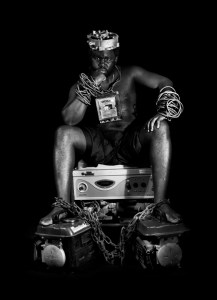
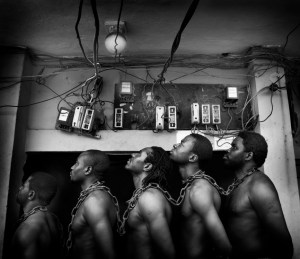
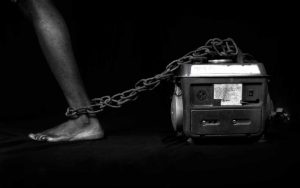
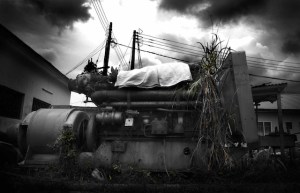
He decided to showcase his findings through photography, in an exhibition supported by Nikon. The exhibition, Power and Powers, presented a disturbing but compelling meditation on the relationship between electricity, political authority, privilege and the people who continue to live in the darkness. Omenka Gallery described the exhibition as an introspection into 54 years of epileptic power supply in Nigeria.
His father was the renowned thespian James Iroha, popularly known as Gringory, who gave his country selfless service through broadcasting and theatre, including the iconic drama series The Masquerade. Uche James Iroha studied sculpture at the University of Port Harcourt and took to photography in the mid-1990s. A Prince Claus Fund recipient because of his outstanding contribution to photography among his generation, the Flesh, Fire and Blood photo artist and steadily built a career that moved from Nigeria into global reckoning. He also founded Photogarage, a photo clinic and a place where people, both young and old could develop their personal interest in photography.
The dreadlocked photographer eventually swept civil society, collectors and photography enthusiasts off their feet with this offering at Omenka Gallery.
Power and Powers exhibition ran from November 8 to 22, 2014, and all the photographs were shot exclusively with Nikon.
All photographs were presented in black and white, but there was nothing colourless about the message.
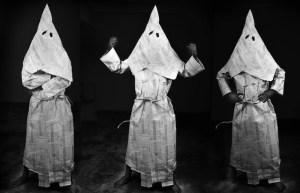
Among the works associated with the project were Enthroned (2012), Looking Down, Still Shackled (2012), Canon Ball (2012), Rolls Royce (2013), Masked (2013), Potty Training (2014), Umbilical Mortgage (2014), Standing on the Fence, and Looking Upwards but Standing in Chains. The body of work was presented as a sustained critique of the relationship between political power and electrical power distribution in Nigeria. Other documented works from the exhibition include KBK – Krazy Bill Klan (2013) and Ready for Post-Mortem.
The titles themselves reveal the tensions running through the body of work: authority, dependence, privilege, captivity, uncertainty, aspiration and power.
The artist and the activism in him revealed the truth behind the darkness of one of the richest African countries and the people who were also in the dark, perpetuating a cycle that had kept supposedly precious citizens in darkness for decades.
Often, we received information and press releases about the grid and the enormous money being pumped into everything for a stable power supply. But behind us, in the dark, the greed of certain groups continued to put the country in the dark.
Allegations of corrupt practices had been exposed so many times within the power sector, but the people in the dark corners perpetuating these darkening acts were rarely brought to book.
We would recall the 1987 power blackout throughout the federation and the uproar that followed. People were arrested, saboteurs were caught, people were sentenced, yet the darkness remained.
Haven’t we seen staff of the electricity corporation warning intruders and even fellow staff on disconnection patrol never to step into their homes and tamper with their electricity? There was always that familiar sign beside a metre: “NEPA staff lives here. Please don’t disconnect.”
Anybody who worked with the power and electricity-generating company could become a demi-god in the neighbourhood. That person could command more popularity than the Community Development Association leader because of perceived access to the corridor of power.
Wanton riches were associated with the electricity business to the extent that parents and guardians could even encourage their wards to find their way into the parastatal corporation responsible for electricity and power jobs. The power sector had acquired a reputation for corruption, patronage and privilege.
Even the privatisation and commercialisation processes stalled repeatedly. The promises changed, the institutions changed and the terminology changed, but the darkness remained familiar.
And so the people created their own joke.
To give power to the people, the people were also warned by the slogan, “Never Expect Power Always.”
Looking back at Power and Powers today, the joke feels less like humour and more like an archive of a national experience.
This is why the exhibition deserves to be remembered.
Uche James Iroha did not simply photograph darkness. He photographed a system, a society and a contradiction. He looked at the relationship between those who possessed power and those who waited for it. He transformed an everyday Nigerian frustration into a visual language that could travel beyond Nigeria.
That is the power of the artist as witness.
Today, Iroha lives in America, while the writer who documented this exhibition from Lagos remains here, still living with the subject that inspired the work. The distance between the photographer and the writer has changed, but the question raised by the exhibition has not disappeared.
Nigeria is still searching for power. And perhaps that is why Power and Powers continues to speak.
It reminds us that artists are not merely observers of their societies. Sometimes, they are the ones who preserve the memory of what society has tried to forget.
Nigeria was 54 when this exhibition confronted the country’s electricity crisis. Today, the country is 65, and the conversation has not disappeared. That alone gives the exhibition a new life beyond its original moment.
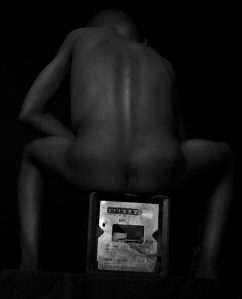
Nigeria’s electricity story has since acquired new language with Band A, B, C, D and E, alongside the Electricity Act 2023, metering initiatives and other ongoing reforms in the sector. Yet beneath the new bands, tariffs and reforms, the old conversation about access to reliable power continues. That makes Power and Powers even more relevant today as an exhibition that captured not just Nigeria’s darkness, but our enduring struggle over who controls the power and who gets to enjoy it.
The lights may come and go, governments and institutions may change, and promises may be renewed, but the photographs remain. Power and Powers stands as a record of a nation’s long struggle with power, political and electric and a reminder that artists can preserve truths that institutions often fail to confront. More than an exhibition, it became a witness to its time, and its relevance has only deepened with the years.
iBAND Magazine, Celebrating Visual Art from the Original.
Africa | Visual Art | Lifestyle | Culture
 iBAND Magazine