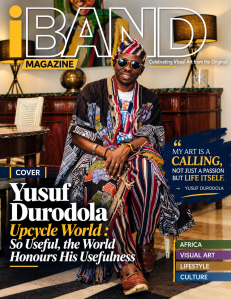
“I have seen this as my calling. I got determined that this is no more passion but life itself.”
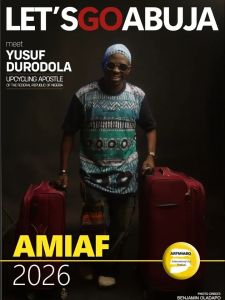
As the ArtMiabo International Art Festival draws closer, one of the creative Nigerians who has helped shape its story graces our Cover Edition.
Yusuf Durodola takes us into his world, growing up, family, influence and the experiences that helped make him who he is today. His journey did not begin with art alone. He fell in love with accounting and mathematics, disciplines built on numbers, order and calculation. Yet, somewhere along the way, creativity changed the equation.
Today, those early influences have found a different expression. Durodola has carved a creative path of his own, one that has increasingly brought people to him in search of something deeply personal: the freedom to express themselves.
In this Cover Edition, he talks about the people, places and experiences behind the man and the creative force we have come to know as Yusuf Durodola.
Words Ireho Aito | Don’t Keep Your Art in the Finger! Photographs courtesy Yusuf Durodola archives
He was infectious to everyone around him. It was hard not to notice Yusuf Durodola, not only because of his top-notch fashion appearance, always turning out in beautifully embroidered African fabrics with the cap to match, but also because of the energy he brought to whatever he was doing.
I watched the behind-the-scenes of Yusuf trying to direct an orchestrated scene for a short documentary on one of the legends of Nigerian art, painter and teacher of teachers, Dr Kolade Osinowo, during the Kolade Osinowo Honour at the ArtMiabo Art Festival. Watching him move around the production, trying to put the story together, offered another glimpse into the many sides of a man who is never quite limited to one role.
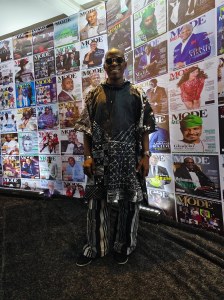
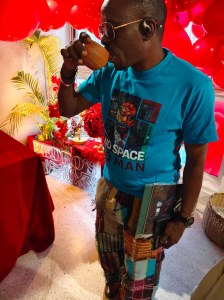
Yusuf Durodola’s maverick but high-fashion appearance is hard to miss, thanks in no small measure to what seems like a genetic trust from his father. He is simply Mr. I-Taste. His confident use of African prints, the way he combines them and wears them, gives him an identity beyond the conventional image of the Nigerian visual artist. Even before you begin to examine his art, Durodola has already made an impression through the way he presents himself.
Yusuf Durodola is a man of many parts, an artist whose usefulness stretches across several creative territories and who has emerged as one of the most valuable artists of his generation.
From a childhood spent drawing cartoons, tracing patterns from his father’s sewing machine and learning the language of creativity from his family, Yusuf Durodola has grown into an artist, curator, graphic designer, teacher and creative thinker whose usefulness extends far beyond the gallery walls. His story is one of curiosity turned into calling, talent transformed into purpose and a life in which art has never existed in isolation from learning, teaching, designing and helping others.
Yusuf grew up in Ibadan, Oyo State, at Isale Osi, close to Oja Oba. His earliest lessons in art did not begin in a formal studio but around his father, a fashion designer involved in sewing and embroidery. At about five or six years old, his father taught him to sew and would give him paper to run through the sewing machine. The needle left perforated dots on the paper, and the young Yusuf began turning those dots into cartoons and patterns. Fido Dido, then a popular soft-drink character, became one of the figures he enjoyed drawing, while his little sketch pads found buyers for five kobo, ten kobo and twenty-five kobo. Even at that age, he was already watching closely, paying attention to details and creating from his environment.
“My father was my first mentor who opened my eyes to fashion,” Yusuf says, recalling how the sewing, embroidery and patterns around him became an early visual vocabulary. Those patterns and lines from his father’s Agbada and native attire have never really left him; “Till date, you see such patterns and lines in my professional journey.”
Creativity was also a family language. His father was a fashion designer, while his brothers were involved in branding, architecture and graphic art. One of them noticed that there was much more in the young Yusuf than he perhaps understood himself and began to mentor him, introducing him to graphics, branding and other possibilities within creative practice. His brother was also instrumental in making sure he took Fine Art in secondary school.
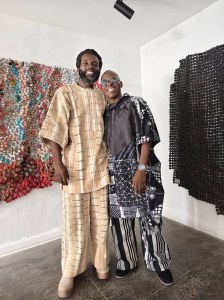
That intervention mattered because Yusuf had another ambition at the time. He loved Accounting and Mathematics and had once imagined himself becoming an accountant. Art was a passion and a gift, but not yet the life he had chosen. Yet after Junior Secondary School, he began using his artistic skills to make money through hall decorations, event captions and other creative jobs. As he puts it, “When I started art was passion for me,” but the experience of making a living from that passion gradually changed his understanding of what art could become. He got determined that this is no more passion but life itself.
His formal journey would take him from Ibadan to Lagos and through several different learning environments. After primary and secondary school, he attended an Arabic school in Lagos, where he developed his handwriting and calligraphy. He later apprenticed in computer graphics, handmade cards and printing, experiences that broadened his view of art. “I began to see art from a broader angle,” he recalls, as each new skill added another layer to his understanding of creativity.
At Federal College of Education, Akoka, Lagos, that understanding expanded further. He was exposed to sculpture, textiles, graphics, painting, ceramics and other forms of art while also being trained as a teacher. He subsequently proceeded to the University of Lagos for his first degree and Obafemi Awolowo University for his Master of Fine Arts. He is presently pursuing a PhD in Painting at Olabisi Onabanjo University. Through all these stages, one thing remained constant: “Throughout my educational journey, Fine Art has always been there.”
For Yusuf, the upcycle artist, education is not simply about certificates. It is an ongoing appetite. “I love knowledge,” he says, explaining a philosophy that has influenced virtually every stage of his development. “For me, knowledge is power.” It is why his creative practice has continued to expand beyond painting. Today, he is also a graphic designer, designing most of his own catalogues and producing design work for many other artists. He has trained young artists too, some of whom are now taking their own spaces in the art business.
His training as a teacher has been equally comprehensive. From kindergarten and Montessori education through primary and secondary school to tertiary education, Yusuf has taught across the educational spectrum and is today a lecturer. “I have touched all the levels of educational settings,” he says, seeing the different things he learnt through education as part of the larger art form that has shaped his life.
The people around him have remained important to that development. His father introduced him to fashion, sewing and embroidery; his brother opened his eyes to graphics, branding and signage; his brother’s friend further exposed him to art design and painting; the Arabic school strengthened his handwriting and calligraphy; while his apprenticeship introduced him to graphics, handmade cards and printing. At Federal College of Education, Akoka, and through friendships with people from institutions including the Federal College of Technology, Yaba and the University of Lagos, he continued to learn. He was deliberate about it. “I worked so much studying my friends who were lecturers too,” he says, adding, “I made so sure that hardwork defined me.”
It was this same instinct to learn and contribute that unexpectedly opened the door to curating. Yusuf did not plan a curatorial career. In fact, he is clear that “the curatorial aspect for me, I did not see it coming at all. That happened when I was trying to help.” He was helping other artists install their works, checking settings and offering practical assistance with exhibitions. Gradually, people began to see another ability in him. They told him he was not only an artist but could also curate.
The distinction is important because, as Yusuf explains, “Curatorial aspect of my practice started from answering people’s call not that I chased it.” He was not pursuing a title; he was responding whenever people needed his contribution. That willingness eventually led him to ArtMiabo International Art Festival.
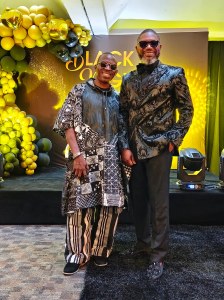
Yusuf was invited to the first edition of ArtMiabo as a participating artist, but while there, he found himself helping other artists install their works, looking at their settings and assisting with the overall exhibition arrangement. His contribution caught the attention of ArtMiabo founder Miabo Enyadike, who subsequently invited him to curate the festival. Yusuf would go on to serve as curator of the ArtMiabo International Art Festival for three years, an experience that became one of the defining moments in his curatorial journey.
Looking back, he remains almost amused by how it happened. “I didn’t plan to become a curator at all. My plan was to just help.” But that help became an opportunity, and the opportunity became a professional responsibility. He describes the three-year experience as “a lovely and memorable experience,” but its greater significance was what it revealed about him. “It was from curating ArtMiabo that I realised I am a curator.”
It was a role other people had begun to recognise in him before he fully recognised it in himself. He had entered the space as an artist willing to help, and emerged with a clearer understanding of another dimension of his practice. Even now, he says, “It is only recently I started seeing myself as a curator.”
That pattern runs through much of Yusuf’s career. He learns something, applies it, shares it and then finds himself entering another territory. The artist became a graphic designer. The artist became a teacher and lecturer. The artist who helped other artists became a curator. Yet none of these identities displaced the original one. They grew around it.
“I have never done anything different from art in my life,” he says.
Perhaps that is also why his understanding of art is so expansive. Yusuf does not see art as something that belongs only inside galleries or museums. “Art is everywhere,” he says, pointing to the most ordinary example: “Check the roadside pepper seller, even the way they arrange their pepper is always so artistic.” For someone whose own artistic eye began by observing a sewing machine, patterns on clothing and the details of everyday life, the example feels entirely natural.
The journey from Isale Osi to the professional art world has therefore been built from many seemingly different experiences that have continued to connect. The sewing machine gave him his first encounter with lines and patterns. Fashion introduced him to design. Calligraphy sharpened his relationship with handwriting. Graphics expanded his visual language. Formal education gave him wider artistic training. Teaching turned knowledge into something he could pass on. Graphic design became another professional expression. Helping artists opened the door to curating. ArtMiabo gave him three years to develop that role.
And through it all, the original curiosity remains.
Yusuf’s story is not simply about becoming an artist. It is about discovering how many things an artist can become without ever leaving art behind. It is about knowledge, usefulness and the willingness to answer when there is work to be done. His career has repeatedly expanded because he was willing to contribute before asking what the contribution would be called.
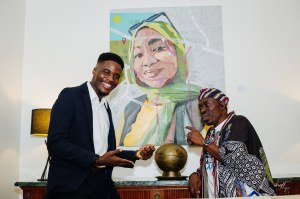
That may be the simplest way to understand the man behind the work. He has spent his life learning from others and giving what he has learnt back to other people. He has designed for artists, taught artists, helped artists, curated artists and continued to develop himself.
The boy who once turned perforations from his father’s sewing machine into drawings could not have known where those dots would lead. But the lines have continued from fashion to Fine Art, from teaching to graphic design, presently Upcycle art, and from helping with exhibition installations to becoming curator of the ArtMiabo International Art Festival for three years.
“I have never done anything different from art in my life.”
He did not plan every chapter. Some chapters found him. But whenever they did, he was ready to work.
iBAND Magazine, Celebrating Visual Art from the Original.
Africa | Visual Art | Lifestyle | Culture

