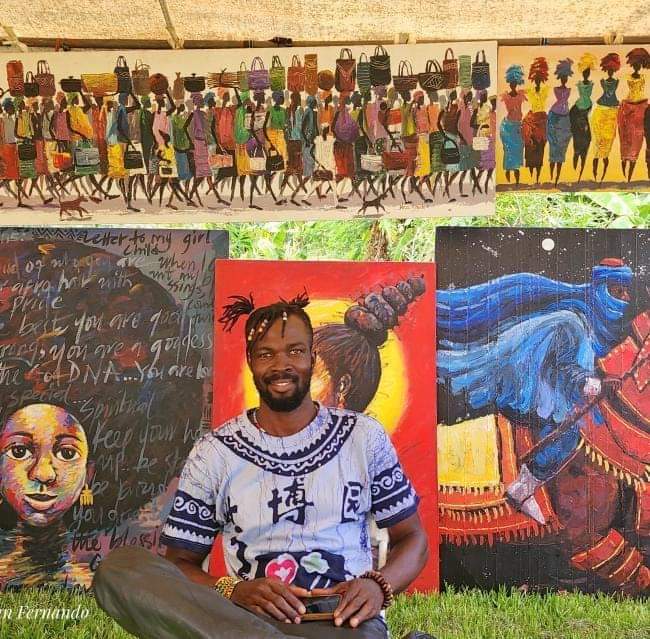
He is stylishly and creatively different from the conventional artists we know and admire. In fact, Nefe Ogodo looks like an Afrobeats star who keeps performing in front of global audience scattered around the world. Nefe Ogodo is contemporary and very promising. He is not just an artist from Africa with Urhobo admiration, Nefe is urbane and ready to be seen as another game – changer in Africa’s arthouse. He works through commentaries that challenge the establishment because he always create art as a tool to correct injustice
Words by Ireho Aito | Don’t Keep Your Art in the Finger! Artworks and photographs courtesy Nefe Ogodo
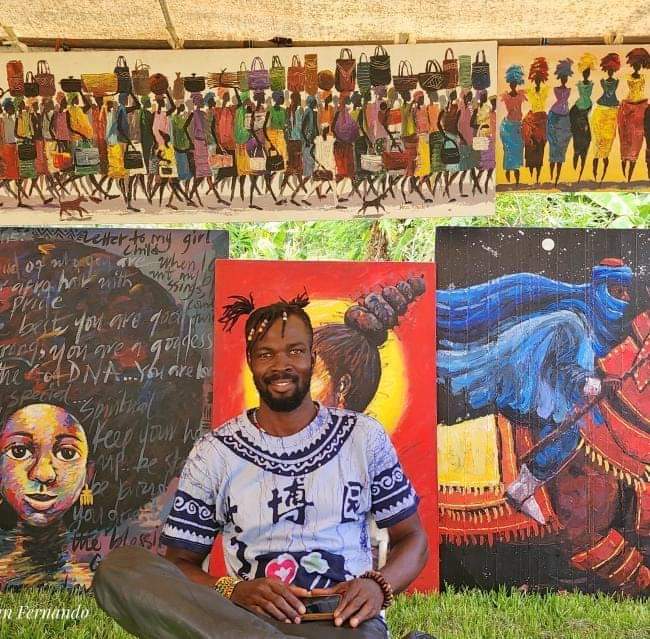
Nefe Ogodo, hailing from Warri in Delta State, unveils his nostalgic odyssey from a childhood adorned with a fervent passion for drawing to emerging as a prominent artist making waves in Africa’s pulsating art scene. Growing up amidst the vibrant culture of Warri, Nefe’s childhood canvas was painted with intricate sketches, embellishing not just exercise books but adorning walls and cars within his neighborhood. By the tender age of 8, he was already crafting cinematic storylines within his school notebooks, showcasing a profound early inclination for creativity and boundless imagination.
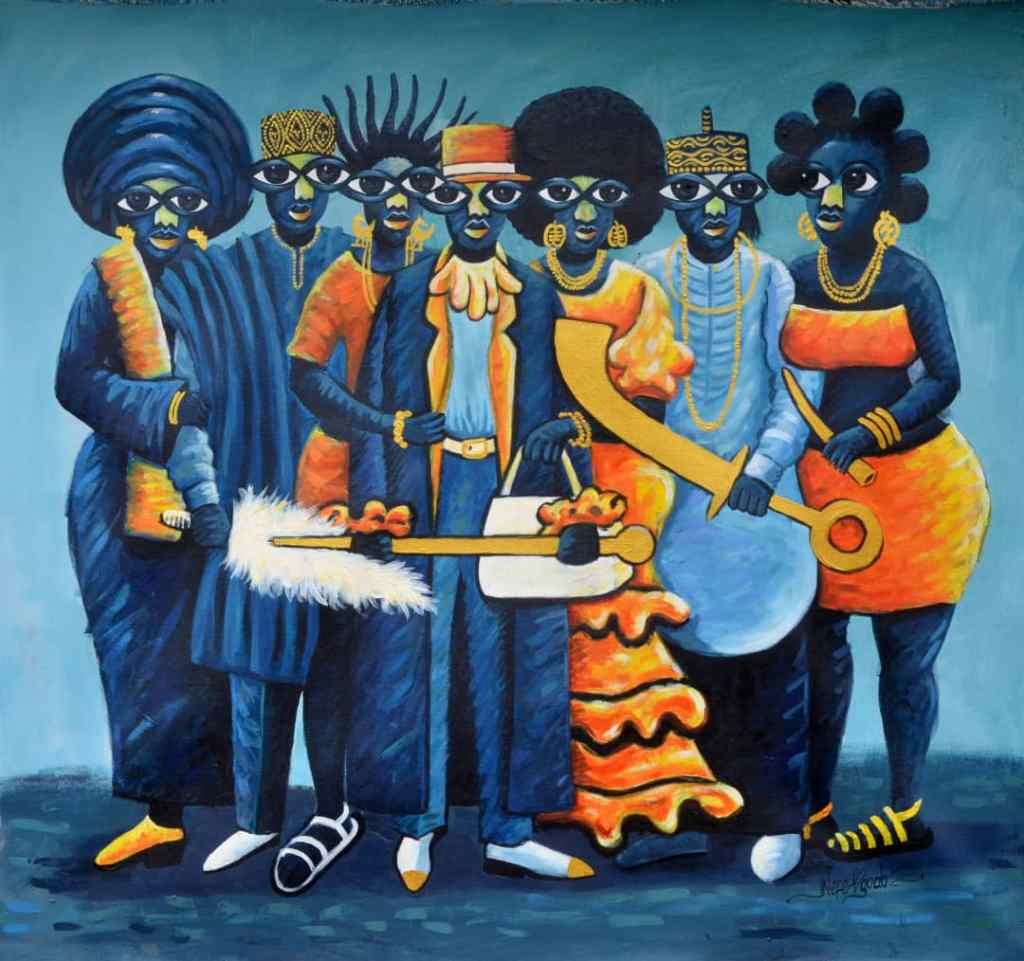
Reflecting on the transformative power of education, Nefe attributes his current audacity, resilience, and artistic dexterity to his academic journey. He accentuates the pivotal role education played in shaping his career, underscoring its absence among many talented peers whose artistic potential faltered without formal artistic education.
Reflecting on the transformative power of education, Nefe attributes his current audacity, resilience, and artistic dexterity to his academic journey.
Assessing the metamorphosis of Africa’s visual art domain, Nefe observes a remarkable shift. Once dominated by Western influences, today, African art commands global recognition. Artists across the continent utilize diverse mediums—paintings, sculptures, and thought-provoking installations—to address poignant societal issues encompassing women’s rights, politics, and cultural heritage. There’s an undeniable cultural resurgence, with an escalating appreciation for art among Africans, transcending mere ornamentation to foster genuine adoration and comprehension.
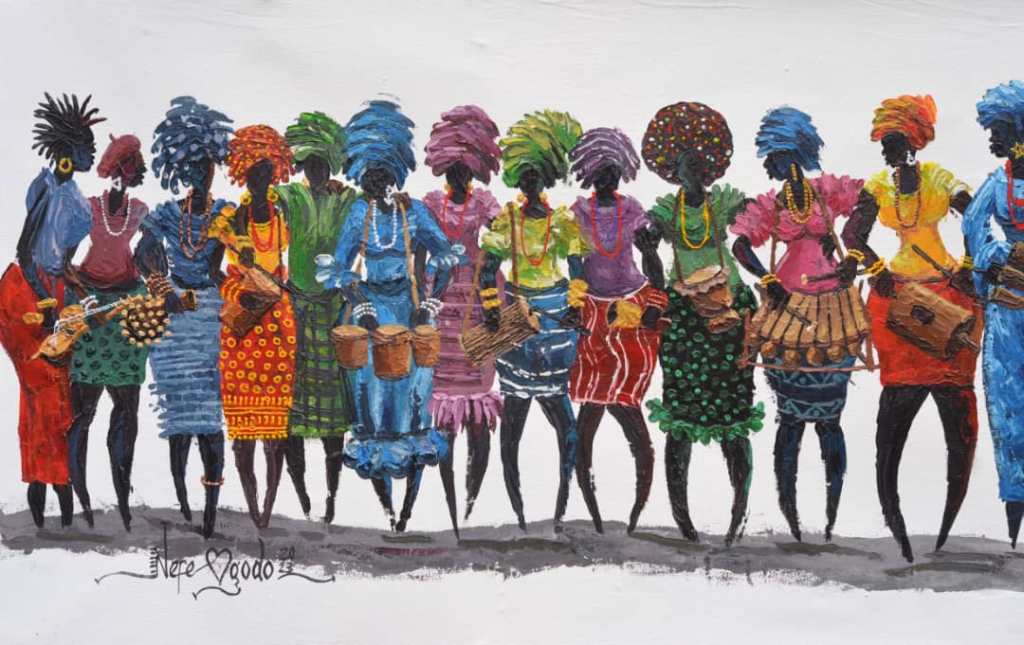
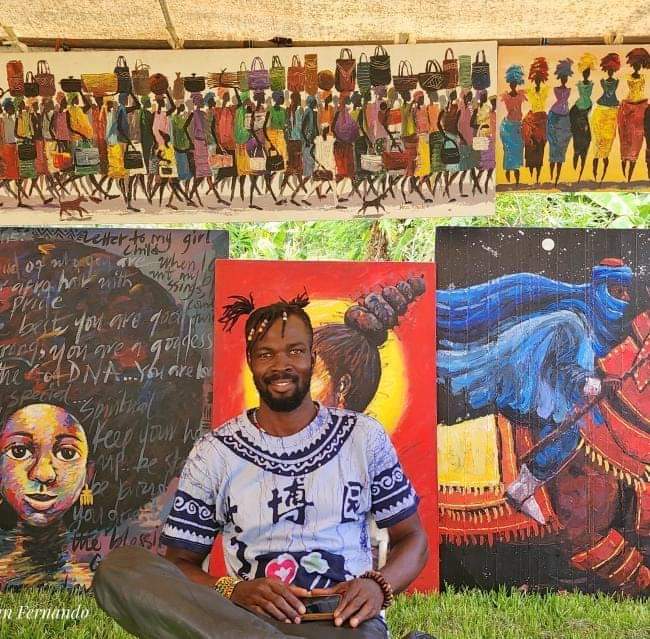
Delving into the impact of the COVID-19 pandemic on his artistic journey, Nefe reveals it acted as a catalyst for some of his most exceptional artworks. Despite adversities, the pandemic propelled him beyond confines, prompting contemplation on the legacy he’d leave, urging him to embrace each day as if it were his last.
Despite adversities, the pandemic propelled him beyond confines, prompting contemplation on the legacy he’d leave, urging him to embrace each day as if it were his last.
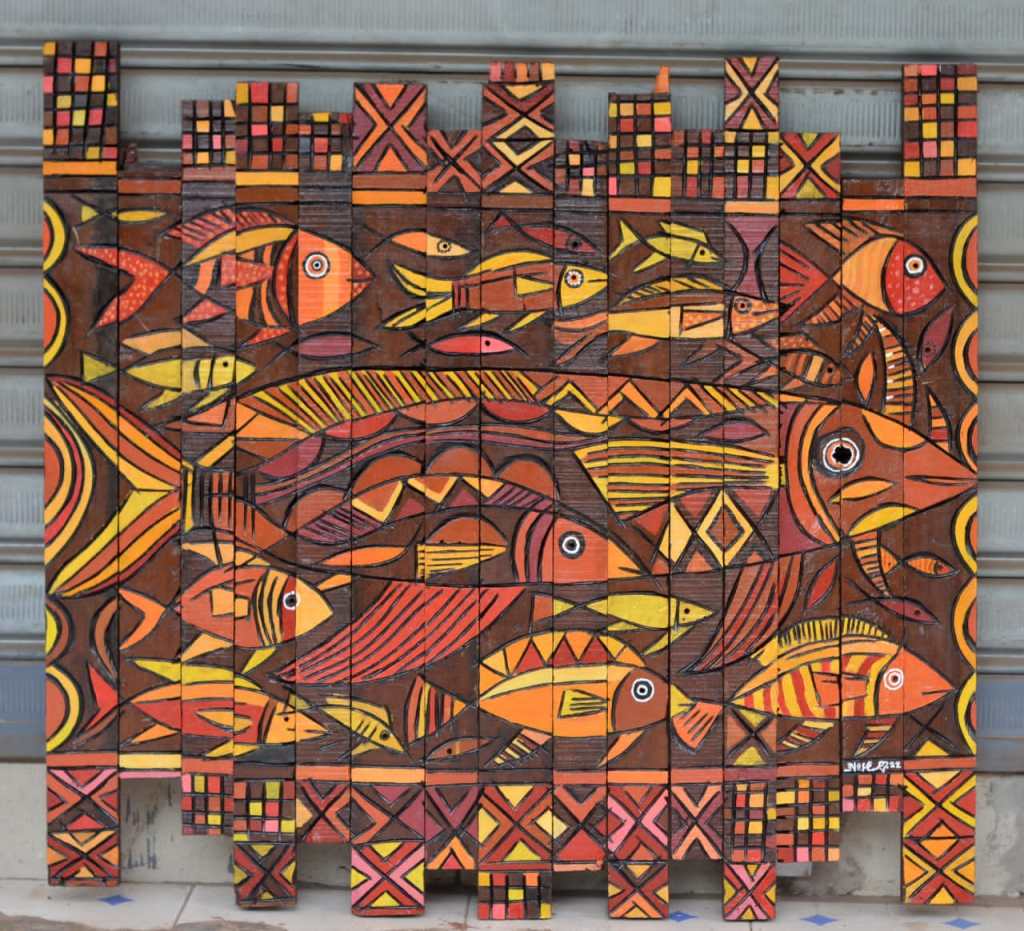
Through Nefe Ogodo’s narrative, the profound amalgamation of art, education, and unyielding passion surfaces as a driving force catapulting an individual from a childhood doodler in Warri to a distinguished artist significantly influencing Africa’s flourishing art panorama.
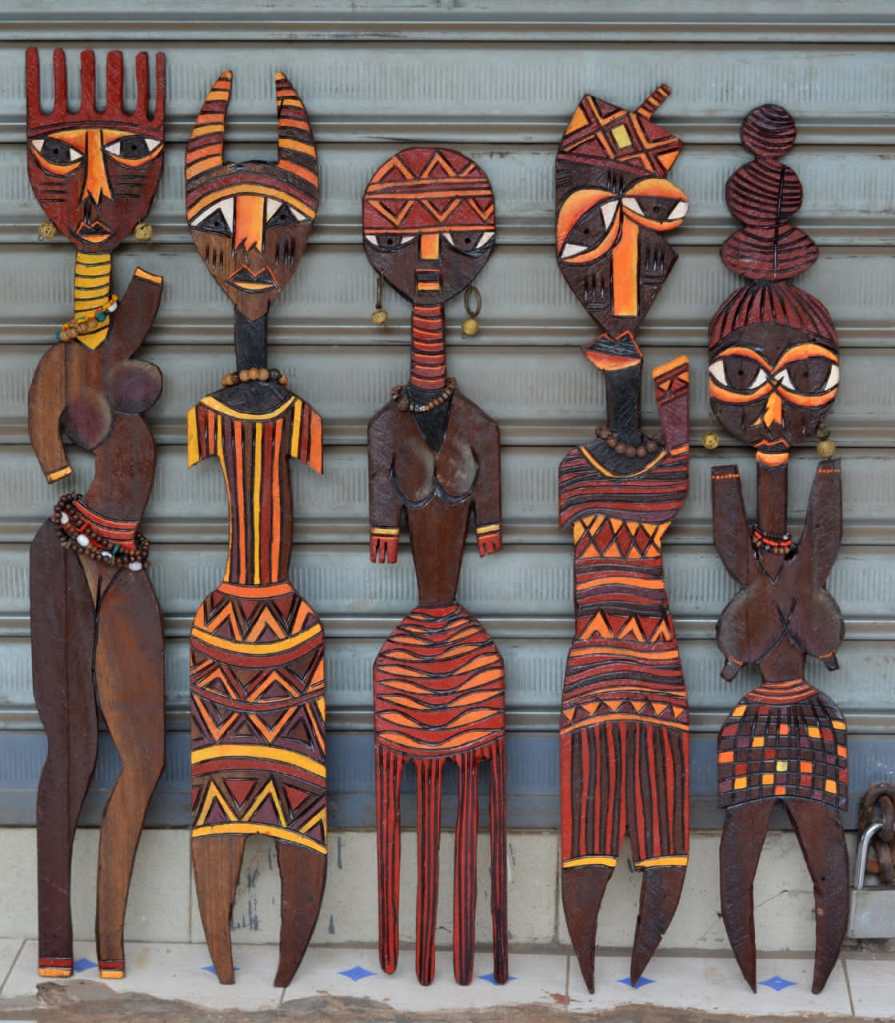
Nurturing Artistic Ingenuity: A Voyage with Nurturing Arts Hub in Africa
Embarking on a voyage into the ethos of Nurturing Arts Hub—an online haven fostering connections within the visual arts community—we unravel the aspirations and objectives with its founder, a fervent advocate nurturing emerging talents across Africa.
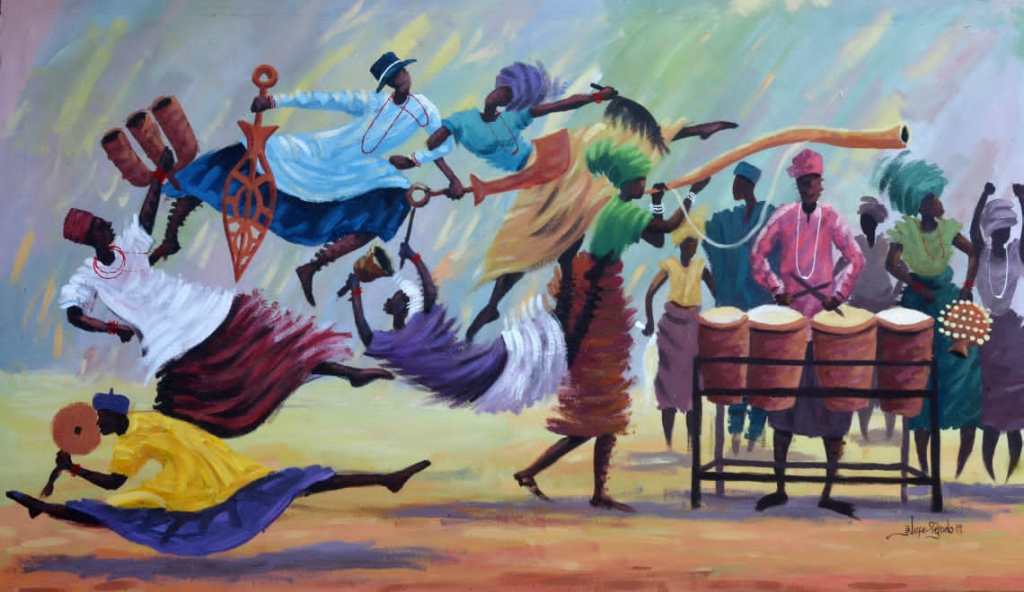
This platform, epitomized by collectives like “Black Artists Worldwide,” doesn’t merely exist; it thrives on cultivating and bolstering nascent artists. It extends beyond guidance, offering tangible support through funds, art supplies, and curated exhibitions, thereby catalyzing sales and financial autonomy. By empowering these talents, the platform endeavors to unlock creativity boundlessly, sculpting the forthcoming generation of extraordinary artists.
This platform, epitomized by collectives like “Black Artists Worldwide,” doesn’t merely exist; it thrives on cultivating and bolstering nascent artists. It extends beyond guidance, offering tangible support through funds, art supplies, and curated exhibitions, thereby catalyzing sales and financial autonomy
In navigating the evolving terrain of art marketing, the founder accentuates the transformative role of social media. Platforms like Facebook and Instagram dissolve geographical barriers, enabling artists to exhibit their creations globally and directly engage with potential patrons, fundamentally reshaping the conventional role of galleries in art promotion.
Influences and inspirations resonate deeply in an artist’s expedition. For the founder, Professor Bruce Onobrakpeya, an illuminating figure in Urhobo art, stands as an influential beacon. Drawing inspiration from ancestral legacies, global trends, and daily life, the founder’s work mirrors a tapestry woven with cultural motifs interlaced with contemporary finesse.
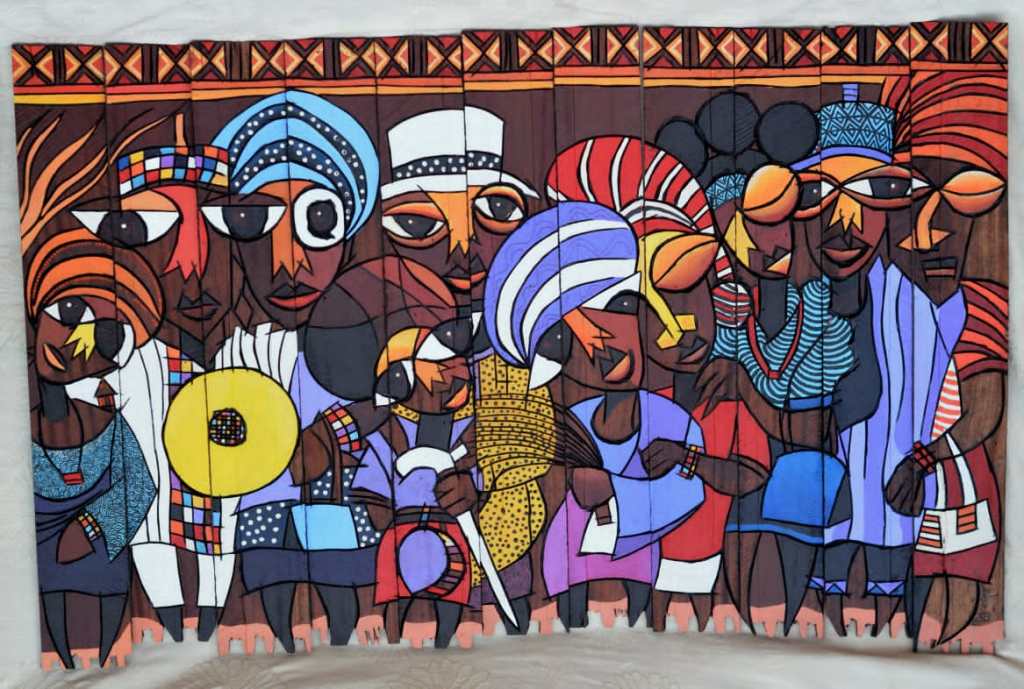
The creative process, as elucidated by Nefe entails an immersive dive into African history, envisioning cultural spectacles translated into sketches, often metamorphosing into vibrant canvases over time.
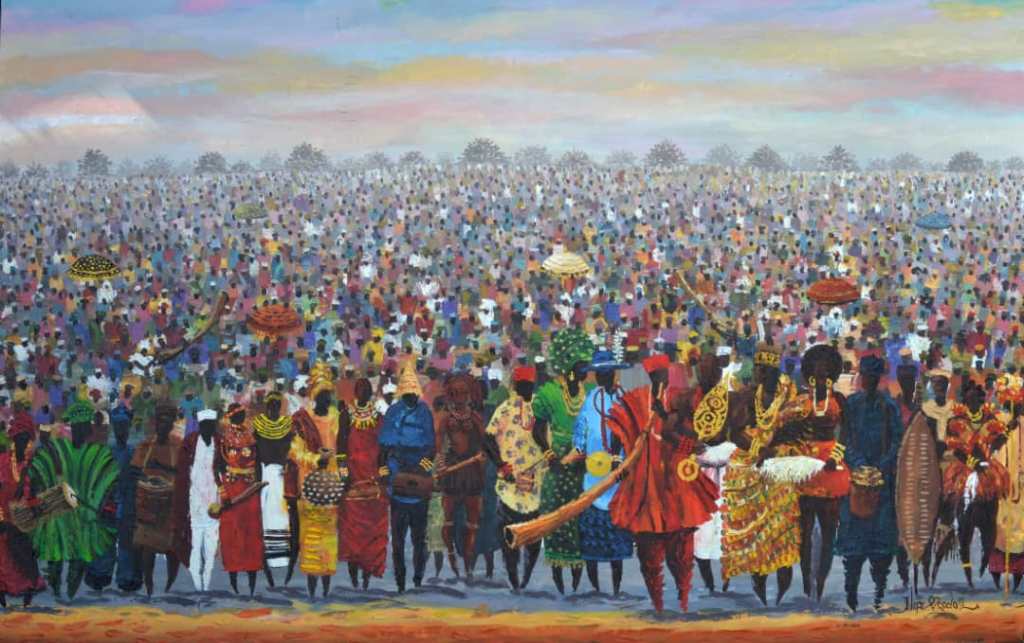
Artwork themes and messages are steeped in the exploration of Nigerian culture and the global narrative, integrating diverse mediums and techniques. Navigating the challenges within the contemporary art realm, Nefe Ogodo derives strength from achievements and sustained involvement within local art communities.
Nefe Ogodo derives strength from achievements and sustained involvement within local art communities.
Contemplating the distinct contributions of Nigerian artists, the stylish artist underscores the infusion of cultural identity into art, harmonizing tradition and innovation to carve out a unique narrative in the global art panorama.
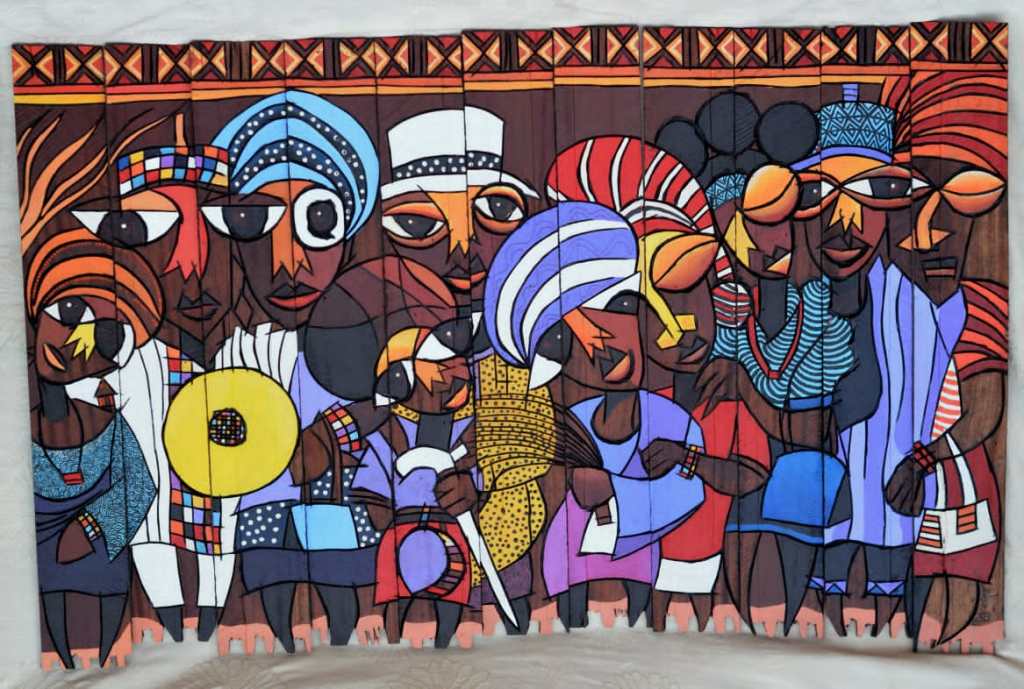
The aspiration lies in engaging audiences deeply with the art, invoking varied responses and perceptions, fostering an ongoing dialogue between the art and its beholders.
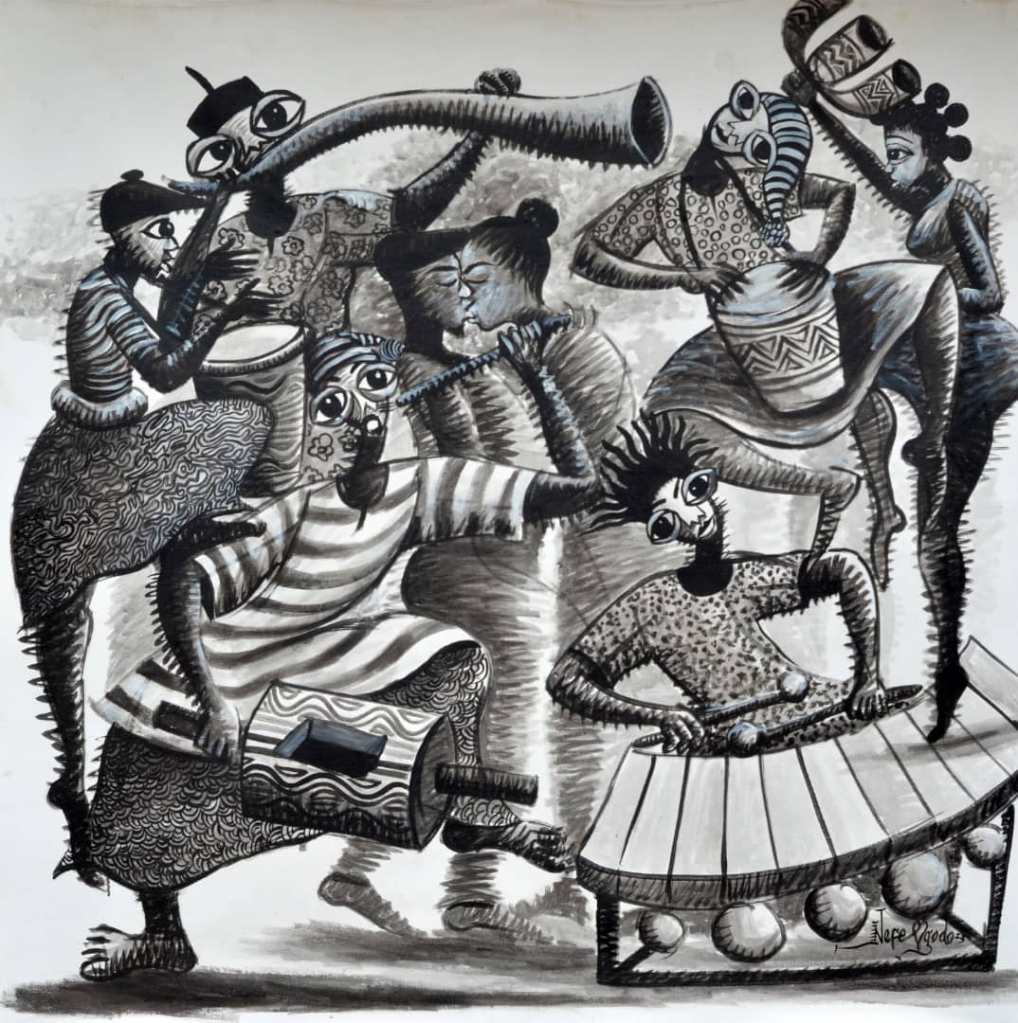
Motherhood Under Fire – Nefe Ogodo’s Metaphor of a Nation Carrying Violence
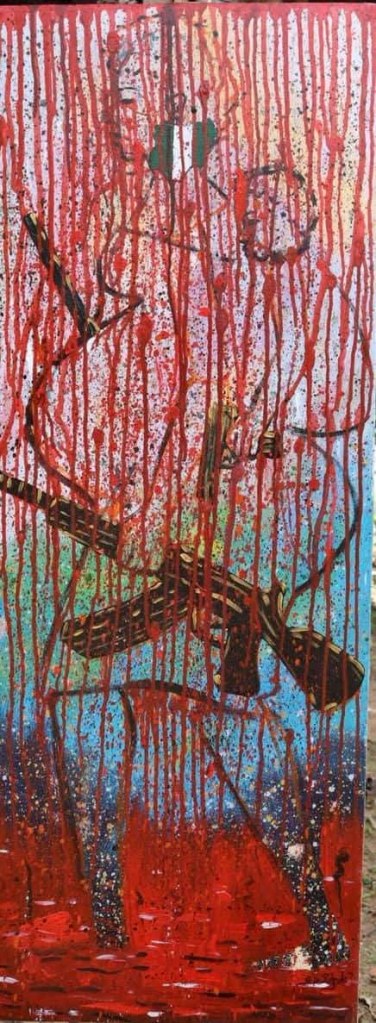
Nefe Ogodo’s painting unfolds as a haunting allegory where life, violence, and nationhood are bound together in a single female form. At first glance, the canvas is overwhelmed by cascading red lines, blood-like drips that refuse containment. But within this torrent emerges a more unsettling narrative of a pregnant woman, heavy with child, clutching a gun, while the map of Nigeria hangs from her ears like earrings. This is not merely a figure; it is a country embodied.
But within this torrent emerges a more unsettling narrative of a pregnant woman, heavy with child, clutching a gun, while the map of Nigeria hangs from her ears like earrings. This is not merely a figure; it is a country embodied.
Pregnancy, traditionally a symbol of hope, continuity, and the future, is here burdened with dread. The woman carries a baby, yet she also carries a weapon. Ogodo stages a painful contradiction of a nation that should be nurturing life is simultaneously armed, violent, and complicit in destruction. The unborn child becomes a metaphor for future generations that will be conceived and developing in an atmosphere soaked with bloodshed and fear.
The gun in the woman’s hand is not accidental. It suggests normalisation of violence, the way arms have slipped into everyday existence. Violence is no longer an external threat; it is held, owned, and even protected. By placing the weapon in the hands of a mother figure, Ogodo intensifies the moral tension when survival demands violence, what kind of future is being prepared for the child she carries?
Equally potent is the use of Nigeria’s map as earrings. Earrings are ornaments, decorative, symbolic of identity and pride. Here, the nation is worn casually, almost fashionably, yet it weighs heavily. The implication is sharp which Nigeria is not just a backdrop to suffering, it is intimately attached to the body, to daily life, to personal identity. The violence bleeding through the canvas is not abstract or distant; it is worn, felt, and lived.
The relentless red drips that dominate the surface operate on multiple levels. They read as blood, as rain, as tears, and as an unending tally of loss. They obscure details, much like violence obscures clarity, morality, and accountability. The absence of a clear ground or horizon suggests instability of a society with no firm footing, where life and death blur into one continuous stain.
Ogodo’s decision to avoid realism sharpens the impact. The woman is not a portrait of a specific individual but an archetypal ‘Mother Nigeria.’ Her posture, burdened yet resolute, reflects a country enduring crisis after crisis, carrying its future forward even as it bleeds. There is no heroism romanticised here, only survival under impossible conditions.
For iBAND Magazine readers, this work exemplifies Ogodo’s strength as a social commentator who relies on metaphor rather than slogans. Unlike overt political imagery, this painting unsettles quietly, forcing the viewer to sit with contradiction. It asks difficult questions without offering comfort like what happens when violence becomes inherited? When a nation adorns itself with identity while dripping with blood? When the womb of the future is surrounded by guns?
Ultimately, this artwork is a lament and a warning. It suggests that the greatest tragedy is not only the bloodshed of the present, but the world being prepared for those yet unborn. In presenting a pregnant, armed woman marked unmistakably by Nigeria, Nefe Ogodo captures a painful truth and that is a nation can give life and take life at the same time while history will judge which it chose to protect.
In this canvas, motherhood is no longer only about birth. It becomes a metaphor for responsibility. And Ogodo leaves us with an unsettling silence, asking whether the child being carried will inherit hope or learn to hold the gun.
Such art has put even Nefe Ogodo’s life on the line. Such creativity exposes him to clashing with the establishment and sometimes, Nefe finds himself on the run. Nefe Ogodo’s art many times put on the frontline. But for him, justice must be done by art means.
Fulani Herdsmen
His activism has increased the demand for his art among collectors and public institutions, even as his outspoken commentaries have not always endeared him to state authorities.
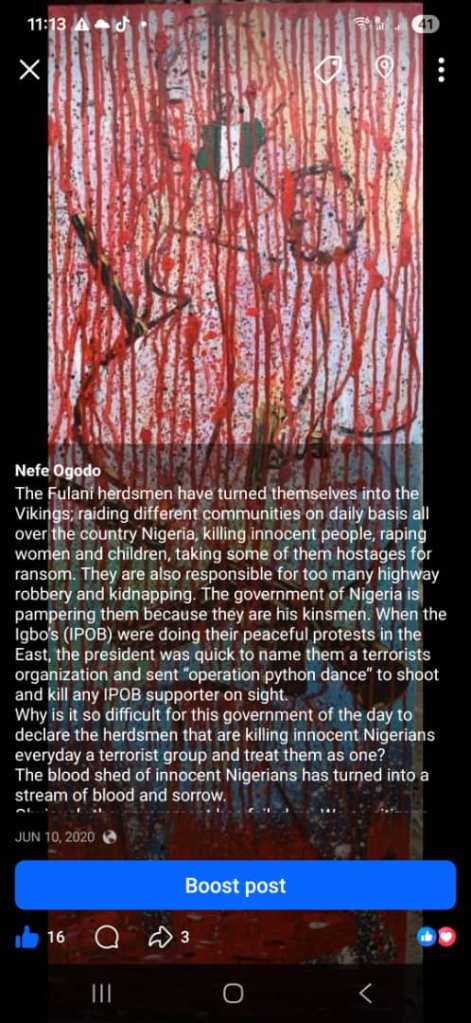
Nefe Ogodo’s Fulani Herdsmen is a visceral outcry rendered in pigment and accusation. The surface is saturated with streaks of red that fall like unending rivulets, transforming the canvas into a field of mourning. Blood becomes both colour and language and this an indictment that refuses quiet contemplation. This is not a painting that asks to be admired; it demands to be confronted.
Embedded in the artwork is a searing text that frames the painting as a political lament. Ogodo invokes the daily terror experienced by communities across Nigeria through killings, sexual violence, kidnappings, and highway robberies, attributed here to armed herdsmen. The artist’s words do not hedge. Rather, they accuse.
By likening the perpetrators to “Vikings,” Ogodo underscores the sense of relentless raids, mobility, and impunity that, in his view, define the crisis. The comparison is strategic as it strips away any romanticised notions of pastoral life and replaces them with an image of organised violence.
The text sharpens its focus on the state. Ogodo questions what he sees as selective justice, contrasting the swift designation of IPOB as a terrorist organisation with the perceived reluctance to apply the same label to armed herdsmen responsible for mass civilian casualties. This juxtaposition is central to the work’s moral argument. For the artist, the issue is not only violence itself but the unevenness of power, naming, and accountability. Who gets named a terrorist, and who does not? Who is pursued, and who appears to be tolerated?
Who gets named a terrorist, and who does not? Who is pursued, and who appears to be tolerated?
Visually, the painting’s chaotic marks, scratches, stains, and obscured forms mirror of a nation in distress. Any suggestion of figuration, no but individual identities have been swallowed by collective trauma. The red lines drip downward like tears or wounds that refuse to clot, reinforcing the idea of an unending cycle of bloodshed and sorrow.
For this cerebral artist and activist, Fulani Herdsmen functions as both artwork and witness statement. It channels rage, grief, and a demand for moral clarity. Ogodo’s insistence is uncompromising as the blood of innocent Nigerians, he argues, has turned the land into “a stream of blood and sorrow,” and silence or selective outrage is itself a form of complicity.
In this work, art becomes protest and remembrance. It preserves anger as evidence, insisting that the suffering it names must not be normalised or forgotten. Whether one agrees with every assertion or not, Fulani Herdsmen stands as a raw document of a moment in Nigeria’s history.
Justice for Sale – Nefe Ogodo and the Theatre of a Broken Judiciary
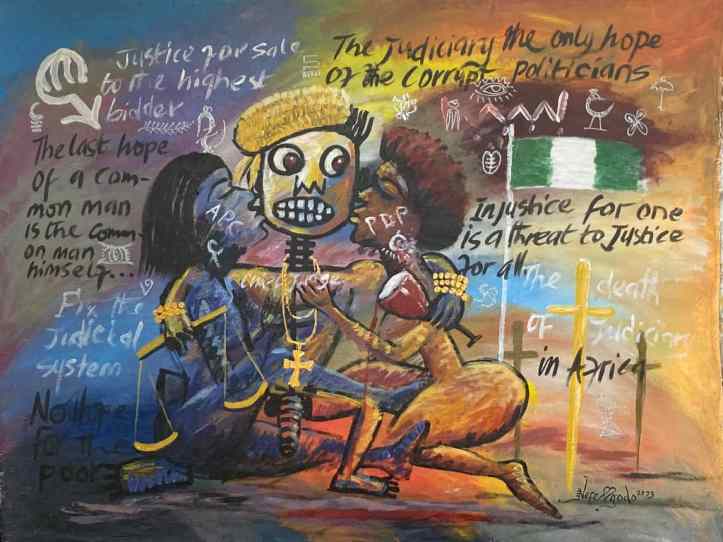
In this arresting painting by Nefe Ogodo, words are not captions, instead they are witnesses. Scribbled, scrawled, and asserted across the surface, the text functions as both indictment and lament, collapsing image and language into a single, uneasy testimony about justice in contemporary Africa, and Nigeria in particular.
Expressed in a graffiti style. Phrases such as “Justice for sale to the highest bidder,” “The judiciary, the only hope,” and “Injustice for one is a threat to justice for all” hover like broken commandments over the scene. They are familiar maxims, yet here they are bruised by context, stripped of idealism, and forced to confront a harsh reality.
Ogodo’s canvas suggests that justice, once imagined as sacred and impartial, has been reduced to a commodity that has been auctioned to power, money, and political patronage.
At the centre of the composition is a grotesque, skeletal judicial figure, adorned with symbols of authority and faith with the wig of the law, the cross of religion. This figure is neither fully alive nor entirely dead but represents an embodiment of an institution that still breathes but has lost its moral spine. Clinging to it are shadowy presences marked with inscriptions of Nigeria’s dominant political parties. Their embrace is not one of support but of suffocation, implying a judiciary trapped between competing political interests, held hostage by corruption and influence.
Ogodo reinforces this suffocation through his text, “The judiciary the only hope of the common man,” followed almost immediately by despairing counters like “No hope for poor” and “Judicial system?” with the question mark doing as much damage as any accusation. The contradiction is deliberate. Hope exists in theory, but in practice, the common man is left exposed, disillusioned, and unprotected.
The Nigerian flag appears in the background, not as a symbol of pride but as a muted reminder of national responsibility. Nearby, crosses punctuate the composition, evoking both graves and faith. They suggest that justice, morality, and even belief itself are under burial pressure. When Ogodo writes “death of justice in Africa,” it reads less like metaphor and more like a death certificate that is signed repeatedly by systemic failure.
Stylistically, the work borrows from expressionism and street protest aesthetics. The rough lines, raw colours, and urgent handwriting echo placards from demonstrations and graffiti from neglected urban walls. This is art that refuses polish because the subject itself is unclean. Ogodo understands that a corrupted system cannot be critiqued with elegance alone; it demands abrasion.
Ultimately, this painting is less about the judiciary alone and more about collective consequence. “Injustice for one is a threat to justice for all” is not merely quoted but enacted on the canvas. Ogodo warns that when justice is compromised for the poor, the powerless, or the politically inconvenient, the entire society stands on trial.
iBAND Magazine, Celebrating Visual Arts from the Original.
Africa | Visual Art | Lifestyle | Culture
Looking forward, Nefe Ogodo envisions an artistic voyage characterized by continual evolution, aspiring to delve deeper into Nigerian cultural themes while adapting to the ever-evolving art landscape, fostering a legacy that transcends boundaries and resonates universally.
Words/Ireho Aito/Don’t Keep Your Art in the Finger/Images/Nefe Ogodo archives