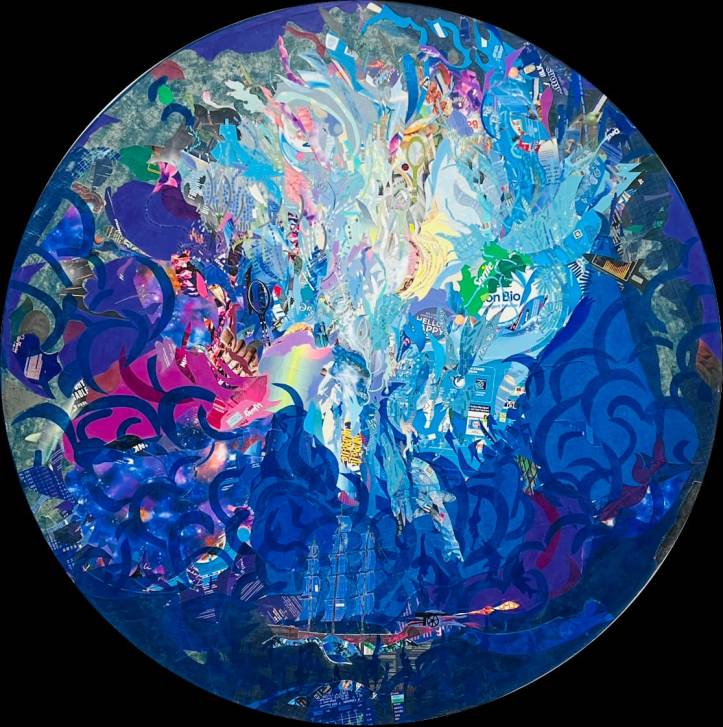
Deep Blue Sea is a collaged painting that depicts a slave ship in the tumultuous waters of the Atlantic, symbolising the victims of capitalism being consumed by sea monsters and sharks. – Dr. Hassan Aliyu
While the slave ship (the “Guineaman”) played a significant role in the development of modern capitalism, it was also foundational to a dark era of Africa’s victimisation, exploitation, and marginalisation. In his article, Marcus Rediker emphasises the often-overlooked nature of the slave ship in our understanding of history: “The slave ship is so far from romantic that we cannot bear to look at it, even though it was one of the two main institutions of slavery”. While the plantation, the other institution, has been extensively studied, the slave ship remains under-explored. Rediker argues that despite the rich historical literature on the slave trade covering origins, timing, scale, flows, and profits, the vessel itself, the mechanism for history’s greatest forced migration and an instrument of ‘‘commercial revolution’’, has received little attention. He contends that “if Europe, Africa, and the Americas are haunted by the legacies of race, class, and slavery, the slaver represents the ghost ship of our modern consciousness”.
Rediker further asserts, “The slave ship was a factory that manufactured two related products: labour power and race. It made labour power for the world market by helping to create the lucrative commodity called slave. In the process, it contributed to the production of categories of race. Essential to the production of both was terror. Indeed, the slave ship was an instrument of terror, crucial to the making of modern capitalism” (Rediker, 2008).
Regrettably, all endeavours to locate models of the Guineaman within the collections of esteemed institutions like the UK’s National Maritime Museum in Greenwich, the London Sugar & Slavery Gallery at the Museum of London, and the Science Museum in London have yielded no results. This situation has fostered the perception that this significant facet of British history is being relegated to the periphery and systematically effaced. In response to this void, I chose to exercise artistic prerogative and envision the harrowing ordeal of the enslaved individuals on board the Guineaman during their ill-fated voyage, where they were treated as mere cargo and chattel destined for inhumane abuse in the New World, owned by gentlemen, bankers and the clergy. This artistic undertaking became the driving force behind my painting, Deep Blue Sea.
Deep Blue Sea is a collaged painting that depicts a slave ship in the tumultuous waters of the Atlantic, symbolising the victims of capitalism being consumed by sea monsters and sharks. It alludes to the story of the Zong which is also told through JMW Turner’s painting, Slavers Throwing Overboard the Dead and Dying— Typhoon Coming On. Although it is unknown if Turner’s painting was inspired by a sense of consternation or compassion for the live cargo that was jettisoned into the sea to secure an insurance claim or if his motivation for this painting owed to the widespread hysteria that the court case, Gregson v Gilbert (1783) aroused — which was initially decided in favour of the slave traders, that the murder of enslaved people was legal, hence, the insurers had to compensate for their losses. “The White jurors found that the “Cap” had done what was right to save the remaining crew members since the enslaved people were no more than animals.” In his judgement, Chief Justice Lord Mansfield ruled that “The Matter left to the Jury was, whether [the mass murder arose] […] from necessity [,] for they had no doubt (tho’ it shocks one very much) the Case of Slaves was the same as if horses had been thrown overboard. The question was, whether there was not an Absolute Necessity for throwing them overboard to save the rest, [and] the Jury were of opinion there was.” Mansfield’s further comment that insurers had to pay up for dead slaves killed in an insurrection “just as if Horses were kill’d” but that insurers did not have to pay up for slaves dying naturally just as “you don’t have to pay for horses that die a natural death” (Burnard, 2019).
Deep Blue Sea is executed on canvas and mounted on a sturdy round stretcher I created. The stretcher consists of two latticed sheets of 2cm plywood glued together and cut to a width of 13cm in circumference. To safeguard against potential damage from humidity, UPVC glazing quadrant trims were affixed to the outer edge of the stretcher, providing a moisture barrier.
The ideas for the painting were developed through a series of preliminary ink sketches. In the final composition, the decision was made to emphasise the sea and minimise other elements, such as the drowning captives thrown overboard. The commodification of African captives.
I sourced most of the materials for the collage from the packaging of food consumed in my household. Occasionally, I would intentionally buy a particular brand or item for the colour of its packaging. For example, I bought a chocolate cake for my wife’s birthday because the packaging was the colour I needed for my painting. Even though no one in my family likes chocolate cake, and I do not eat cake, the half-eaten cake sat on our kitchen table for over a week while I waited to use the colourful box.
To create the underpainting, I ripped larger sections of packaging and adhered them to the canvas using PVA glue. I used a carpet-laying tool to smooth out the cardboard to eliminate any air pockets. For more detailed sections, I cut smaller pieces of collaging elements using scissors and scalpels, but I also used hand-ripped pieces to create dramatic effects. The collage elements become progressively smaller depending on the amount of detail required. The transition of light captured in the work aims to achieve an effect of the sublime.
Although the sketches for Deep Blue Sea are primarily figurative, the resulting painting is largely abstract, with limited representational elements and figuration. This decision offers the viewer a more immersive experience by creating greater ambiguity within the painting. While the motif of a slave ship with a Maxim gun mounted on its deck is discernible, the drowning bodies in the turbulent sea are less visible, blending into the rippling waves and diffusing into the shapes of sea creatures that are transfigured as a cascade of crescent shapes, creating illusions of the moving sea.
As the African slave trade was the wind in the sails of capitalism, the sails on my slave ship are represented by digital prints of on-screen bond prices. The ship’s starboard and deck are collaged with cutouts from Bloomberg Magazine, including templated figures of sharks overlaid with market data technical charts displaying price and volume data. The intentional inclusion of some global brand names of consumer products highlights the market-making in Africa of finished consumer goods, which is the hypotenuse of the triangular trade.
In the planning stages of Deep Blue Sea, I integrated representations of a slave ship, a container ship, and a refugee boat. The slave ship represented historical aspects of global capitalist domination through trade, while the container ship addressed contemporary manifestations of this domination. The refugee boat highlighted the repercussions of a divided world, resulting in economic refuge and asylum-seeking from the impoverished global south. However, I later separated these elements due to technical considerations and my decision to incorporate them into subsequent paintings, specifically Triangular Trade II and Stop the Boats. In Deep Blue Sea, my primary focus centred on portraying the dehumanisation of enslaved individuals, drawing inspiration from the legal concept of a “double character” articulated by Thomas Reade Cobb. This concept perceived slaves as both persons and property under the law, holding them accountable for their actions while simultaneously treating them as commodities for sale or hire. This dual perspective allowed for the assessment of their physical or moral “defects.” (Gross, 2006)
Through a deeply affective process, I envisioned the terror the slaves must have felt during a sea storm, with thunder and lightning illuminating the waves and sky. I imagined six hundred black bodies, packed tightly together in neck rings and leg irons, lying naked on rivets that caused open wounds to fester in the sweltering heat. Equiano and Delany’s narratives provide accounts of the brutality and horror of slavery. Equiano describes the unbearable conditions aboard slave ships, where the lack of space and intense heat led to sickness and death among the enslaved (Equiano, 2019). My painting aims to capture this traumatic experience as a reminder of the inhumane treatment inflicted upon enslaved people. Similarly, Delany speaks to the horrific fate of enslaved people, including men, women, and children, who were thrown overboard and left to drown at sea (Delany, 2017). These narratives emphasise the horrors of the slave trade and the pressing necessity to recognise and address its enduring consequences, which encompass racism and various other manifestations of violence.
Deep Blue Sea is a significant component of my exploration centred on the overarching theme of the Atlantic. This thematic series encompasses a collection of paintings, including pieces such as ZONG: Stop the Boats (200 x 240cm, collage on canvas), HMS Reparationship (300 x 350cm, collage on canvas), To the Lands Beyond the Seas, a pentaptych collage on canvas with a combined measurement of 240 x 1000cm and Crimson Tide: Legacy of the Voyage (163cm diameter, collage on canvas).
Article/Dr. Hassan Aliyu/Artwork/Dr. Hassan Aliyu

