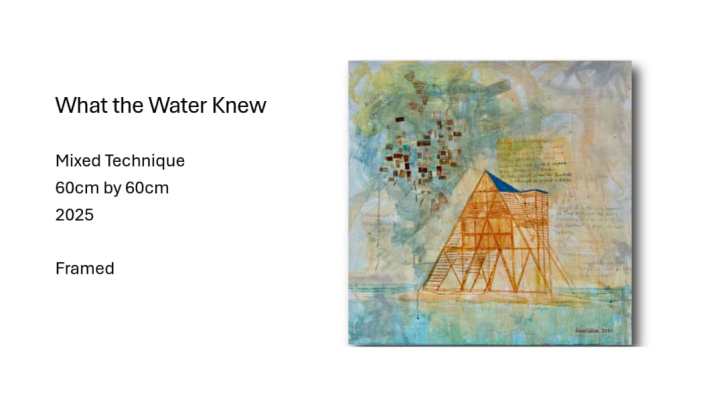
Blending art with environmental memory, Imal Silva’s What the Water Knew, his striking abstract piece channels the timeless truth of Fela’s anthem Water No Get Enemy through bold textures and layered strokes. Silva reflects on our fragile dance with nature, and how, sooner or later, water always tells its own story. Writes Ireho Aito
On a certain Saturday morning, July 19th, the airwaves of Eagle 7 Sport Radio in Wasinmi, Ogun State, carried a rare conversation. Dr. Segun Odegbami, football legend, Green Eagles captain, and African Cup of Nations champion now a columnist and broadcaster, sat across from his guest, the ever-vibrant saxophonist Dede Mabiaku. More than a musician, Dede is a “Felasopher,” a disciple of the Afrobeat king himself, Fela Anikulapo Kuti. Dede was a loyal protege to Fela Anikulapo Kuti.
Dede Mabiaku just like his master is also a social commentator, challenging the establishment with songs. He was invited by Odegbami to deliver a keynote address at the 16th Convocation of the Segun Odegbami International College and Sports Academy. And on air, their chat was a lively journey into Fela’s world, discussing about his Pan – Africanism, his genuine generosity, his genius, and the stories behind his unforgettable songs and why music became the weapon.
One tale stood out among the revelations about Fela according to Dede’s account. In the 1970s, while preparing for a gig in Warri, Farm Kitchen to be precise, torrential rain turned the venue into a mini-lake. As Fela waded in, stood in the middle of the hall in his rolled up trousers, water almost on his knees and puzzled over how to begin a show they had prepared themselves for, an elderly woman showed up from nowhere, tapped him gently and said, “My son, your show go work, e go work you hear… but remember, water no get enemy.” This literally means the elderly woman assured Fela that the show must go on but he should remember that water begrudge no one.
Fela was transfixed! And before he could reply or beckon at his band members and organisers of the show about his strange encounter with the elderly woman, she vanished. Fela was speechless but got inspired by the elderly woman’s message. Fela turned the strange encounter into a timeless anthem by releasing a critically acclaimed single titled – Water No Get Enemy.
Like Fela, Sri Lankan-born artist Imal Silva uses his craft to tell nature’s stories and run social commentaries. A University of Ibadan alumnus, Silva is known for bold abstractions that probe our relationship with the environment. His 2025 piece What the Water Knew, part of his Our Sheltered Identity series, a Mixed Technique and measuring 60cm by 60cm captures our uneasy dance with water. A profound reminder of how easily we forget its power. It is a painting that brought memories of living around coastal areas and water imminent neighbourhoods. The painting examines who we are and if we really know how nature operates.
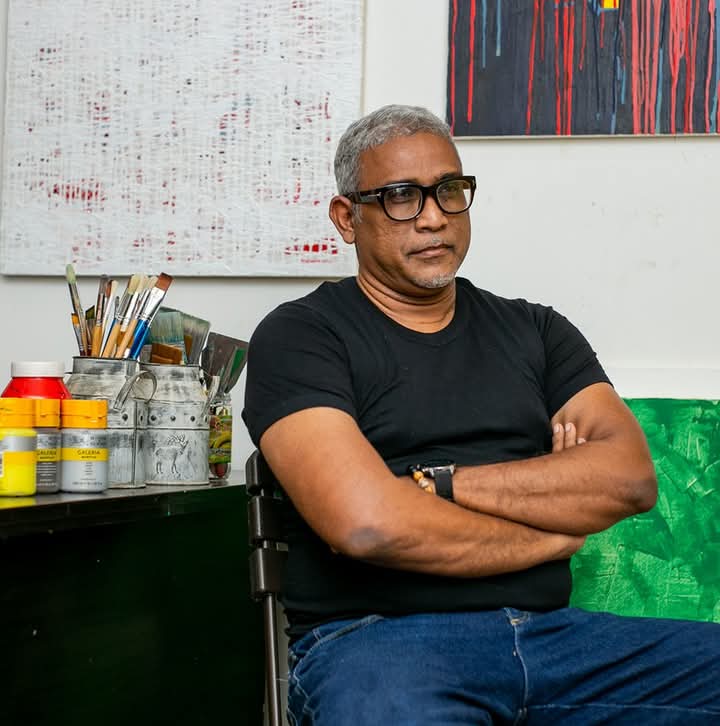
In Our Sheltered Identity series, Imal Silva goes beyond painting. In fact, he observes, questions, and records. His 2025 work, What the Water Knew, is more than colour and texture; it’s an environmental mirror. The piece examines how people treat water when investing in structures as if it were a passive neighbour, forgetting that it’s a living force with memory, mood, and muscle. Silva’s inspiration is rooted in lived experience. In his last solo exhibition titled “Our Sheltered Identity” where through series of abstract paintings, he explored our cultural , social, historical and spiritual narratives of living spaces and built environment. On What the Water Knew painting, One could see Imal’s constant muses from his palette on the canvas. This indicates his thought process on his work as he is performing his surgical moment on Canvas.
He has constantly been at the vanguard of using his palette to paint environmental themes through abstract styles. His art has often explores sustainability, human interaction with nature, and our collective future, all expressed through various medium such as acrylic, pour, and drip techniques on canvas. A unique artist that is different from the crowd. He lives his passion and this attitude is giving him an edge as a cultural gatekeeper.
Historically, Imal grew up in the South – Western of Nigeria when he landed in the country with his mother as a 10 year old boy from Sri Lanka. His documentation of shelters with key social commentary on each painting on Canvas shows he is a man with eye for his environment and what shapes people. Imal believes our actions actually narrate our stories and shape our histories.
The 1980 and 2011 flood disasters in Ibadan, Oyo State, both readily come to mind about how we sometimes take the power of water for granted in our environment and places. Our negligence to life was exposed.
When the waters first came on August 31, 1980, Ibadan residents awoke to a day that would be etched in their memory forever. An evening of relentless rain had swelled the Ogunpa River and other ones like Odo Ona river beyond their banks, sending torrents of dangerous water racing through streets, markets, and homes. Roofs collapsed under the force, and wooden kiosks floated like paper boats. By the time the waters receded, over 200 lives were lost, thousands were homeless, and the city’s bustling commerce lay in ruins. It was more than a flood that fateful Sunday, it was a wake-up call on the fragility of urban life without proper planning. Even the President at the time, Shehu Shagari had to embark on a state tour of Oyo State and most importantly paid visit to the communities destroyed by the flood.
For years, Ibadan vowed never to see such devastation again. Drainage channels were promised, environmental laws were discussed, and the Ogunpa River channelisation project was launched. Yet, as the decades rolled by, waste clogged waterways, houses crept back to the river’s edge, and the city’s rapid growth outpaced its safety measures.
Then, on August 26, 2011, history returned with a cruel echo. Heavy rains lashed the city, and once again, the Ogunpa and other rivers like Odo – Ona rose in fury, lashed the city, earth was crumbled, cars bobbed in floodwaters, and entire families clung to rooftops waiting for help. More than 100 lives were lost, and property worth billions washed away. Schools were turned into IDPs camps for displaced families. Again, the President at the time, Goodluck Ebele Jonathan had to embark on a visit to affected communities and displayed Nigerians as well. Everywhere was like war zone.
We lived in Odo Ona, Ibadan, for many years and saw the great 1980 flood with our own eyes. Later, from 1992, my family spent another 11 – long years in a house right on the riverbank. The apartment was so close we could watch the Odo Ona River from our bedroom windows like it was our personal TV channel.
Our landlord was a shrewd man let’s call him Alhaji the Shylock. He was a former mason who believed he knew more than any engineer alive. Deciding he didn’t need fancy contractors, he built his own mini-estate by the river, using his big family as builders. With wheelbarrows and shovels, they dumped sand into the water, dredged here and there, and claimed a chunk of the river as if it were empty land waiting for a house.
When we moved in, the house already had a personality, that is one of a tired old man. The walls cracked and sank every year, doors leaned like drunkards, missing their hinges, and rats popped out of the floor as if we were their tenants. It was clear this “brand-new” bungalow wouldn’t survive forever.
And it didn’t. In 2011, the flood came. The river, patient for years, took back its land in one powerful sweep. The walls gave way, the water roared through, and Alhaji’s proud handiwork vanished under heavy rainfall and river dominance.
It turned out the river knew something Alhaji didn’t know. You can’t trick water. You might fill it, block it, or build over it but in the end, water always comes home.
Residents who remembered 1980 spoke in disbelief that how could the same tragedy strike twice in one lifetime? Experts blamed poor waste management, weak enforcement of building regulations, and the slow pace of flood-control works.
Today, both disasters stand as sombre reminders. In a city known for its resilience, the question still lingers, will Ibadan finally learn to live with its rivers, or will the waters write yet another chapter?
In What the Water Knew, the abstract swirls and layered strokes are Silva’s way of saying to us that water keeps score. It remembers the land we fill, the banks we steal, the channels we choke. And when the time comes, it returns not in anger, but in inevitability.
Just like Fela’s “Water No Get Enemy” was born from a flooded Warri venue, Silva’s work is born from witnessing water’s power at firsthand. Both remind us that be prepared to live with nature, or be ready for the day it takes back what’s its own.
Need more information about Imal Silva’s collection, art and catalogue, do call +2348056227730
Words /Ireho Aito/Don’t Keep Your Art in the Finger!/What the Water Knew artwork/Imal Silva/Imal Silva Photographs/Imal Silva archives

