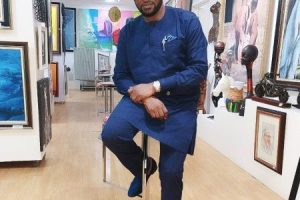
As Biodun Omolayo turns 62, he does what he has done for decades, celebrate life through art. With his latest exhibition, This Land is Green, opening on the 21st of March 2026, the Lagos-based artist continues a tradition that transforms birthdays into powerful statements of faith, purpose, and creative legacy.
Words Ireho Aito | Don’t Keep Your Art in the Finger! Photographs courtesy Biodun Omolayo Gallery, iBAND Magazine
 There is something poetic about birthdays when you are Biodun Omolayo. They are not just markers of age; they are statements. They are exhibitions. They are declarations of purpose.

With March 23, 2026 in view, one wonders what soundtrack will define the moment. Will it be the nostalgic warmth of Evi-Edna Ogholi’s “Happy Birthday,” the Fuji-infused celebration of Sikiru Ayinde Barrister, or the timeless global anthem by Stevie Wonder? With Omolayo, it could be all three because his life, much like his art, is layered, expressive, and unapologetically celebratory.
Named Ojogbogbobiodun by his father “every day is a milestone” Omolayo has lived up to that name with striking intentionality. “The man Biodun Omolayo knows how to celebrate himself and equally celebrate people around him,” one might say, but he would rather frame it differently,
 “Everything I have been doing ever since is to use the visual art business to reaffirm and reinforce the good name for myself, my family, and others… I am adding value to society through my art.”
He continues, “This Land Is Green is the celebration of God’s abundant gift of the earth and her resources to humanity… Green symbolises nature, renewal, health, wellness, balance, stability, safety, prosperity, fertility, peace and much more.”
 Since 1992, the Lagos – based artist has cultivated a deeply personal tradition, marking each birthday with an art exhibition. It is a ritual that merges celebration with storytelling, a yearly offering that documents not just the passage of time but the evolution of vision.
At 62, that tradition finds expression in his latest exhibition, This Land is Green, that is a body of work that is as symbolic as it is spiritual, as reflective as it is forward-looking.
But to understand the weight of This Land is Green, one must return to a defining moment in Omolayo’s journey, one shaped not by applause, but by rejection.
In 1991, a young artist seeking visibility walked into a gallery in Ikoyi, Lagos, hopeful and prepared. What he met instead was dismissal. A painting he had created in 1987 was turned away, not for lack of merit, but for lack of name recognition.
His name, he was told, was “not known.”
For many, that might have been the end of the road. For Omolayo, it became the beginning of a statement.
More than a decade later, in 2004, he responded not with bitterness, but with brilliance. At the National Museum Lagos, he staged a solo exhibition titled Naming Ceremony to mark his 40th birthday. It was both symbolic and strategic. It became a reclamation of identity and a declaration of presence.
The boy whose name was once dismissed had given himself a platform loud enough to be heard.
“To the glory of God, it is a different story today,” he reflects. “If nothing at all, you now know me, just like thousands out there who have the privilege of knowing me through my art.”
That journey from obscurity to recognition was not accidental. It was anchored in conviction, discipline, and a deeply rooted sense of divine purpose.
A graduate of the Yaba College of Technology School of Art, Design and Printing, Omolayo sees his work not just as creative output, but as a calling. His philosophy is shaped by scripture, particularly a passage from the Book of Jeremiah 1:4 that speaks to preordained purpose.
“If God who created me knew me before I was formed in my mother’s womb,” he says, “then anyone’s knowledge of me is secondary, it is an assignment for others to discover who I am.”
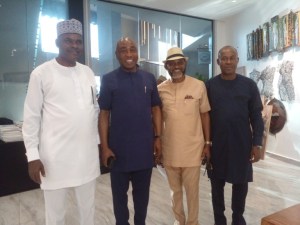
This belief has guided not only his art but his impact. Beyond the gallery walls, Omolayo has invested in nurturing young creativity through initiatives like the Young At Art Children Creative Workshop, a platform that introduces children to artistic expression and self-discovery.
His work, therefore, exists on multiple levels as visual art, as mentorship, and as ministry.
“Everything I have been doing,” he explains, “is to use the visual art business to reaffirm and reinforce the good name for myself, my family, and others who are involved in this creative business who are yet to be known. I am adding value to society through my art.”
That sense of purpose is evident in the thematic direction of his exhibitions. For Omolayo, art is an act of worship as much as it is a form of communication.
“Most of the themes of my art exhibitions centre on the appreciation of the Almighty God who is the Master Artist,” he says. “In addition, I use my art to encourage and celebrate people, purpose, passion, and places as inspired by His word.”
It is within this framework that This Land is Green emerges not just as an exhibition, but as a meditation on life, faith, and abundance.
At its core, the exhibition is a celebration of divine provision.
“This Land is Green is the celebration of God’s abundant gift of the earth and her resources to humanity,” Omolayo explains. “Traditionally, this exhibition is to celebrate God’s grace in my life at 62.”
The choice of green is neither accidental nor aesthetic alone. It is layered with meaning which is universal, cultural, and deeply personal.
Green, in his interpretation, symbolises nature, renewal, health, wellness, balance, stability, safety, prosperity, fertility, and peace. It is a colour that soothes and restores, promoting harmony and mental relaxation.
In the Christian faith, it represents hope, the enduring promise that even what seems lifeless can rise again. In Islam, it is sacred, associated with paradise and spiritual abundance. Nationally, it mirrors the green bands of the Nigeria flag, a quiet reminder of unity, growth, and coexistence across differences.
Even in a global context, green signals access and possibility, the symbolism of the “green card,” a passport to new beginnings.
Through this multi-layered symbolism, Omolayo invites viewers into a broader conversation that transcends art and touches on identity, faith, environment, and humanity’s shared inheritance.
“There’s so much more to say about this land that is green,” he notes, almost teasingly. “But the conversation continues another day in the future.”
And perhaps that is the point.
At 62, Biodun Omolayo is not concluding a story, rather, he is extending it. Each exhibition, each stroke, each child mentored is part of an ongoing dialogue between the artist, his faith, and the society he seeks to inspire.
In a world that often measures success by visibility alone, his journey is a reminder that recognition is not the starting point but it is the result of persistence, purpose, and unwavering belief.
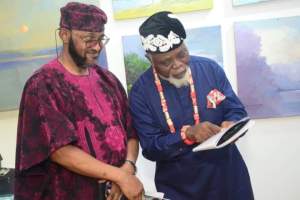
From Naming Ceremony to This Land is Green, the arc is clear, a life lived intentionally, a name reclaimed boldly, and a legacy still unfolding.
This Land is Green opens on Saturday 21st of March 2026 at Omolayo Gallery in Lagos.
iBAND Magazine, Celebrating Visual Arts from the Original.
Africa | Visual Art | Lifestyle | Culture

