
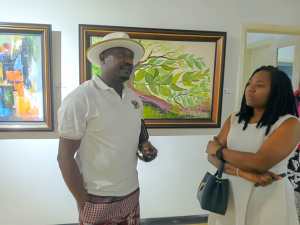
“Don’t let the smoke that comes out of you be of cigarettes, let it be of knowledge.” Timi Melaye
At the opening of This Land is Green by Biodun Omolayo, iBAND Magazine editor Ireho Aito sat down with Timi Melaye, a diplomat, collector, and passionate advocate for creativity. In this brief but thought-provoking conversation, Melaye reflects on art as inspiration, investment, and a vital force for shaping minds, nurturing independence, and reimagining a more sustainable future.
Words Ireho Aito | Don’t Keep Your Art in the Finger! Photographs Role Favour Oluwaseun
From beautiful music, being churned out at the background to gkasses of wine to toast, This Land is Green exhibition atmosphere carried a quiet intensity, one shaped not only by the visual power of the works on display but by the depth of conversations they inspired. Within this space curated by Biodun Omolayo, art was not merely observed; it was interpreted, questioned, and lived. Among the collectors present was Timi Melaye, a diplomat and art enthusiast whose relationship with art extends far beyond acquisition into philosophy, spirituality, and legacy.
For Melaye, collecting is not a passive act, for him, it is a deliberate engagement with creativity as a fundamental force of existence. He speaks of art with conviction, grounding his perspective in a belief that creativity itself is divine. “God is an artist,” he reflects, drawing from scripture. “The Bible says God created heaven and earth. He used creativity in creating them and creativity requires analogy. It requires deep sense. It requires intellectual capacity as well as ability to adapt.”
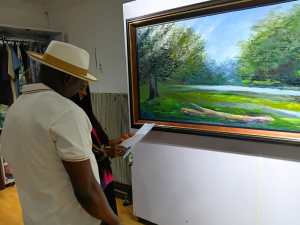
Oil on canvas
81cm x 203cm
Biodun Omolayo. Photo credit Role Favour Oluwaseun
In his telling, creation was not random but intentionally structured with precision and foresight. God, he explains, created the firmament before the animals, ensuring there would be sustenance. The plantation, the sun, and the moon followed, each element carefully positioned to support life. “So there is structure, there is organisation. There is sense of coordination in creation,” he says. It is within this framework that Melaye situates his passion for art. To him, collecting is an extension of that same order which is an appreciation of creativity that is thoughtful, purposeful, and deeply human.
Earlier in the week before the exhibition, Melaye acquired another work from the gallery, a piece he describes as carrying value far beyond its price. For him, art is both inspiration and investment, a duality that defines his decades-long journey as a collector. “If you wake up in the morning and see an artwork that interprets success, it propels you… Sometimes artwork propels you for calmness. Creativity is essential to human existence,” he says.
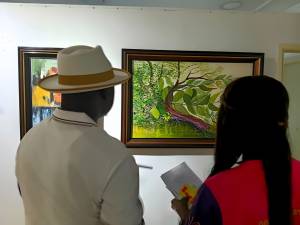
Yet, he is equally pragmatic about the economic power of art. Referencing the legacy of Yusuf Grillo, he notes how a work acquired decades ago for a modest sum can now command millions. The same trajectory, he suggests, applies to contemporary artists like Omolayo. What may have been purchased for a few hundred naira decades ago can today be valued in millions. “That is an investment. That is profit. It is not just collection but it is business and mindset.”
Melaye’s journey into collecting began 24 years ago, shortly after leaving university. Drawn initially to sculptural works that spoke to his immediate environment, his early acquisitions were driven purely by interest rather than financial foresight. Many of those pieces remain in his home today, serving as reminders of how art transforms imagination into reality. “You can imagine your life to be a successful one, artwork creation from an artist can bring it to life,” he says, echoing again the biblical refrain that says “let there be” a declaration that turns absence into presence.
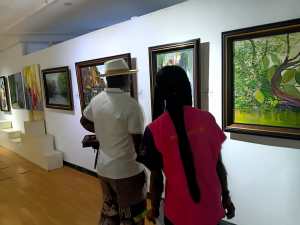
This philosophy extends into his family life. Determined to nurture creativity in his children, Melaye introduced them to the Young at Art Children’s Workshop, where they spend holidays learning sculpture and experimenting with discarded materials. For him, the lesson is clear and uncompromising: “If you are not creative, you will depend. If you are creative, you will be independent.”
Today, he says with quiet pride, his children can create things for themselves and that is an ability he considers essential not just for personal growth but for economic empowerment. “If you can create, you will create jobs, employment and opportunities because you have the creativity.”
It is perhaps this belief in creation as both personal and collective responsibility that shapes his reading of This Land is Green. Having followed Omolayo’s artistic journey for years, Melaye immediately connected with the exhibition’s theme. “Green is a reflection of life. That is why plants are green because they are alive,” he explains. To him, the exhibition is not merely aesthetic, it is restorative. It speaks of bringing life back into people, into the environment, and into the land itself.
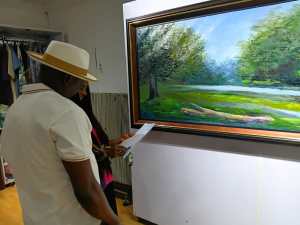
“He told me about the theme for this year’s exhibition. I have been part of his birthday activities right from his 50th birthday and till now. When he told me the title was This Land is Green. I saw the flier everything was green and he said the works he will exhibit will be green.”
Green, is a reflection of life. That is why plants are green because they are alive. They are living things.
His interpretation expands into a broader environmental consciousness. Referencing global concerns such as climate change and the degradation of the ozone layer, Melaye sees the exhibition as a call to action. It speaks, he says, to prosperity, productivity, food availability, and sustainability. “This Land is Green is speaking to life in our land… better weather, better productivity, agricultural advancement and returning life to the land. All of us should rally round this.”
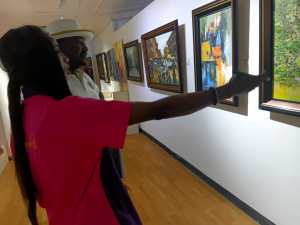
In a world increasingly shaped by environmental urgency, he aligns Omolayo’s message with global initiatives, noting that even innovations like electric cars reflect a collective effort to reduce harm and restore balance. For Melaye, the artist’s voice is not isolated and can never be. The artist’s voice is part of a wider conversation that institutions and organisations must engage with. “What Biodun Omolayo is saying today is what United Nations Environmental project should take and run with. All organisations that are working in climate change advancement projects and policies should run with it.”
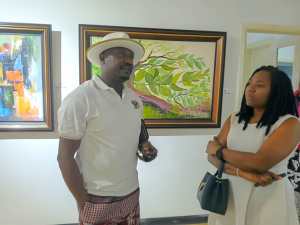
Among the many works in his collection, one stands as a personal emblem of this philosophy. The work is a striking piece he collected from the gallery, constructed from motorbike chains to form the face of a man with a pipe. Melaye has installed the work in his country home, and he wrote a footnote attached to the work which carries an inscription that transforms it into both object and message; “Don’t let the smoke that comes out of you be of cigarettes, let it be of knowledge.”
In that single statement lies the essence of Timi Melaye’s worldview, art as message, art as movement, art as a living force. Through his eyes, collecting becomes not just an accumulation of art but a way of seeing, thinking, and ultimately, a way of shaping the future.
iBAND Magazine, Celebrating Visual Arts from the Original.
Africa | Visual Art | Lifestyle | Culture

