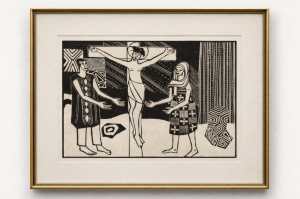
“This powerful Good Friday meditation, is an early linocut by *Bruce Onobrakpeya* done in April 1968. It reinterprets the Crucifixion through an African visual language. Christ is rendered with calm dignity at the centre, flanked by two figures whose open gestures suggest both grief and witness. The stark black-and-white adire and aso oke, contrasts and patterned, textile-like motifs root the sacred event in a Nigerian aesthetic, transforming a universal story of sacrifice into a culturally resonant image of redemption, mercy, and shared humanity..”
– Dr. Mudiare Onobrakpeya
Words Dr. Mudiare Onobrakpeya, Ireho Aito. Artwork credit Prof. Bruce Onobrakpeya.
Renowned curator Dr. Mudiare Onobrakpeya presents our Good Friday edition of Don’t Keep Your Art in the Finger! with a powerful 1968 linocut by Bruce Onobrakpeya, reimagining the Crucifixion through African patterns and dignity.
In April 1968, at a time when Nigeria itself was steeped in uncertainty and searching for meaning, as the civil war was ravaging the country, Bruce Onobrakpeya created a work that continues to resonate with quiet power. This early linocut, conceived as a Good Friday meditation, transcends the boundaries of conventional Christian imagery, offering instead a deeply African interpretation of the Crucifixion, that is, one that speaks not only to faith, but to identity, resilience, and shared humanity.
At the centre of the composition, Christ is rendered not in agony, but in a state of composed dignity. There is a stillness about Him which is an almost meditative calm that shifts the narrative from suffering alone to something more expansive, acceptance, transcendence, and grace. Flanking Him are two figures, their open gestures embodying both grief and witness, as though inviting the viewer into the sacred moment.
What distinguishes this piece most profoundly is its visual language. Working in stark black and white, Onobrakpeya employs bold contrasts that echo the resist-dye traditions of adire and the textured richness of aso oke. These are not incidental stylistic choices, instead they are deliberate cultural anchors. The patterned, textile-like motifs transform the biblical scene into something unmistakably Nigerian, weaving indigenous identity into a story often depicted through Western iconography.
In this reimagining, the Crucifixion is no longer distant and no longer bound to a foreign visual tradition. Instead, it becomes so immediate and familiar, grounded in the rhythms, textures, and symbolism of African life.
For a visual arts magazine like iBAND, rooted in contemporary African culture, this work offers more than historical or artistic significance. It is a reminder of how art can reinterpret global narratives through local perspectives, creating space for dialogue between tradition and modernity.
Professor Bruce Onobrakpeya’s linocut stands as both meditation and statement. It stands as an assertion that African art does not merely adopt universal stories but it reshapes them, giving them new voice and deeper relevance.
Nearly six decades later, the piece remains timeless. In its quiet intensity, it asks us to look again not just at the story of Good Friday, but at the ways culture, faith, and art intersect to tell stories that belong to all of us, yet must be seen through our own eyes.
iBAND Magazine, Celebrating Visual Arts from the Original.
Africa | Visual Art | Lifestyle | Culture

