

https://theluxuryreporter.com
Artistic influence rarely announces itself loudly. Sometimes it lives quietly in studio corners, in conversations after exhibitions, in the posture of younger painters, or in the memories of those who once watched a master at work. For many within Nigeria’s contemporary art scene, Olu Ajayi belonged to that rare group of artists whose presence shaped people long before history fully recognised his impact.
Words Ireho Aito | Don’t Keep Your Art in the Finger! Photographs courtèsy Google
In the iBAND Magazine Cover feature “Cover | Ola Balogun Made in Lagos – The Rise and Fall of Defactori Studio,” Nigerian artist and painter, Ola Balogun, a member of the distinguished Class of Auchi ’99, in his beautiful memories of influence, reflected warmly on the man he considered one of the important figures in his creative journey.
After completing his Industrial Attachment, Balogun worked closely with Olu Ajayi and remembered him as “a detailed, brilliant and very articulate artist.”
But it was not only Ajayi’s technical mastery that stayed with him.
Balogun also recalled the artist’s elegance, composure, and refined public presence, noting that,
“His appearance was an inspiration. Olu Ajayi was always looking debonair…”
That observation now feels deeply symbolic.
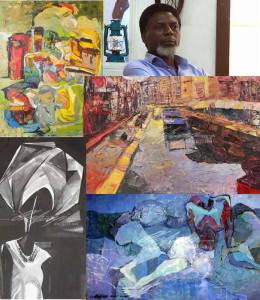
tealearn.org
Because Olu Ajayi represented a generation of Nigerian artists who understood that artistry extended beyond the canvas. The painter, in his world, was not merely a maker of images but a custodian of culture, intellect, discipline, and social consciousness.
Even his physical appearance communicated intention. He carried himself with the quiet confidence of a man who believed art deserved dignity.
To encounter an Olu Ajayi painting was often to encounter a nation speaking through colour that is layered, bruised, hopeful, defiant, and deeply human.
As Lagos prepares to host “Colour as Resistance: The Art and Advocacy of Olu Ajayi” at the J.Randle Centre for Yoruba Culture and History, the city is once again returning to the language Ajayi spent decades refining which is to provide fearless visual expression.
It is going to be more than a memorial exhibition, the event promises to become a cultural reunion of artists, scholars, collectors, students, and admirers who witnessed his contribution to the evolving identity of Nigerian art.
Olu Ajayi was born in Ososo, Edo State, in 1963, Ajayi emerged from the celebrated Auchi School tradition, a movement that produced some of Nigeria’s most technically accomplished and intellectually rigorous artists. Yet even among distinguished contemporaries, he developed a voice that felt unmistakably personal.
His works travelled fluidly through realism, abstraction, satire, portraiture, and socio-political commentary, always carrying emotional urgency beneath the surface.
While his visual language was rich with movement and layered symbolism, faces appeared reflective yet burdened. Colours collided like arguments and textures carried emotional weight.
Nothing in his work felt accidental. Every composition seemed to ask difficult questions about power, identity, memory, inequality, and the fragile condition of African urban existence.
Ajayi never separated art from society. Even long before activism became fashionable within global art conversations, he already believed the African artist had a responsibility to remain socially awake. And through cartoons, essays, paintings, and public engagement, he consistently challenged silence and complacency.
His practice confronted corruption, cultural erosion, political instability, and social injustice, yet it always retained compassion for ordinary people caught within those realities.
That is why the exhibition title “Colour as Resistance” feels less like a curatorial theme and more like a summary of his philosophy.
For Olu Ajayi, colour was never decorative. Instead Colour protested, remembered, mourned and survived.
Internationally, his works travelled beyond Nigeria to exhibitions across South Africa, Europe, Canada, and the United States, helping position contemporary Nigerian art within wider global conversations.
Yet despite that international reach, Ajayi remained spiritually connected to Lagos, a city he both admired and interrogated through his practice.
And perhaps no city could host this tribute more appropriately.
iBAND Magazine, Celebrating Visual Arts from the Original.
Africa | Visual Art | Lifestyle | Culture

