
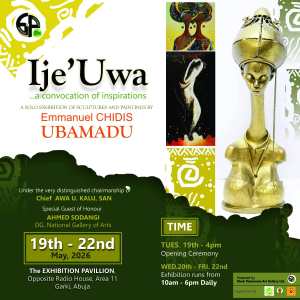
As Emmanuel Chidis Ubamadu prepares to unveil Ije’Uwa A Convocation of Inspirations in Abuja, on the 19th of May 2026, the moment feels larger than a personal milestone. It is also a reflection of how far Nigeria’s creative landscape and democratic journey have evolved over the past three decades.
Nigeria’s present democratic dispensation began on May 29, 1999, marking the start of the Fourth Republic. By May 2026, Nigeria’s democracy is 27 years old. Interestingly, this timeline runs almost parallel with Chidis Ubamadu’s artistic journey nearly thirty years of creating, experimenting, mentoring, and refining his voice before arriving at his debut solo exhibition.
Back in the late 1990s, Nigeria’s art industry was still struggling for structure, visibility, and institutional support. Many artists depended heavily on word-of-mouth recognition, modest gallery spaces, and occasional cultural events. Abuja itself was still growing into its identity as a national cultural capital. The creative economy had not yet become a major conversation, and artists often worked quietly without the digital exposure available today.
Three decades later, the landscape has transformed remarkably.
Today, Nigerian art commands international attention. Nigerian painters, sculptors, photographers, and installation artists now feature prominently in global auctions, biennales, festivals, and museum collections. Social media and digital platforms have expanded visibility beyond physical galleries. Abuja and Lagos have developed stronger art ecosystems, with exhibitions, festivals, collectors, and cultural institutions helping to sustain conversations around African identity, heritage, and contemporary expression.
What once felt like a distant dream for many artists has gradually become achievable. Younger creatives now see pathways that were almost invisible thirty years ago.
That is why Ije’Uwa carries symbolic weight.
It is not simply an exhibition of sculptures and paintings. It represents endurance. It represents artistic patience in a country where many creatives often battle limited funding, inconsistent infrastructure, and cultural underinvestment. It also reflects the maturation of Nigeria itself, as a nation still evolving democratically, culturally, and creatively.
In many ways, Chidis Ubamadu’s story mirrors Nigeria’s democratic story: a journey of persistence, reinvention, setbacks, experimentation, and continuous becoming.
And now, Abuja becomes the meeting point between history, memory, and artistic revelation.
The exhibition runs from 19th to 22nd of May 2026.

