
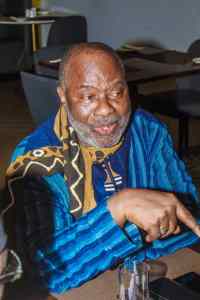
It is with profound sadness that the Nigerian art community receives the news of the passing of Prince Olasehinde Odimayo at the age of 76. His departure marks the end of an era defined by pioneering effort, institutional commitment, and an enduring belief in the power of art to shape society.
Reflections Dr. Mudiare Onobrakpeya, Mr. Moses Ohiomokhare, Prof. Peju Layiwola and Dr. Adeola Balogun | Don’tKeep Your Art in the Finger! Group Photograph courtesy Dr. Mudiare Onobrakpeya
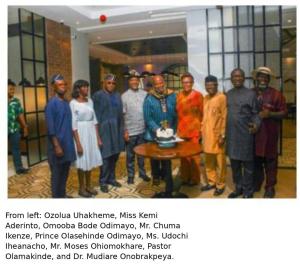
In reflections shared by Mudiare Onobrakpeya, Moses Ohiomokhare, Prof. Peju Layiwola, and Dr. Adeola Balogun, four voices from different corners of the Nigerian art landscape converge on the memory of a man whose influence went beyond the gallery space, he was a collector, gallerist, mentor, historian of taste, and custodian of artistic conversations.
Mudiare Onobrakpeya begins with a framing that places Odimayo within a rare category of cultural builders:
“There are artists who create great works, and there are cultural visionaries who create the environment in which great works can flourish. Prince Olasehinde Odimayo belongs firmly to the latter category.”
For Mudiare Onobrakpeya, Odimayo’s significance is rooted in the long duration of his commitment and the breadth of his impact:
“For over four decades, he has stood as one of the pillars of the Nigerian art ecosystem, championing artists, nurturing collectors, building institutions, and helping to shape the modern Nigerian art market through his pioneering work at Treasure House Fine Arts.”
That vision, he notes, was sustained at a time when the art sector was still finding its footing:
“At a time when few saw art as a viable enterprise, he invested his resources, intellect, and reputation in preserving and promoting the creative genius of Nigerian artists.”
Running parallel to this reflective lens is the institutional voice of Moses Ohiomokhare, President of the Art Galleries Association of Nigeria (AGAN), who situates Odimayo within the operational core of Nigeria’s gallery system.
He describes him as “one of the pioneer gallerists in Nigeria, a visionary whose passion, commitment, and unwavering belief in the power of art helped shape and nurture the growth of the Nigerian art scene.”
Moses Ohiomokhare further emphasises his active role within the professional body, “a very active leader of Art Galleries Association of Nigeria (AGAN).”
Beyond institutional leadership, Ohiomokhare highlights Odimayo’s cultural depth and curatorial sensitivity:
“Beyond being a gallerist, he was a great art enthusiast and collector whose discerning eye and deep appreciation for creativity contributed significantly to the preservation and promotion of Nigeria’s rich artistic heritage.”
He also reflects on the social life of Odimayo’s gallery, “his gallery became a meeting point for artists, collectors, scholars, and lovers of culture, fostering dialogue and inspiring generations.”
For Prof. Peju Layiwola, an artist and scholar whose own practice has been deeply connected to history, memory, heritage, and the preservation of cultural narratives, Odimayo’s passing represents the loss of a rare mind in Nigerian art.
Her reflection carries both grief and a sense of unfinished possibilities:
“What a sad exit. So many plans he had that he did not accomplish. Several manuscripts lost!”
The words capture the intellectual depth of a man who was not only passionate about art objects, but about knowledge, documentation, and the stories surrounding Nigerian creativity.
Dr. Adeola Balogun, sculptor, educator, and one of the respected voices in contemporary Nigerian art, also reflects on the magnitude of the loss:
“Prince Sehinde Odimayo will be remembered for his passion and perspicacity in matters relating to visual arts, ranging from antiquity to contemporary art in Nigeria and beyond.”
Balogun continues in his reflections, “certainly, his wealth of knowledge in the realm of visual arts is a big loss to the Nigerian artist. Our consolation is that he left an impressive footprint in the sand of time. May his soul attain eternal rest.”
Across these four reflections, a shared truth becomes visible: Odimayo’s life was not only about art objects, but about the ecosystem that sustains them.
Mudiare Onobrakpeya captures this philosophy in a final line that resonates with his broader tribute when he wrote that “his life reminds us that true leadership is not measured by what one accumulates, but by the opportunities one creates for others.”
Moses Ohiomokhare closes from the institutional perspective by writing about Odimayo when he says, “his legacy lives on in the countless artists he supported, the collections he built, and the cultural institutions he helped strengthen.”
Between these four voices, Mudiare Onobrakpeya’s reflective lens, Moses Ohiomokhare’s institutional testimony, Prof. Peju Layiwola’s scholarly appreciation, and Dr. Adeola Balogun’s artistic perspective, Prince Olasehinde Odimayo emerges as both builder and custodian of Nigerian art.
His legacy remains embedded not only in memory, but in the structure of the art world he helped shape.
iBAND Magazine, Celebrating Visual Arts from the Original.
Africa | Visual Art | Lifestyle | Culture

