
“That we have over 720 paintings in our studio in Lekki is simply because we listened to the voices of our teachers. They told us to read, read and read.” — Duke Asidere
Words Ireho Aito | Don’t Keep Your Art in the Finger! Artwork Credit: Matt Ehizele, Photographs of events provided by Duke Asidere archives
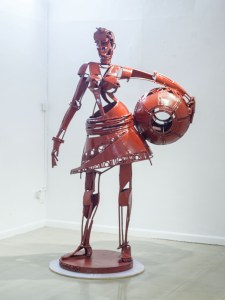
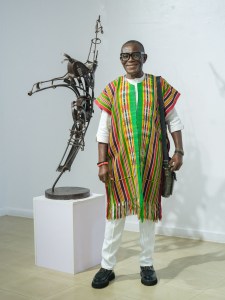
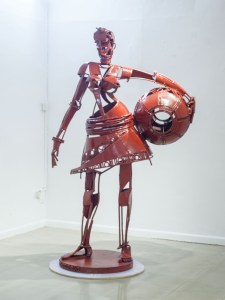
From Saturday, July 18 to Saturday, July 25, 2026, the National Museum, Onikan, Lagos, became more than an exhibition space. Open daily from 10:00 a.m. to 5:00 p.m., it welcomed visitors into “Udu Ematon The Heart of Steel,” a remarkable solo exhibition by veteran sculptor Matt Ehizele, presented by acclaimed Nigerian painter and President of the Guild of Professional Fine Artists of Nigeria (GFA), Duke Asidere. The exhibition has since been widely celebrated, not only for the strength and elegance of Ehizele’s steel sculptures but also for the profound story behind it. It was the story of a former student honouring one of the teachers who helped shape his artistic journey at Ahmadu Bello University, Zaria.
There is something profoundly moving about a successful student returning to honour the teacher who helped shape his future. In an age where achievements are often celebrated without acknowledging the shoulders upon which they stand, Duke Asidere reminds us that gratitude remains one of the greatest virtues an artist can possess.
 At the National Museum, Onikan, Lagos, the exhibition “Udu Ematon (The Heart of Steel)” by veteran sculptor Matt Ehizele became much more than a display of steel sculptures. Presented by Duke Asidere, the exhibition evolved into a heartfelt tribute, a celebration of mentorship, artistic lineage and the enduring influence of teachers whose lessons continue to echo decades after the classroom.
For those who know Duke Asidere through his paintings, writings, lectures and conversations since 1981, the exhibition came as no surprise. Respecting teachers has never been an occasional gesture for him; it is a philosophy that runs through his entire career. Nigerian photographer, Uche James Iroha, once revealed that Duke Asidere is one artist he has known to be full of gratitude. He shared this element of Duke when he was still in Nigeria. Uche James Iroha has since relocated to United States of America.
 Asidere often returns to the importance of education whenever he speaks to young artists.
“That we have over 720 paintings in our studio in Lekki is simply because we listened to the voices of our teachers. They told us to read, read and read. Our Gbagada studio houses more than 250 finished paintings”
Those words are not empty motivation. They are reflected in the discipline that has defined his life. His studios in Lekki and Gbagada are filled with hundreds of completed works, paintings refined through years of reading, observation, experimentation and relentless practice. Visitors who have walked through these spaces encounter not simply an artist’s production line but a visual library of ideas, each canvas demonstrating that mastery is earned through patience rather than shortcuts.
Long before he became one of Nigeria’s most respected painters, Duke Asidere was a student at Ahmadu Bello University, Zaria, where he graduated with a First Class degree. Among the lecturers who shaped his artistic foundation was sculptor Matt Ehizele, whose technical rigour and commitment to sculpture influenced generations of students.
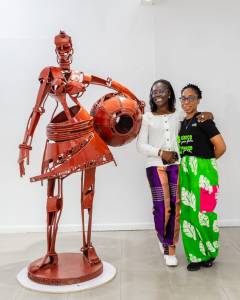
Years later, Duke chose not merely to remember his teacher privately but to celebrate him publicly. That decision carries enormous significance.
As President of the Guild of Professional Fine Artists of Nigeria (GFA), Duke Asidere has consistently advocated for artistic excellence, professional ethics and the nurturing of younger generations. His leadership has never been confined to administration. It has been about preserving artistic values, encouraging scholarship and reminding artists that success comes with responsibility.
He is well known for his studio engagement at his PlaySpot Studios where artists are honoured with speaking engagements. Also, his street art activism which he started from his old studio at Orelope side of Alimosho, on the Mainland of Lagos is returning very soon.
“No patriot betrays his people,” he exploded on one of his Instagram stories recently.
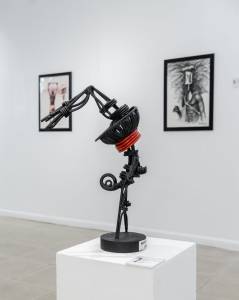 Presenting “Udu Ematon” therefore became an extension of that leadership. It was the student becoming the custodian of his teacher’s legacy.
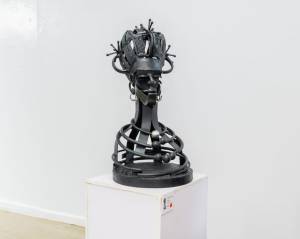
The exhibition title, The Heart of Steel, could hardly be more appropriate. Matt Ehizele’s sculptures reveal extraordinary technical confidence, transforming industrial steel into elegant human forms filled with rhythm, balance and movement. Every welded joint reflects decades of experience. Every figure demonstrates that steel, despite its hardness, can convey tenderness, dignity and emotion. They remain memoirs of a teacher.
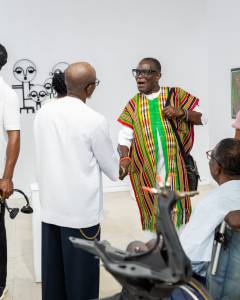
Visitors responded enthusiastically throughout the exhibition. And in Duke’s testament, it was a good outing so far.
Many enthusiasts admired the craftsmanship of the sculptures, while others recognised something even more powerful, that is, the story behind the exhibition itself. It became a reminder that Nigerian art has always advanced through mentorship, apprenticeship and respect for elders.
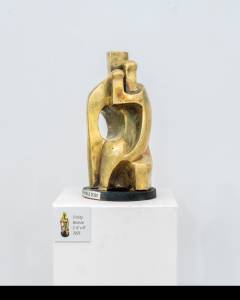
Duke Asidere himself embodies that tradition. Throughout his career, iBAND Magazine has documented his belief that learning never ends. Whether speaking to emerging artists in his studio or addressing audiences at exhibitions and art conversations, he repeatedly encourages artists to cultivate knowledge before seeking recognition.
“The hardest thing in the world for someone to do in life is to take what everyone already knows and make it a little better. It is only possible when you think outside the box. But what about the courage?”
That courage has characterised many stages of his artistic journey.
For over four decades, Duke Asidere has produced exhibitions that have expanded conversations around contemporary Nigerian painting. From the reflective “Lost in a Duke’s Muse” to the expansive retrospective “Works From Across a Life of Thinking and Making,” his exhibitions have consistently demonstrated an artist unwilling to repeat himself. Each body of work has explored new emotional territories while remaining rooted in technical excellence and thoughtful storytelling.
“When I go to other people’s exhibitions, the catalogues are important to me and I buy when money is attached to them. Not only for me but to hand over to the younger ones to read and get knowledge,” Duke Asidere stated.
Yet perhaps his greatest exhibition was never about himself. By choosing to present Matt Ehizele, Duke redirected the spotlight towards the teacher who helped illuminate his own path. This is an act that says much about his character.
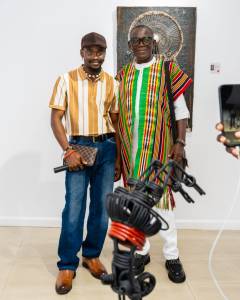
One cannot fully understand Duke Asidere without understanding his reverence for teachers. He frequently tells the story of his first teacher who happened to be his mother. Before art school, before university, before galleries and collectors, there was a woman who taught him discipline, compassion and resilience. It is no coincidence that women occupy such an important place in his paintings. They are not merely subjects, rather, they are acknowledgements of life’s earliest lessons.
His respect for his mother naturally extended to the lecturers who refined his artistic language at Ahmadu Bello University. For Duke, every teacher deserves honour while they are still alive.
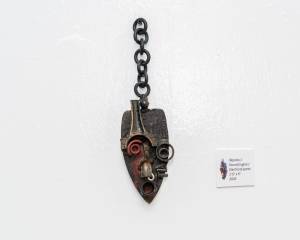
That philosophy gives “Udu Ematon” an emotional depth beyond exhibition. It becomes a lesson for younger artists, curators and collectors alike. Too often, recognition comes after a lifetime has ended. Duke Asidere chose another path. He celebrated excellence in the present, ensuring that audiences could appreciate Matt Ehizele’s achievements while the artist himself could witness the admiration.
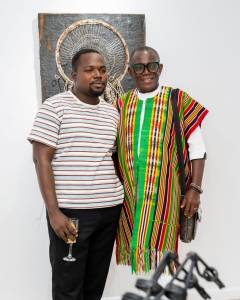
In many ways, this exhibition also reflects the values Duke now champions as President of the Guild of Professional Fine Artists of Nigeria. The future of Nigerian art cannot be built solely on talent. Instead, it requires continuity, mentorship and the willingness of one generation to acknowledge another.
It remains certain that at a time, every accomplished artist was once a student that struggled to hold a pencil.
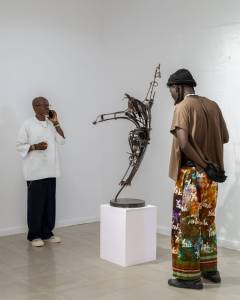
That is why “Udu Ematon -The Heart of Steel” resonates far beyond the walls of the National Museum. It reminds us that legacy is not measured only by the works artists create but also by the gratitude they show to those who shaped them.
As visitors continue to visit the exhibition, they will always carry memories of remarkable body of work, but they also leave with a quieter lesson, the one that cannot be welded, painted or framed.
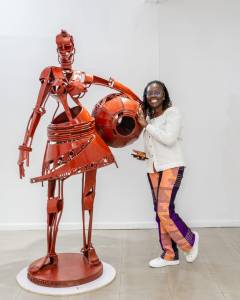
Throughout his career, Duke Asidere has embodied a simple but enduring philosophy: respect your teachers, honour your mentors, read widely, and never stop learning. These values have shaped not only his artistic journey but also his approach to mentoring younger generations, reminding us that true growth comes from humility, knowledge, and a lifelong commitment to learning.
And when success finally arrives, never forget the hands that first pointed you towards greatness.
In celebrating Matt Ehizele, Duke Asidere has once again demonstrated that true leadership is not about standing above others. It is about lifting those who made your own journey possible. In that simple yet profound act, “Udu Ematon” becomes more than an exhibition. It becomes a powerful testament to memory, gratitude and the enduring heart of Nigerian art.
Although the exhibition officially runs from July 18 to July 25, 2026, its impact will endure far beyond those dates. The National Museum, Onikan, became the meeting point of generations where students, collectors, artists and art lovers witnessed not only the brilliance of Matt Ehizele’s sculptures but also a rare public expression of gratitude from Duke Asidere.
While celebrating his teacher, Asidere reminded the Nigerian art community that every enduring legacy begins with a teacher who believes in a student. Just as he maintained, “It is wrong for you to enter the gate, only to forget how you got in.”
“Udu Ematon – The Heart of Steel is still on view at National Museum Onikan in Lagos and ends July 25th 2026
iBAND Magazine, Celebrating Visual Arts from the Original.
Africa | Visual Art | Lifestyle | Culture

