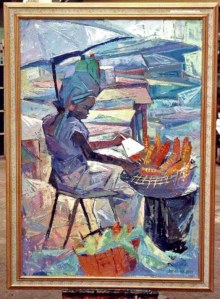
Medium : Oil on Canvas
Year – 2001
Corn Seller in the collection of Dr. Kudo Eresia – Eke
Artwork courtesy Chief Joe Musa
Roast corn is one of Nigeria’s most familiar roadside delights. We eagerly await its season, drawn by the irresistible aroma of fresh maize over glowing charcoal. Yet behind every roasted cob is someone patiently tending the fire, enduring the heat so others can enjoy a simple pleasure.
It is this quiet dignity that Joe Musa captured in Corn Seller. Painted in 2001, the work has become more than a painting; it is a document of memory, preserving an everyday Nigerian experience that continues to resonate across generations. Corn Seller caught our attention this week as a feature on Don’t Keep Your Art in the Finger! and the legendary touch of Joe Musa gave it a refreshing appeal.
Words: Ireho Aito | Don’t Keep Your Art in the Finger! | Artwork: Joe Musa
The corn seller has always been part of the Nigerian landscape. Long before conversations about the informal economy became fashionable, they occupied familiar corners of our cities, patiently waiting for customers with glowing charcoal fires, fresh maize and an unmistakable aroma that announced their presence before they came into view.
Nigerian master painter Joe Musa saw this ordinary figure as worthy of preservation.
His vision takes me back to another period. I remember joining Artwatch Africa Studios at Anthony Village, Maryland, Lagos. From Anthony Village through Mende, roast – corn sellers stood at strategic locations. They were as permanent as the roads themselves, quietly serving commuters, residents and travellers. They formed part of the rhythm of everyday life.
Joe Musa may have drawn inspiration from the scenes around him. It is easy to imagine that his journalistic instincts led him to observe closely by buying from the corn seller, perhaps even exchange a few words with the corn seller before committing the scene to canvas. That is the depth of the grandmaster’s practice. He did not merely paint what he saw; he sought to understand the people and stories behind the everyday moments that many overlooked.
Those who knew that part of Lagos in those days will vividly remember the famous Lagos State University satellite campus at Idi-Iroko Bus Stop, Anthony. They will also remember the women who sold roasted and boiled corn by the street corners in the middle class community, providing an affordable meal for countless students struggling to balance lectures, transport fares and daily survival.
As the formal economy struggled to absorb millions over the years, the streets continued to create their own economy. The corn seller became one of its enduring symbols with small-scale entrepreneurship driven by resilience rather than policy.
Curiously, I have never asked Joe Musa what inspired this painting or who the muse behind it might have been. Perhaps that mystery is part of the artwork’s strength. It allows every Nigerian to recognise someone they once knew, maybe a woman by the roadside, a familiar face outside a bus stop, or a vendor who faithfully returned every season.
One place again, continues to remind me of this remarkable continuity. Beneath the Independence Tunnel at Mende, Maryland, the community often associated with crane furniture makers, also the art and craft village community, has for decades been home to roast – corn sellers. They remain there almost permanently, roasting corn every season and are never short of maize in supply to make the delicacy, somehow, finding ways to sustain the trade beyond its expected cycle. Their presence has become part of the identity of the place itself.
That is precisely what Joe Musa understood. He was not merely painting a trader but was documenting a social institution by recognising the dignity in labour, beauty in the everyday and permanence in what many considered temporary.
More than two decades after it was painted, Corn Seller still speaks to us as a people. It reminds us that history is not preserved only through monuments or government records. Sometimes it survives in the glow of charcoal, in the hands of a roadside vendor, and in the quiet observations of an artist who understood that today’s ordinary scene could become tomorrow’s cultural memory.
Perhaps that is the true measure of Joe Musa’s greatness. Legends do not merely paint what they see; they preserve what a nation is too busy to notice. In Corn Seller, he immortalised not just a roadside trader, but the quiet resilience, dignity and enterprise that have sustained generations of Nigerians. As time continues to validate his vision, the painting stands as a reminder that some of our most enduring histories are found not in grand monuments, but in the ordinary lives that master artists like Joe Musa chose to honour. Corn Seller, painted in oil on canvas in 2001, measures 3 ft × 4 ft and is held in the distinguished collection of Dr. Kudo Eresia-Eke.
iBAND Magazine, Celebrating Visual Arts from the Original.
Africa | Visual Art | Lifestyle | Culture

