Behind every masquerade is a supply chain no spreadsheet counts. Who carved the mask? Who dyed the raffia? Who beaded the tunic? Who fed the drummers? We fund the spectacle, we photograph the spectacle, but we rarely fund the maker. How do we change that?
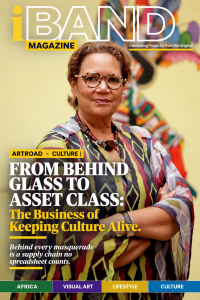
Words Ireho Aito | Don’t Keep Your Art in the Finger! SMO Contemporary Art | Photographs courtesy SMO Contemporary Art
Audu Maikori, the intelligent Chief Executive Officer of Chocolate Music stirred the honest truth to millions of Nigerians who are aloof of the way the current music industry works globally. The upwardly mobile music executive was a guest on Afropolitan podcast this year and the topic was about the urban culture music from Africa, most importantly, Nigeria. The topic surrounds investment, music distribution policies, artistes royalties, publishing and essence of music catalogue. Where do the Africans and their music start to pay their bills and build their economies? Audu Maikori revealed the truth on this engaging conversation with the hosts of the show why Africans are not in control of their destiny.
The corporate and suave Chocolate Music boss didn’t hide the truth. After celebrating the global index for Afrobeats genre of music that is strictly becoming too urbane in culture, now deviating from the traditional sounds Afrobeats started before exportation. Audu maintained that the music has been hijacked by the powerful Western music corporations for their gains and profits. They direct the flow of the music distribution and especially, the streaming platforms are controlled by the West. Africans do not have a say and he was sure of his opinion because Africans have lost the power of the music culture to the West.
Juju music maestro and one of the pioneers of modern music in Nigeria, King Sunny Ade shared his experience, too, many years ago why he was dropped from Island Records, the record company he signed with in the 80s. He was chosen to replace the legend Bob Marley after his demise.
The Juju icon explained that one of the challenges he encountered with the UK label was the intention to dilute his traditional Juju music, that is more from the grassroots of Nigeria where he was coming from. Island Records wanted a fast tempo rhythm which they experimented with the Sunny Ade known as KSA back home. It didn’t sound too good with the legend and his team which led to collapse in relationship rhythm between the two parties. KSA, finally left the record company after few stints with them and a Grammy nomination with global tours and global media interviews that were part of the deal. The real question is the authenticity of the work and who controls the table?
Afrobeat musician Femi Anikulapo – Kuti has also shared his share of such career challenges when he signed with an International label in his early part of his career. The relationship went sour and the musician and the record company parted ways as well due to contract misunderstanding that the Nigerian musician was not in in good terms with. If this is happening in music, it is not different in visual art, fashion and more.
The story of African music is therefore not only about sound, fame or global recognition. It is also about ownership, control and who gets to benefit when African creativity travels beyond its original home. The same question follows the artist, whether the work is a song, a painting, a sculpture, a textile or a masquerade. Who owns the story? Who controls its movement? Who keeps the value when the work becomes globally desirable?
This is where the conversation moves from music into visual art. If African musicians have had to negotiate contracts, royalties, distribution and cultural identity with powerful international structures, visual artists and cultural makers are facing a related question: how do we ensure that the growing global appetite for African art does not become another system where the culture is celebrated while the people who created it remain outside the real value chain?
Back home, within the visual art community, there has been concerns about Africans and our art and culture, now blowing in sales, enjoying incredible applause in, not only in the West, but also in Asian countries. African prints and materials are now being produced by the Asians and still being sold to Africans to buy. Dr. Kunle Adeyemi, a renowned scholar and artist stated this in an exclusive Cover edition with iBAND Magazine in Lagos, early this year.
The versatile printmaker, Dr. Adeyemi is coming out before the year runs out in an exhibition, showcasing African embroidery designs that is big and flowing outfit we fondly called Agbada. One of the reasons he is coming out with such series in exhibition is to reveal the tradition, the root, culture, origin and why it is important it is preserved before being hijacked by intruders.
We must continue to admit that we are losing so much in our art and culture, yet we cannot account for our loss since the invasion in 1897.
Last year, at Tate Modern Museum in London, the Nigerian Modernism exhibition was opened to the public and it was a show stopping event where the modernists of Nigerian art were celebrated through their crafts, innovations, beliefs, dedication, integrity, natural synthesis and being culture custodians who created cultural map for Nigeria through their ideas using painting, wood, prints and other mediums that are organically etched for global appreciation and education.
Back home in Lagos, there are evenings in Lagos when art stops being decoration and becomes a question, just as was posted on SMO Contemporary Art social media platform. One of such evenings happened in September at the Gaia Africa Club. Report indicated that the room was charged, not just by who was in it like investors and collectors, Young Global leaders gathered by the Aliko Dangote Foundation and the World Economic Forum, but by what was in it. The conversation was necessary and at the right time.
For a century, too much of Africa’s heritage has lived behind glass. Behind the glass of museums in London and Paris. Behind the glass of private vaults in New York and Geneva. Admired, studied, insured but not alive. Not here. Not paying school fees for the carver’s child in Abeokuta or feeding the studio of a young painter in Yaba.
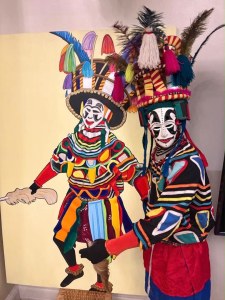
At the centre, the Agbogho Mmuo. The maiden-spirit masquerades moved, luminous and unsettling, as if the past had walked into a boardroom. Around them, large, arresting paintings from REWA’s Embodied Spirits series. The performance was not a backdrop. It was the opening statement.
SMO Contemporary Art, under the moderation of the artist REWA, called the conversation “Behind Glass to Asset Class: the Business of Keeping Culture Alive.” And in that title lay the entire crisis and promise of African art today.
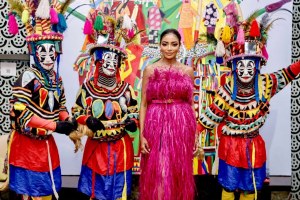
The question SMO Contemporary Art posed was deceptively simple: What would it take to bring it home, and keep it alive?
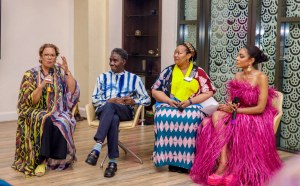
On the panel was Femi Akinsanya, a calm investment banker, chartered accountant, one of Nigeria’s most deliberate collectors, Chairman of NGX Regulation and trustee of the J. Randle Centre for Yoruba Culture & History, brought the language of markets to the language of masquerades. Also, present was Karabo Morule, founder of Amara Strategic Investments and Capital Art from South Africa, who brought a continental investor’s lens. Together, they and SMO founder Sandra Mbanefo, forced the room to confront what we prefer to romanticize.
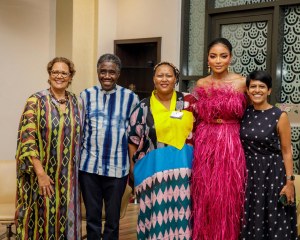
If African art is truly an asset class, what must be true? Provenance must be clean, data must exist and liquidity must be real. But can an investor enter and exit without begging a gallery? Trust must be institutional, not personal. Today, an investor who wants exposure to African creativity has nowhere formal to go. Our value is everywhere, our value chain is nowhere.
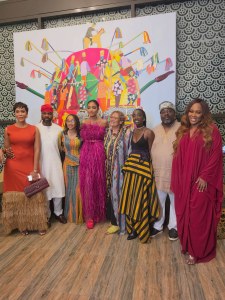
This was the second wound the evening exposed: African creativity is consumed everywhere, yet the value is captured elsewhere. Our rhythms fill stadiums in London, our prints walk runways in Milan, our masks inspire films in Hollywood. But where does the leak happen? In the absence of documentation, in the absence of royalties, in the absence of museums and markets that keep the margin at home. The conversation asked bluntly: who plugs it?
And then, the most human question of the night: Behind every masquerade is a supply chain no spreadsheet counts. Who carved the mask? Who dyed the raffia? Who beaded the tunic? Who fed the drummers? We fund the spectacle, we photograph the spectacle, but we rarely fund the maker. How do we change that?
It mattered that this conversation happened at Gaia Africa, a women-led club, moderated by a woman artist, centred on maiden spirits. It allowed SMO to ask the question most economic forums avoid: What changes when we put women at the centre of the creative economy? The answer was in the room. When women hold cultural capital, it tends to stay in families, in communities, and in legacy.
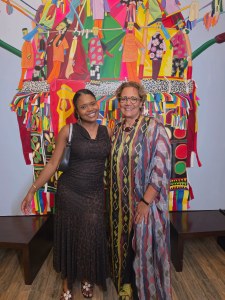
By the end of the night, it was no longer a panel. It was a super-charged celebration of art, culture and spirituality.
And it ended with a challenge to the very people in the room: What can this room do in the next twelve months to turn African culture into durable value?
Not into another round of talk anymore but instead Into value to get children to go to school. Have access to fund, be able to be positioned in a museum wing with a verifiable archive. The maker’s effort must be purchased, or get commissioned that keeps a maker alive.
SMO Contemporary Art’s conversation was held at Gaia Africa Club, Lagos, as part of the Aliko Dangote Foundation and World Economic Forum Young Global Leaders convening on investment, technology and innovation in Africa..
iBAND Magazine, Celebrating Visual Art from the Original.
Africa | Visual Art | Lifestyle | Culture

