Kongo
Kongo explores the historical context surrounding the Scramble for Africa when King Leopold II of Belgium seized control of the region that later became known as Belgian Congo, marking an era of terror. The narrative extends to critique violence, civil wars, and human suffering associated with the blood diamond trade. Children were conscripted into these conflicts, with warring sides resorting to the gruesome practice of amputating the limbs of youngsters, reminiscent of Leopold’s Belgium, which employed mutilation as a tool of terror to boost production for capitalist exploitation. Leopold’s legacy of violence continues to influence postcolonial societies, as it is adopted by armies, judiciaries, and law enforcement agencies, perpetuating terror, brutality, radicalisation, and dehumanisation. As Aimé Césaire eloquently observed, “[Colonization] dehumanises even the most civilised man; that colonial activity, colonial enterprise, colonial conquest, which is based on contempt for the native and justified by that contempt, inevitably tends to change him who undertakes it; that the coloniser, who in order to ease his conscience gets into the habit of seeing the other man as an animal, accustoms himself to treating him like an animal, and tends objectively to transform himself into an animal.” (Césaire, 2018)
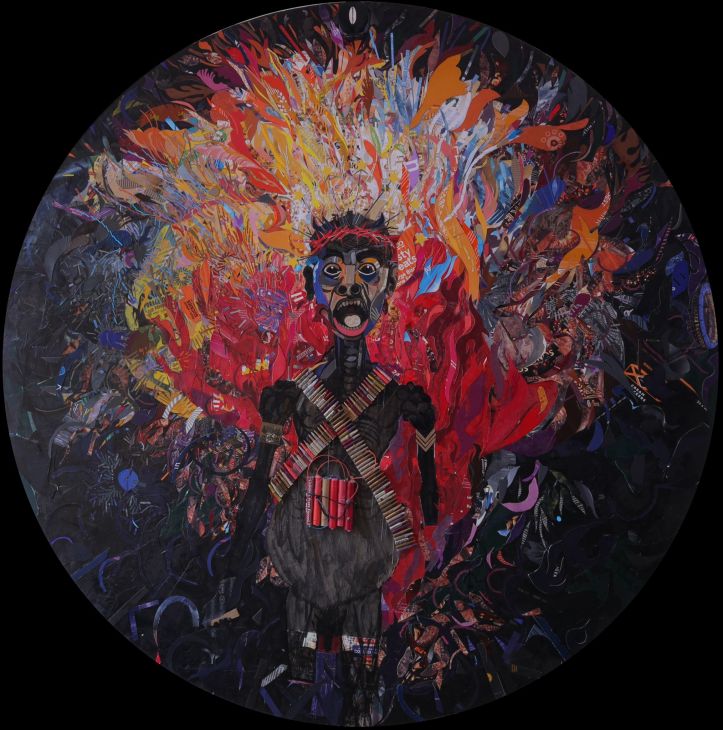
In my painting, the central focal point is an emaciated young figure. This figure wears a bloodied crown of thorns adorning his head and military epaulettes on an amputated upper arm and holding a sickle on the other hand, symbolising the ideals of the proletariat revolution. A shoulder flash on the right upper arm bears the logo of Edward Colston’s Royal African Company. The figure’s expression conveys shock and despair through piercing eyes and an agape mouth, revealing pointed teeth. Tragically, these facial features were misconstrued by Mbye Ota Benga’s captors as evidence of his supposed animal-like nature. This misunderstanding led to his trafficking to America, where he spent much of his adult life exhibited in a human zoo, confined to a cage alongside a monkey. After enduring tragic circumstances that significantly impacted his mental health, at the age of 32, he took his own life by shooting himself in the heart with a borrowed pistol in 1916.
Kongo is crafted on a 6mm thick, sized wood panel affixed to a circular frame measuring 120mm in width. The frame is cut out in a ring shape using a jigsaw, constructed from a lattice of two sheets of 18mm plywood bonded together. The wood panel is securely glued to the ring frame, and underneath the wood panel, strips of 2×1 inch timber are arranged in a spoke formation to deter warping. Incorporating diverse elements beyond the prevalent packaging and leafleting components in my recent collaged paintings, I have acquired additional materials such as cylindrical spools, bits of wiring, and inexpensive plastic bullets sourced from a toy rifle purchased at a pound shop. This approach aligns with the method employed by Hew Locke in obtaining some of his materials. The solitary figure, rendered as a cut-out, is securely adhered to the collaged backdrop of an inferno. Executed on commercial brown wrapping paper, the figure is painted using an ink wash of varying shades of black, drawing inspiration from the elegant simplicity evident in Tam Joseph’s Spirit of the Carnival. While the upper torso is deliberately exaggerated to convey the effects of Kwashiorkor on a malnourished form, the lower anatomy is portrayed flat, seamlessly merging into the foreground of the painting.
In the initial sketch for Kongo, I contemplated encapsulating the desolate portrayal of the central figure behind symbolic bars, some of which would allude to world religions, posing a moral challenge to the inhumanity of Benga’s captivity with an ape. I also envisioned depicting the burning map of Africa, suggesting a vibrant crowd of its people dwindling into a horizon shaped like the continent in flames. However, I opted against these elements, realising that in a single painting, caution should be exercised against overcomplicating the focus.
Positioned at the painting’s zenith, a realistically rendered chain winds around the outer surface of a raised cylindrical element. Within its circular face, a cowrie shell symbol is displayed. This juxtaposition of the chain and cowrie signifies the link to
slavery and the perpetuation of violence. Additionally, symbols of the KKK sporadically appear, intermingled with crescent-shaped sickles in the painting’s foreground, representing racial intolerance and exploitation of the colonised.
Amid this grim backdrop, the figure in my painting is heavily equipped with ammunition strapped across his chest and torso as he limps away from a scene defined by the terrifying shape of the African map ablaze.
The proliferation of firearms and ammunition in various post-war scenarios, such as the aftermath of the NATO intervention in Libya or the radicalisation of pro-Islamic elements sympathetic to distant geopolitical conflicts, leads to continuously evolving security challenges in Africa. This, in turn, provides resources to terrorist groups like ISWAP and Boko Haram, fuels the activities of armed militias, contributes to increased incidents of armed robbery and kidnappings, leads to territorial occupations, prompts internal displacement, exacerbates inter-ethnic and inter-religious tensions and results in summary trials by ordeal and extrajudicial killings.
In response to the escalating threat of terrorist insurgency, the Nigerian Army took extreme measures against Boko Haram suspects, actions that included dumping bodies in mass graves, as reported by Reuters News. This approach was an attempt to quell the vicious Islamic insurgency (Cocks, 2014). Within my painting Whispers from a Fractured Epoch, I have portrayed this grim reality as part of a broader commentary on violence.
Words by Dr Hassan Aliyu/ Artwork courtesy Dr. Hassan Aliyu
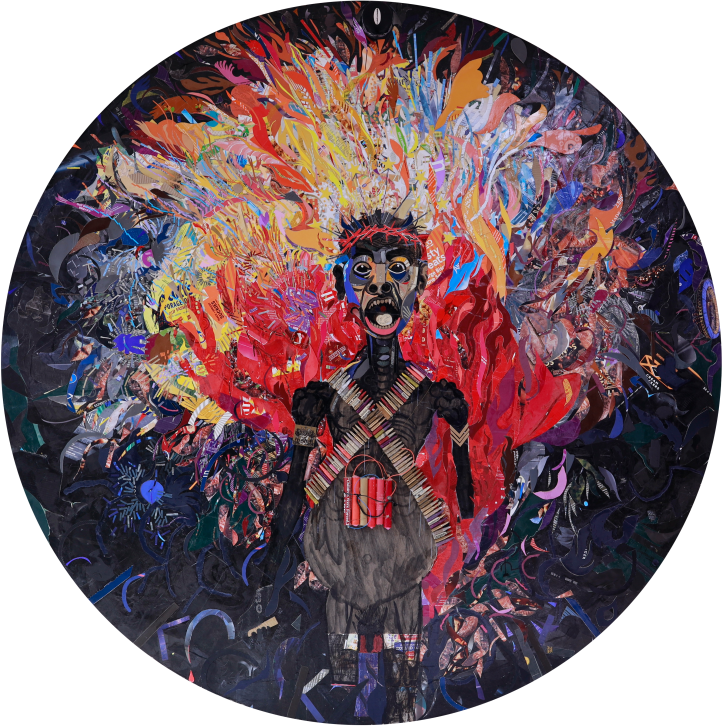
Congo is very much available. It’s a very large painting – appx 2.35 meters in the round.
+2348056227730

