Imal Silva is a spiritually attuned artist whose work uplifts the soul and stirs deep reflection. His creativity glides like silver across a polished canvas that is so fluid, luminous, and unforgettable. Just as
he is structured to be a storyteller and a storyteller, he is. Imal Silva’s paintings tel usl who we truly are. His art speaks. This time, one of his paintings, “The Festival Goes On,” makes us remember one of the most important music and cultural festivals in a West African University Campus known as the Havana Music Festival. Writes Ireho Aito.
Anywhere you go, Imal Silva’s passion for what he does is exemplified in his paintings. Painting is a lifestyle for him and he lives it. He is certainly different from a typical Nigerian artist. Imal reads philosophy, and he engages in theology. He comes around to discuss physics and gravitational pull. He wants your opinion on Nollywood and Netflix partnership, he needs your review on art and the gains of financial technology in the creative economy. Imal is a frequent guest at diplomatic events. He is such in demand. Don’t be surprised if he meets you and asks for your thoughts on Professor Bruce Onobrakpeya’s hydrochloric acid accident. Imal Silva can be called a visual art maestro.
Imal wants to know the music you listen to. He is ready to share his playlist from the current Billboard Charts and he confesses how every touch of everything brings the best out of him. Just as he has Fela’s globally accepted Afrobeat songs such as Grammy honoured ‘Zombie’ or ‘Beast of No Nation‘ on his playlist, so also, you will find British singer Ed Sheeran’s ‘Shape of You’ or Burna Boy’s ‘Glory’ featuring the iconic South African group, Ladysmith Black Mambazo on the list.
Imal Silva is a spiritually attuned artist whose work uplifts the soul and stirs deep reflection. His creativity glides like silver across a polished canvas that is so fluid, luminous, and unforgettable.
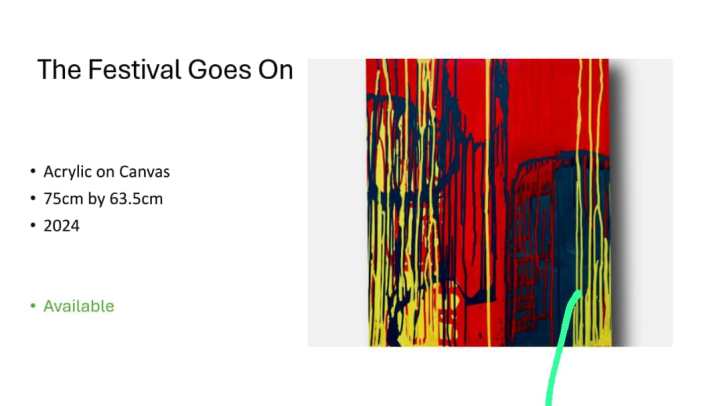
Oh my goodness! Imal Silva paints around the festival and why we won’t stop celebrating. We all know that festival is life. This we have experienced from different version in various places all around the world. The Festival Goes On by Imal Silva is an Acrylic on Canvas, measuring 75cm by 63.5cm and was done in 2024. If you are dead curious, the work is a reflection of the way we live.
The Festival Goes On by Imal Silva is an Acrylic on Canvas, measuring 75cm by 63.5cm and was done in 2024.
In Europe and America, the summertime is here and festivals are opening up everywhere. Roll call of performing artistes are on the rise because of demands presently. And back home, we have experienced one of the most glamourous festivals in Nigeria known as ‘Ojude Oba’ festival 2025 and it was a beauty to behold. Despite the economic loose canon globally, festivals are bringing life to people. Even the just concluded, inaugural FIFA Club World Cup 2025 in the United States brought excitement to a lot of football fans all over the world as they supported their clubs to win. A team in blue eventually won leading to another round of festival in the city of London and other major cities in the world where they have their passionate and loyal fans. It was a fiesta for Chelsea and their fans.
‘The Festival Goes On’ actually captured our essence and very powerfully. It re-enacts what we overlook but it is a true reflection. We once experienced during COVID – 19, how the world stopped for more than 100 days. Life came back and we all agreed life must go on. Imal Silva paints in strong metaphors and he wants the viewer of his work to see and reflect from their point of view. Being the child of a teacher and himself being one, he walks around you, seeking your opinion and telling you how he felt while on the work.
‘The Festival Goes On,’ metaphorically could interpret resilience and continuity despite loss, hardship, or change, life continues. For the deep thinkers, the work may reflects joy in motion where the painting captures rhythm, movement, and colour in a way that feels like music or dancing, so the “festival” is visualised through abstract forms. Likewise, it may symbolises hope and upliftment. Even in abstraction, there’s light, energy, and a pulse, so the festival becomes a symbol of hope that refuses to fade.
Even in abstraction, there’s light, energy, and a pulse, so the festival becomes a symbol of hope that refuses to fade.
Imal Silva is a man of mixed cultures. He was born in Sri Lanka and came to Nigeria at the age of 10 with his mother. A mother that he cherished so much for given him a better life with moral guide to succeed and be humble.
Imal went to International School, Ibadan and studied at the prestigious University of Ibadan in Ibadan.
Definitely, living in the south – western part of Nigeria, Imal witnessed festivals from one part to another with sound memory. Such memory brings back that echo and reflection. Also, being a student in University of Ibadan, the school hosts one of the most prestigious University campus music festivals in West Africa.
Who would not like Havana Carnival?
It is a festival of music, fashion and academic. One could reflect on one of the past celebrations like the 1995 edition, that demonstrated that campus community energy still lives on in memory or in spirit. At Havana ’95, there was light, energy and the needed pulse making the festival a symbol of hope that refuses to fade.
Just as Imal Silva’s painting might capture rhythm, movement, and colour in a way that feels like music or dancing, so also, Havana ’95 brought hope that tomorrow will come better for the Nigerian students.
When Nigeria Stood Still
“Enough is enough” those were the strong phrase heard from General Sani Abacha, sometime in November 1993, when he removed Chief Ernest Shonekan and his Interim National Government which also marked the end of June 12, 1993 election results fiasco that could have declared Chief MKO Abiola, the winner of that election. Abacha cancelled what many Nigerians saw as one of the most credible elections in the country’s history.
What followed was tension across the land.
The Civil society groups, students, and lecturers all rose in protest. The streets filled with resistance, and the country slowly came to a standstill. Universities shut down, university teachers went on strike, and for six long months, learning stopped completely.
Even the music, often a voice in hard times, fell silent. Nigeria, full of energy and sound, went quiet for a while.
In 1994, the African Cup of Nations known as AFCON and the FIFA World Cup, two football festivals held in Tunisia and the United States respectively, brought that yearning succour to a crestfallen nation.
Instead of protests and shutdowns, all eyes were on the football team known as the Super Eagles. Nigerians everywhere were proudly cheering for their team, united in hope and celebration as the boys in green conquered in Tunisia and made their World Cup debut.
By 1995, after six months of nationwide disruption in Nigeria’s social and political systems, university students finally returned to school. The academic year—put on hold due to a strike by the Academic Staff Union of Universities (ASUU) demanding action from the Sani Abacha government was able to continue. Everywhere was a bit quiet. University of Ibadan, the premier university wore a sombre look due to lack of campus verve that once characterised a university community.
The Festival Goes On
Then Sigma Club, the official organisers of Havana Musical Festival, then, at that time, was dubbed West African most important campus music festival. And right from inception. the role call has been tremendous. A -list artistes all over Africa have used Havana Music festival to add up to their musical manual. Roll call such as Fela Kuti, Victor Uwaifo and Ebenezer Obey, and many more, have turned out at Havana at different times in their career lives and 1995 was no different. The organisers felt the need to calm down the nerves of students whose morale have been dealt a big blow due to the incessant strike by Academic Staff Union of Nigerian Universities, popularly known as ASUU demanding for justice on June ’12.
The stage was set to organise Havana festival in 1995. Two music giants and the most entertain music behemoth were invited for the showpiece. As soon as the organisers announced Junior and Pretty, alongside Wasiu Ayinde Marshall as the musicians for the festival, the school came back to life and the students went in total frenzy because of the artistes coming and moreover, time to breathe again.
One Night, One Festival
What a night to remember! The famous pop duo Junior and Pretty, known for their hit songs such as Monica and Bolanle, were given the legendary Trenchard Hall as their performance venue, while Wasiu Ayinde Marshall thrilled fans at the nearby Trenchard Garden.
That unforgettable night, Junior and Pretty kicked things off early and lit up the campus. Hit after hit from their collection filled the air, energizing a crowd made up not just of students, but passionate fans who had long been craving great music.
The duo, with their rock star swagger and flowing dreadlocks, did not disappoint their excited fans. In fact, anyone named Monica or Bolanle would have felt proud that night as the pop stars gave their names a moment of fame and made the crowd go wild.
Wasiu Ayinde Marshall, the Fuji megastar, began his performance around 1 a.m. Just as the moon cast a soft, glowing light over the Trenchard Garden, adding a magical touch to the night.
Who could resist moving their body to Fuji rhythms?
He rolled out a string of fan favourites, from his popular Talazo Specials to unforgettable classics, lifting the party to a whole new level. Dressed in a crisp white tee, blue denim jeans, and matching sneakers, King Wasiu, also known as the Fuji Messiah, kept the energy alive non-stop until 5 a.m.
His performance was nothing short of a masterclass. It was a night filled with pure Fuji magic. Even international students at the University of Ibadan, unfamiliar with the electric energy of a legend like Wasiu Ayinde, couldn’t help but get swept up in the African rhythm, thanks to the powerful double act of Junior and Pretty and King Wasiu himself.
Wasiu Ayinde’s spellbinding performance lit up every corner of the campus. That night, Trenchard Garden transformed into a dance floor, vibrating with what could only be described as Wasiumania.
Imal Silva’s artwork, The Festival Goes On, echoes the enduring spirit of one of Nigeria’s most iconic student-led cultural events, the Havana Musical Carnival, founded by the Sigma Club of the University of Ibadan in 1955.
As the oldest student organisation in Sub-Saharan Africa, Sigma Club turned Havana into a celebration of music, culture, and unity. Over the years, it welcomed musical legends making the campus a beacon of African creativity.
Though Havana has not been held in recent times, the Sigma Club reaffirmed during its 75th-anniversary celebration in 2025 that the festival remains close to its heart with plans underway to revive its magic. They all agreed that even in the hearts of people, the festival goes on.
Silva’s piece captures this very essence that festivals may pause, but their spirit never fades.
To see more of Imal Silva’s abstract work collections, do call +2348056227730 or drop a message below. Thanks
Words/Ireho Aito/Photographs of Imal Silva/ Imal Silva archives/Artwork/ Imal Silva

