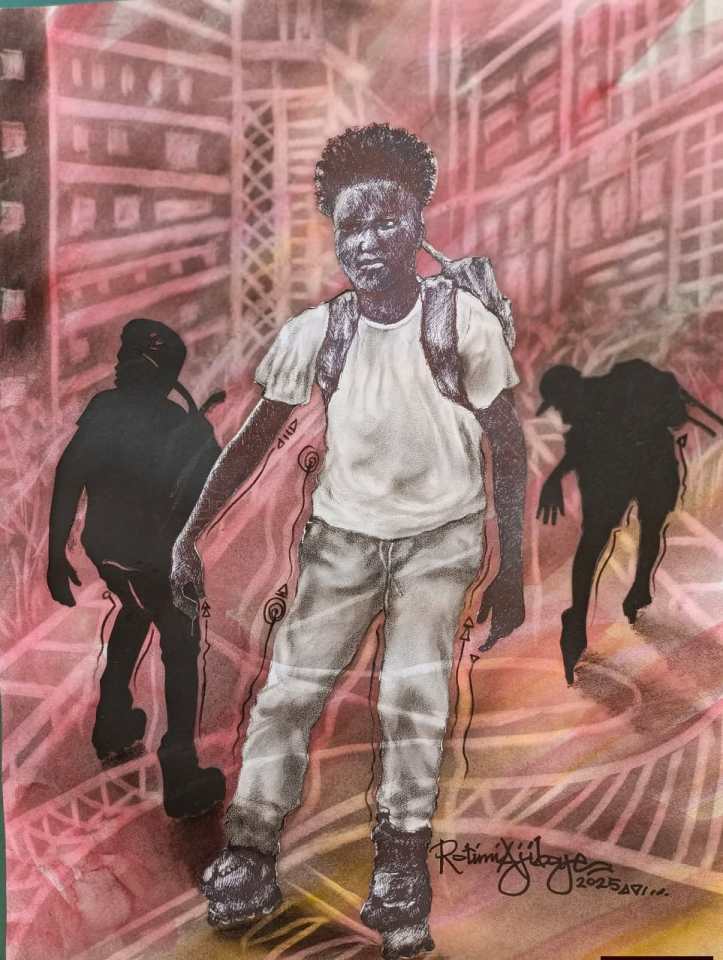
In this issue of Don’t Keep Your Art in the Finger!, we encounter Oluwarotimi Ajiboye’s evocative watercolour and charcoal pencil work, Highway Suicidal Stunts, a piece that immediately transports us back to an era when satire and social commentary shaped public consciousness. It recalls the influential legacy of his father, the now octogenarian Josy Ajiboye, whose iconic cartoons once redefined societal awareness and civic responsibility through wit and visual intelligence. In this magnetic act of advocacy art, Oluwarotimi Ajiboye emerges unmistakably as a chip off the old block, using his practice to educate, caution and engage the young at heart with the same urgency and relevance that defined his father’s work.
Words Ireho Aito | Don’t Keep Your Art in the Finger! Photographs and Artworks courtesy Oluwarotimi Ajiboye


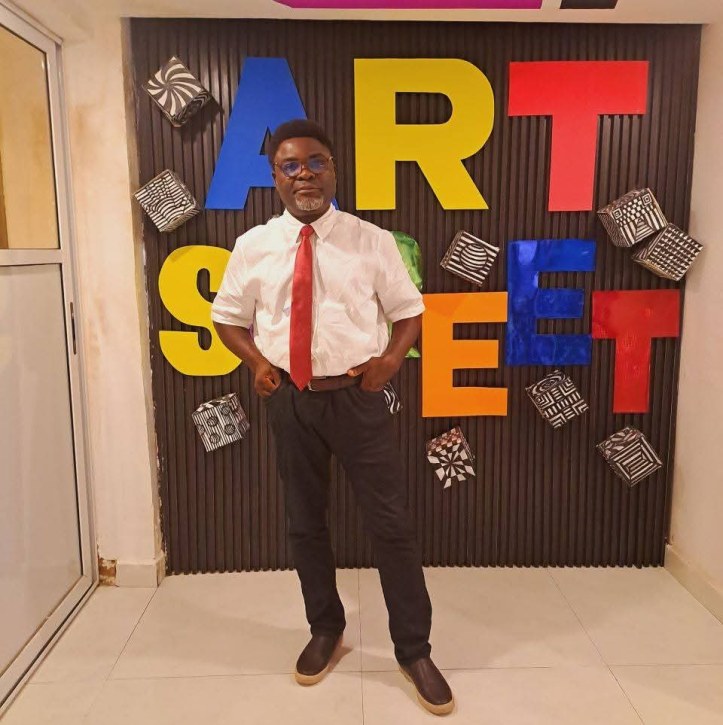
Art, when it truly matters, does not sit quietly in the fingers. So many times, it travels outward into the streets, into public consciousness, into urgent conversations. This truth finds powerful expression in the work of Oluwarotimi Ajiboye, one of the remarkable children of Nigeria’s legendary cartoonist, Josy Ajiboye, a name that shaped the visual and intellectual imagination of a generation.
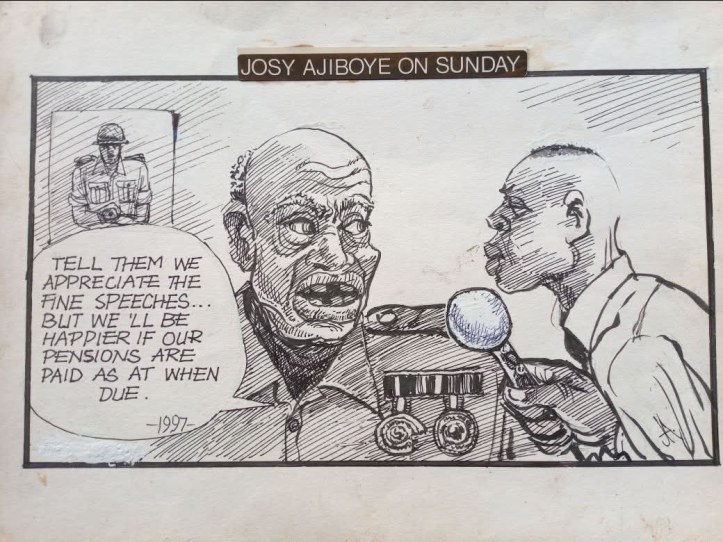
Josy Ajiboye gave Nigerians a memorable childhood in ink and wit. Through his satirical, socially conscious cartoons in major national dailies of the 1970s and 1980s, he carved a unique space where humour met hard truth. His iconic Sunday feature, “Josy Ajiboye on Sunday,” remains an enduring reference point in African cartooning and visual journalism. It remains an archive of social memory that still resonates far beyond Nigeria. It was more than cartoons; it was literature in line, protest in laughter, and journalism in images.
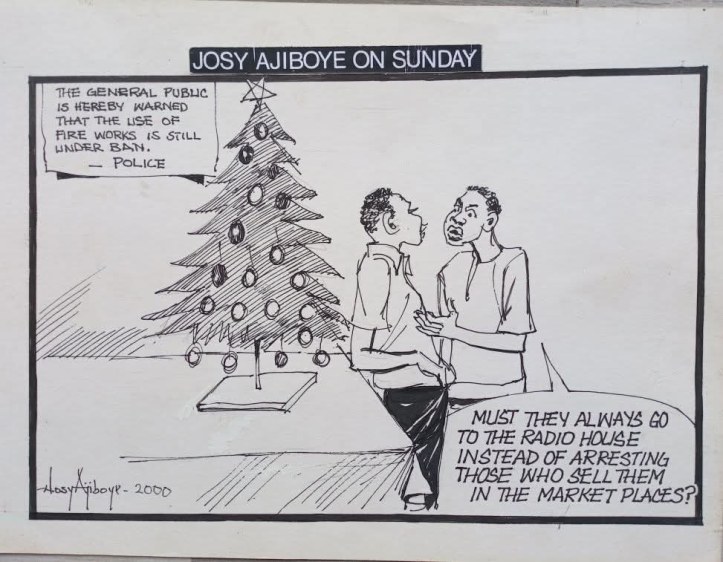
Such an artistic and journalistic movement is impossible to forget. It is one of the reasons the Ajiboye family was honoured in 2008 by Mufu Onifade Studios and the ARA Art Movement at the prestigious National Theatre, Iganmu, Lagos. That moment was historic and not just a celebration of a patriarch, but of a rare artistic lineage. One family where creativity is not inherited as a name alone, but practiced as discipline, vision, and purpose.
Today, the next generation of the Ajiboyes is refining this inheritance, tuning the stories with contemporary urgency while remaining rooted in social commentary. Oluwarotimi Ajiboye in particular, has offered a vivid conversation through advocacy art, art that speaks, warns, and insists on responsibility.
His mixed media work, Highway Suicidal Stunts (Watercolour and charcoal pencil, 37cm x 49cm), is a striking social intervention. At first glance, it captures the dynamism and daring of roller skating, a fast-rising phenomenon among teenagers and youths. The thrill, freedom, and rebellion associated with the sport are undeniable. But beneath the motion lies a stark caution, that is, when thrill migrates to highways, fun can quickly turn fatal.
The artwork confronts a growing urban reality. In megacities like Lagos and other busy Nigerian cities, where reckless driving and poor traffic discipline are daily threats, skating on highways becomes a dangerous gamble with life. Some of these young ones have been embolden by holding on to the trunks or body of vehicles to glide dangerously on the highway without minding the risk.
The piece does not moralise but advocates. It urges youths to recognise the difference between daring and danger, between expression and exposure.
Just as the elder Ajiboye used cartoons to challenge social behaviour and provoke reflection, his son deploys visual art as public safety discourse. The message is clear; creativity must engage society, not endanger it.
“Highway Suicidal Stunts” is a call to action. It enjoins young people to embrace designated skate parks and safe recreational spaces rather than fall prey to hit-and-run drivers or preventable tragedies. It reminds us that art, at its best, protects life while expressing freedom.
In this work, the Ajiboye legacy proves itself alive again, through evolving, responsive, and always socially grounded. It affirms a timeless truth for us all.
His Facebook page is not merely a repository of personal muses or recent works; it is also a living archive of memory. There, Oluwarotimi Ajiboye continually celebrates his father by sharing a rich catalogue of Josy Ajiboye’s cartoons and images that remain iconic, resonant, and firmly lodged in our collective consciousness. Through this thoughtful curation, Oluwarotimi revives moments in time, reintroducing a new generation to the visual wit and social clarity that once shaped national discourse. By adding and preserving many of his father’s collections, he does more than reminisce, he sustains a legacy and invites us to journey back to an era when cartoons were powerful instruments of social reflection.
iBAND Magazine, Celebrating Visual Arts from the Original.
Africa | Visual Art | Lifestyle | Culture

