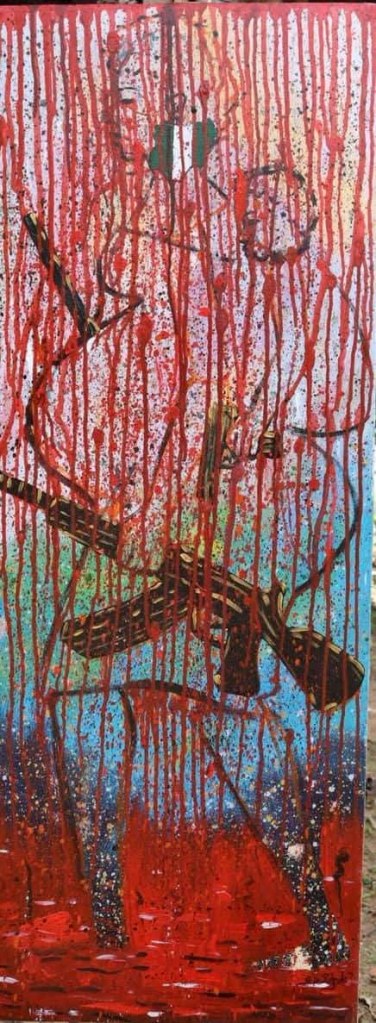
Motherhood Under Fire is a Nefe Ogodo’s painting that unfolds as a haunting allegory where life, violence, and nationhood are bound together in a single female form. At first glance, the canvas is overwhelmed by cascading red lines, blood-like drips that refuse containment. But within this torrent emerges a more unsettling narrative of a pregnant woman, heavy with child, clutching a gun, while the map of Nigeria hangs from her ears like earrings. This is not merely a figure but a country embodied.
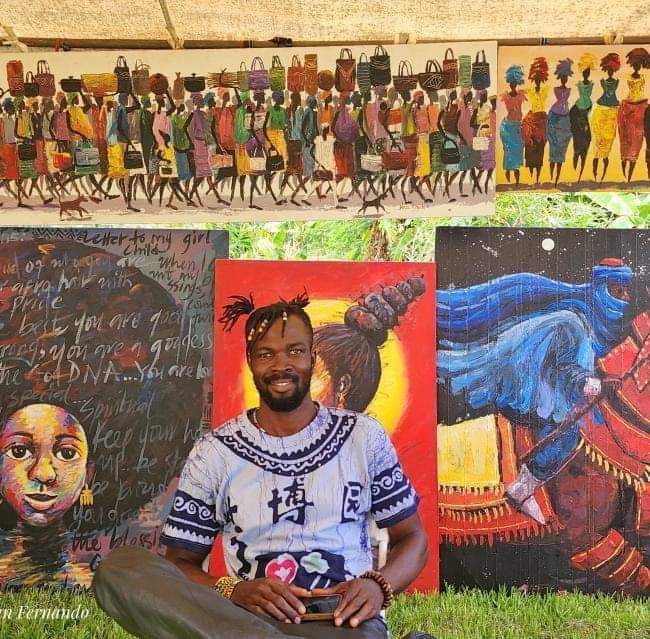
Words Ireho Aito | Don’t Keep Your Art in the Finger! Photograph and artwork credit: Nefe Ogodo
Pregnancy, traditionally a symbol of hope, continuity, and the future, is here burdened with dread. The woman carries a baby, yet she also carries a weapon. Ogodo stages a painful contradiction of a nation that should be nurturing life is simultaneously armed, violent, and complicit in destruction. The unborn child becomes a metaphor for future generations that will be conceived and developing in an atmosphere soaked with bloodshed and fear.
The gun in the woman’s hand is not accidental. It suggests normalisation of violence, the way arms have slipped into everyday existence. Violence is no longer an external threat; it is held, owned, and even protected. By placing the weapon in the hands of a mother figure, Ogodo intensifies the moral tension when survival demands violence, what kind of future is being prepared for the child she carries?
Equally potent is the use of Nigeria’s map as earrings. Earrings are ornaments, decorative, symbolic of identity and pride. Here, the nation is worn casually, almost fashionably, yet it weighs heavily. The implication is sharp which Nigeria is not just a backdrop to suffering, it is intimately attached to the body, to daily life, to personal identity. The violence bleeding through the canvas is not abstract or distant; it is worn, felt, and lived.
The relentless red drips that dominate the surface operate on multiple levels. They read as blood, as rain, as tears, and as an unending tally of loss. They obscure details, much like violence obscures clarity, morality, and accountability. The absence of a clear ground or horizon suggests instability of a society with no firm footing, where life and death blur into one continuous stain.
Ogodo’s decision to avoid realism sharpens the impact. The woman is not a portrait of a specific individual but an archetypal ‘Mother Nigeria.’ Her posture, burdened yet resolute, reflects a country enduring crisis after crisis, carrying its future forward even as it bleeds. There is no heroism romanticised here, only survival under impossible conditions.
For iBAND Magazine readers, this work exemplifies Ogodo’s strength as a social commentator who relies on metaphor rather than slogans. Unlike overt political imagery, this painting unsettles quietly, forcing the viewer to sit with contradiction. It asks difficult questions without offering comfort like what happens when violence becomes inherited? When a nation adorns itself with identity while dripping with blood? When the womb of the future is surrounded by guns?
Ultimately, this artwork is a lament and a warning. It suggests that the greatest tragedy is not only the bloodshed of the present, but the world being prepared for those yet unborn. In presenting a pregnant, armed woman marked unmistakably by Nigeria, Nefe Ogodo captures a painful truth and that is a nation can give life and take life at the same time while history will judge which it chooses to protect.
In this canvas, motherhood is no longer only about birth. It becomes a metaphor for responsibility. And Ogodo leaves us with an unsettling silence, asking whether the child being carried will inherit hope or learn to hold the gun.
Such art has put even Nefe Ogodo’s life on the line. Such creativity exposes him to clashing with the establishment and sometimes, Nefe finds himself on the run. Nefe Ogodo’s art many times has put him on the frontline. But for him, justice must be done by art means.
iBAND Magazine, Celebrating Visual Arts from the Original.
Africa | Visual Art | Lifestyle | Culture

