
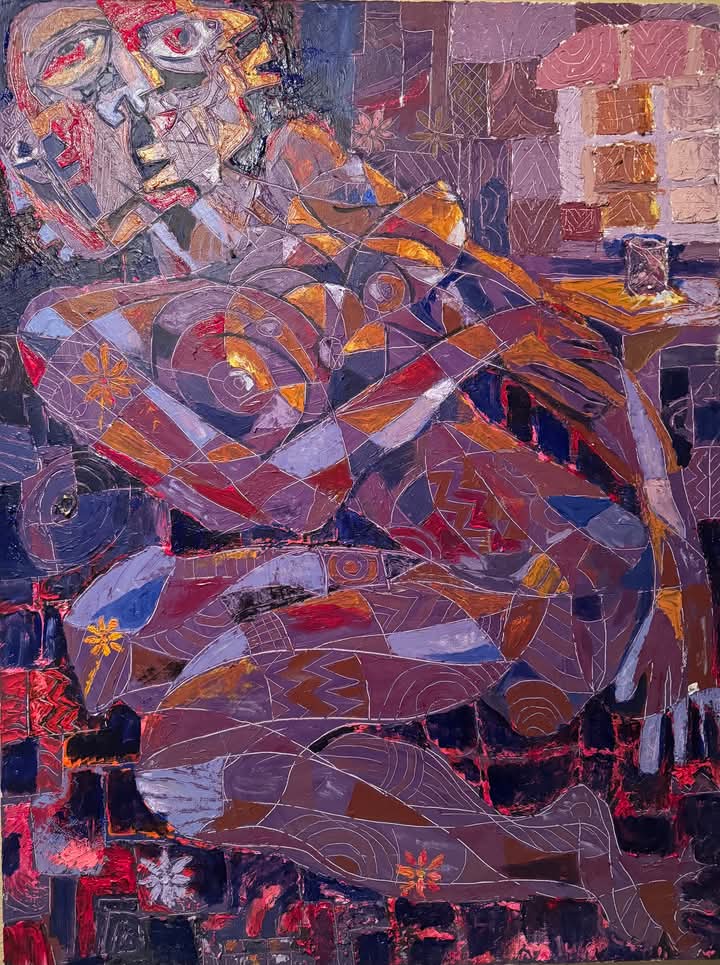
Acrylic on canvas
30” × 40”
2026. Artwork credit: Prof. Moyo Okediji
There are storytellers who entertain, and there are storytellers who stay with you. Professor Moyo Okediji belongs firmly in the latter tradition. Reading him often feels like listening to an elder who understands that memory is not linear, that truth sometimes arrives clothed in humour, irony, and quiet pain.
iBAND Magazine | Don’t Keep Your Art in the Finger! Pictures courtesy of Prof. Moyo Okediji archives. Artwork credit: Prof. Moyo Okediji
Professor Okediji is widely known as a distinguished professor of Art History, but beyond the academy, he has carved out a rare space as a chronicler of lived experience. Regaling his readers about his relocation to the United States and the emotional, cultural, and economic dislocations that followed, to his vivid recollections of student life at Obafemi Awolowo University where paths crossed with Fela Anikulapo Kuti and revelations about Fela’s kinship with Professor Wole Soyinka, his stories blur the line between the personal and the historical.
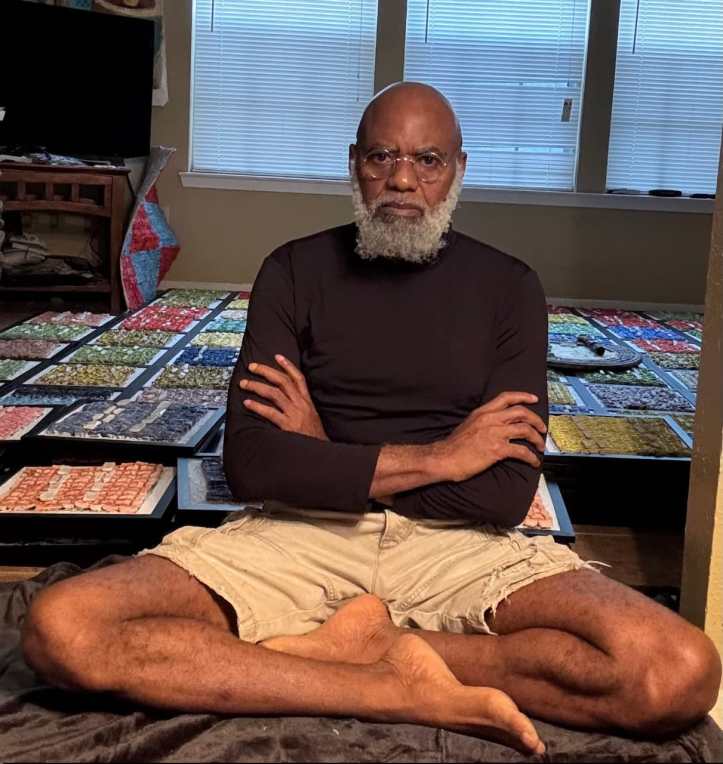
On Facebook, where many now encounter his voice first, Professor Okediji has built an informal but powerful archive of reflections on art and faith, on friendship and loss, on desire and discipline. His writing there is unpretentious yet profound, devotional yet questioning, always human.
In Drinking Again, the narrative we present as our feature on Don’t Keep Your Art in the Finger!, Professor Okediji turns inward with uncommon honesty. What begins as a recollection of love and loneliness in a wintry American city unfolds into a haunting meditation on addiction, creativity, friendship, and the fragile boundaries we draw to protect ourselves from what we love most. It is a story about art’s power to heal and to harm, about how past lives resurface uninvited and about how memory refuses to stay buried.
Drinking again is a memory, reflected in art, and the beautiful danger of what we love presents Professor Moyo Okediji as a master storyteller in the old Yoruba sense of the word. One who does not merely narrate events but unveils meaning. Like the late Professor Akinwunmi Isola, whose novels mapped an odyssey for Yoruba literature, Okediji’s stories dwell at the intersection of memory, morality, humour, and pain. He is a professor of Art History, yes, but he is also a griot of modern displacement, desire, and survival, using personal reflection to illuminate the fragile beauty and danger embedded in the things we love.
The accompanying painting, The Lady Drinks Again (Acrylic on canvas, 30” × 40”, 2026), feels like a visual echo of the prose which is a retrospective gesture rendered not in words, but in colour, form, and silence. Together, text and image offer us not closure, but understanding.
This is not merely a personal essay. It is a testimony. And in sharing it, Professor Moyo Okediji once again reminds us why storytelling that is honest, unguarded, and humane still matters to listen.
Drinking Again by Prof. Moyo Okediji
What we love the most is also what hurts us the most.
In many ways, our love—ironically—is also our taboo.
I will use the tale of my former girlfriend as an illustration.
When I arrived in Denver, Colorado, about twenty years ago, to take up a joint appointment as curator at the Denver Art Museum and professor of African art history, I was lonely and desolate.
I was also broke.
Still, I could afford a two-bedroom apartment in a large complex with central laundry and a swimming pool.
I wanted romantic company, but it proved difficult. My taste, as always, was higher than my value. I didn’t bring to the table what I sought from the dining—an oddly protective negotiating strategy that has often kept me out of trouble.
So I went on the dating platforms to gamble for love.
One person caught my attention. I contacted her and, to my delighted surprise, she responded. We arranged to meet for a drink—or something like it.
On a dark, wintry evening, as I looked for something to wear, I realized to my chagrin that all my jeans had paint spills on them from my artistic adventures.
My best shoes, too, had smudges of paint. I contemplated running to the mall for new gear, but time was not on my side—and I didn’t want to be late.
So I put on my jeans, a black turtleneck, and a cool leather jacket. The shoes were good leather; the problem was that they were ruined by paint.
You might ask: how did I end up ruining my best shoes?
Simple. I get dressed to go somewhere, step out, catch a glimpse of a painting I’m working on, and a sudden idea comes to me. I stop immediately to tend to the painting—and in the process ruin my good clothes.
It happens all the time.
In any case, I was not late. I arrived too early, found a parking spot, and waited until it was three minutes to the hour before walking into the restaurant.
I scanned the dining room for a recognizable face, based on the picture from the dating site. None was familiar. I told the host I wanted a table for two, and he led me to a cool table at the far end of the restaurant.
He seemed to know exactly what I wanted. He winked, poured me a cup of water, and asked if I wanted anything before my friend arrived. I said water was fine. I would wait.
I waited for almost thirty minutes before she arrived. As I was the only Black person in the room, she scanned quickly and then joined me.
She apologized for being late. I will call her Scarlet.
Scarlet looked gorgeous—much better than she did in her dating pictures. Up close, I noticed lines I didn’t expect on a woman of her age. But she also had freckles, and I could tell she refused the usual masks people wear to the world. She wore no makeup—not even lipstick—only lip gloss to relieve the winter dryness.
I was excited.
I wanted to order a bottle of expensive wine for both of us. She declined. Water only. She told me she had given up drinking years ago.
To buttress my confidence, I ordered a glass of wine.
It was a great date. We shared similar backgrounds—she had gone to one of the best art schools in the United States. But she had given up art.
That was why she quit drinking, she said. She needed a stiff one before she could paint, and before she knew it, one became a few too many.
Alcoholism came knocking. So she gave up both art and alcohol.
We started dating. Her non-alcohol habit worked for me too. I only drank socially and didn’t keep alcohol at home.
I learned a lot about her. She came from an upper middle-class American family, with the complicated dysfunctionality that sometimes accompanies people of this class—including forms of abuse that leave invisible injuries for life.
We supported each other. The sex was great. The companionship exceeded my expectations, since we came from different races, countries, and social backgrounds.
Then everything changed.
My artist friend, Mo, joined me after I invited him to prepare for a solo exhibition at the Denver Art Museum.
Any African artist would jump at such an offer. Few African artists had ever been given that kind of opportunity at a major museum in the United States.
And because he was leaving a bad marriage behind and needed a place to live, joining me in Denver—one full year before the opening—was a perfect arrangement.
Before he came, he had not produced any paintings. But I believed that if he had a year, he would create an astonishing body of work—enough to dazzle the museum’s visitors.
He proved me right. While staying with me, he went beyond the call of duty to create what he described as the pinnacle of his entire career.
But there was a complication.
Mo enjoyed fine wine. He also smoked while painting, using my sitting room as his studio.
The trouble started the day he arrived. He brought a keg of red wine with him. He was also an extraordinary chef. He made chicken kabob and isi ewu pepper soup.
The party started.
Scarlet tasted wine for the first time since quitting—nearly a decade earlier. It tore the bandage off a scar that had never fully healed.
She could not control her drinking. She began binging daily. Then she added pills to the drinks. Then powders.
Her life began to collapse. She couldn’t hold down her job.
And I lost Scarlet.
She was drowned by a tsunami of wine, smoke, and drugs.
Today, as I was finishing this writing—I swear—I received a message from her.
It said: “Thinking of you and hoping you are well.” Attached was a video about Fela Kuti titled “Fela Kuti: Fear No Man.”
My friend Mo died about five years ago.
Scarlet, too, is—metaphorically—deceased.
A couple of days ago, I made the attached painting.
The Lady Drinks Again
Acrylic on canvas
30” × 40”
2026
“Drinking Again” courtesy of Prof. Moyo Okediji
iBAND Magazine, Celebrating Visual Arts from the Original.
Africa | Visual Art | Lifestyle | Culture

