Across centuries, the artistic legacy of the Benin Kingdom has travelled far beyond its ancient palace walls. Through bronze, sculpture, oral memory, and scholarship, the kingdom continues to shape global understanding of African civilisation. Today, that story finds a contemporary voice in the work of Nigerian artist Felix Ehis Iyekekpolor, whose presence in an international exhibition once again places Benin’s cultural heritage before the world.
Words Ireho Aito | Don’t Keep Your Art in the Finger! Images courtesy Yekson Museum, akimbo.ca
Few African civilisations have left behind a visual archive as remarkable as that of Benin. Long before European collectors discovered their brilliance, Benin artists had perfected a sophisticated tradition of bronze casting and ivory carving that recorded royal ceremonies, diplomatic encounters, and the spiritual worldview of the Edo people. These works, known today across the world as the celebrated Benin Bronzes, stand as some of the finest examples of artistic mastery anywhere in human history.
Their global journey, however, carries the weight of a complicated past. Following the devastating Benin Expedition of 1897, British forces looted thousands of objects from the royal palace, scattering them into museums and private collections across Europe and North America. While those bronzes continue to fascinate scholars and audiences alike, they also remain symbols of a cultural heritage violently displaced.
Yet the spirit of Benin art has never been confined to those historic works alone. It lives on through scholarship, storytelling, and the creative expressions of contemporary artists who continue to interpret the kingdom’s heritage in new and powerful ways.
Much of what the world knows today about Benin’s complex history owes a great deal to writers and historians who devoted their lives to preserving it. Among the most respected chroniclers is Jacob Egharevba, whose meticulous writings documented the traditions, royal lineages, and social structures of the Edo people. His works remain essential reading for historians and cultural researchers seeking to understand the intellectual depth of the kingdom.
In more recent decades, artist and scholar Professor Peju Layiwola has continued this intellectual tradition, expanding conversations about Benin heritage through research, exhibitions, and advocacy around the restitution of looted artefacts. Through voices like these, the history of Benin has been preserved not only in bronze but also in words.
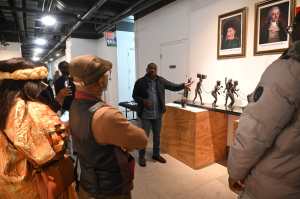
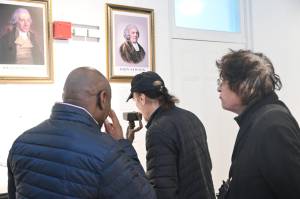
Into this rich cultural lineage steps, we have Felix Ehis Iyekekpolor, whose artistic vision engages deeply with identity, symbolism, and the layered meanings embedded in African cultural traditions. His work forms part of the international exhibition Shadows of the Past; Art and Legacy of Slavery, presented by the Yekson Museum and Gallery of African Art during Black History Month in the city of Toronto.
The exhibition Shadows of the Past; Art and Legacy of Slavery was held from February 12 to February 27, 2026. And the formal opening ceremony took place on Saturday, February 14, 2026, at 2:00 pm at Youngplace in Toronto.
This exhibition brings together historic Benin artefacts, reflections on the trans-Atlantic slave trade, and contemporary artworks that explore memory, identity, and resilience. Within this powerful conversation between history and the present stands Iyekekpolor’s evocative work, “Behind The Mask.”
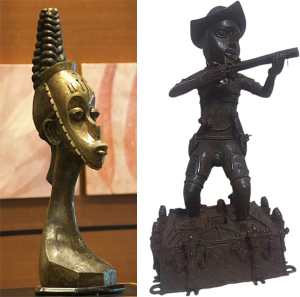
The sculpture depicts a figure with an elongated neck and a face concealed by a mask. The image immediately resonates with the spiritual and cultural significance of masks in many African societies. In traditional performances and rituals, the individual wearing a mask is not merely disguised but transformed. The wearer becomes a vessel through which spiritual presence or ancestral authority is believed to manifest. Respected curator and grandmaster himself, Mr. Moses Ohiomokhare describes Felix as a son that he is well pleased.”
Felix is representing Nigeria very well in the global space and his body of work needs to be studied,” he said.
Iyekekpolor’s interpretation invites the viewer to pause and look beyond appearances. The mask becomes a metaphor for the hidden layers of identity and truth that lie beneath visible surfaces. In many African traditions, the person behind the mask must be pure and spiritually prepared before participating in sacred performance. The mask itself may appear intimidating or mysterious, yet the being behind it represents something sacred and disciplined.
Through this symbolism, the artist offers a quiet but profound meditation on identity, investing on what societies reveal, bringing to fore what they conceal, and what remains sacred beneath history’s many disguises.
The exhibition also features a bronze representation of a Portuguese soldier, a reminder of the early encounters between Benin rulers and European traders during the Age of Exploration. These interactions were carefully documented by Benin court artists centuries ago. The bronzes did not merely decorate palace walls they are living memory that served as visual chronicles of diplomacy, trade, and shifting global relationships.
Art in Benin was never simply ornamental. It was historical memory cast in metal.
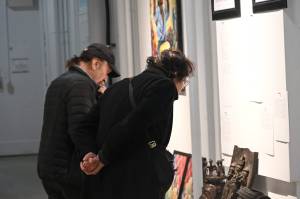
Other contemporary works in the exhibition deepen the reflection on African history and the trans-Atlantic slave trade, including pieces by Efe Iyamu and Aibi Woghihen that explore themes of captivity, endurance, and spiritual resilience. Together, the works remind viewers that even in the face of forced displacement and historical trauma, the cultural soul of a people cannot be erased.
Within this broader narrative, Felix Ehis Iyekekpolor’s work stands as both homage and continuation. His art reflects an understanding that the story of Benin is not locked in the past. It is a living narrative, shaped by artists who carry forward its symbols, philosophies, and aesthetic power.
From the royal courts of ancient Benin to contemporary galleries in North America, the kingdom’s artistic language continues to travel across borders and generations. Scholars, historians, and artists alike return to its imagery again and again, discovering new meanings within its forms.
In the quiet strength of Iyekekpolor’s masked figure lies a reminder that the story of Benin is far from finished. Beneath the shadows of history stands a cultural legacy that remains luminous, resilient, and profoundly alive.
iBAND Magazine, Celebrating Visual Arts from the Original.
Africa | Visual Art | Lifestyle | Culture

