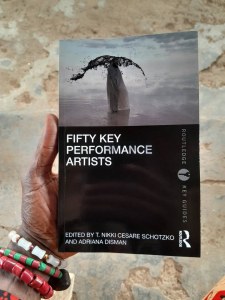
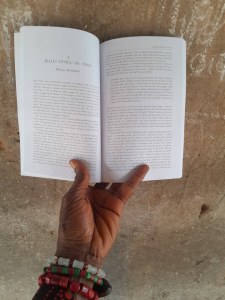
In a moment of global recognition, the Nigerian-born performance artist has been included in Fifty Key Performance Artists, in upcoming publication by Routledge, set for release on March 31, 2026. This publication is edited by T. Nikki Cesare Schotzko and Adriana Disman, the book brings together some of the most influential voices shaping performance art globally.
Words Ireho Aito | Don’t Keep Your Art in the Finger! Photographs courtesy Jelili Atiku.
Performance artist Jelili Atiku is one masquerade that reminds us of our reality. The kind that does not entertain for pleasure alone, but unsettles, confronts, and reveals. The truth he embodies in his performances positions him as a global social crusader that is unyielding, unapologetic, and deeply committed to humanity.
He is a different kind of masquerade, the one that sweeps us off our feet and, in the same breath, blows us apart.
Through consistent performance art, he confronts us with protest. He has become a voice for the voiceless, even as he continues to pay dearly for that position by standing firmly against hatred, poverty, corruption, and inhumanity. His works are raw and real. Too truthful to ignore. Too intellectual not to engage. Too revealing to pretend not to see.
Across continents and cultures, Jelili Atiku has carved a bold identity as one of Africa’s most fearless performance artists, transforming streets, galleries, and public spaces into stages of resistance and reflection.
From the ritual intensity of Aragamago Will Rid This Land of Terrorism to the ancestral symbolism of Eegun Alare, and the biting satire of Coronation of a Mock King, his works blur the line between art and activism.
Whether confronting political violence in Victim of Political Assassination, questioning patriotism in Arise O Compatriots, or exploring environmental urgency in Earth Rising, Atiku’s performances resonate as both protest and poetry deeply rooted in Yoruba cosmology yet globally relevant.
For audiences from Lagos to Berlin, his art is not just seen; it is experienced, felt, and remembered.
Now, the world is paying even closer attention as Jelili Atiku has been included in Fifty Key Performance Artists, edited by T. Nikki Cesare Schotzko and Adriana Disman, and published by Routledge in London. This recognition places him among the most important performance artists shaping global discourse today.
This is not just a win for Jelili. It is a win for Nigerian art. For African voices and for truth.
Before Jelili Atiku, many of us from Edo heritage were already familiar with the power of masquerade through Igbabolelimin—ancestral spirits returning in embodied form, carrying history, ritual, and meaning.
My father, Godfrey Iyere Aito, led such a group and I remember vividly when they performed during the state visit of President Shehu Shagari to Oyo State, under the administration of Governor Bola Ige inside the main bowl of Liberty Stadium, Ibadan. I watched my father, wrapped in traditional cloth, joyfully playing the gong, coordinating dancers, and leading masquerades like our famous Shakara and DC10 in a grand cultural procession.
They were invited under the auspices of Esan Progressive Union, Oyo State Chapter, and the entire performance was broadcast on the Nigerian Television Authority.
We sat glued to the television watching the live telecast.
My classmates and teachers would later recount every detail from the dance steps to the costumes, giggling about my mother’s graceful movements and the troupe’s commanding rhythm. It was pride, pure and unforgettable.
Years later, on January 31, 1993, at Odo Ona, Ibadan, I witnessed another kind of spectacle. This time, it was the passage of my father into the ancestral realm. The Igbabolelimin returned, but now, for performing rites of transition. It was no longer celebration, but a sacred farewell, guiding the dead, negotiating with spirits, and marking the thin line between worlds.
That memory never left me. And perhaps that is why Jelili Atiku resonates so deeply.
My romance with Jelili Atiku began in 2009 during my time working with artists at the Center for Contemporary Art Lagos. Jelili was a different breed with sheer intensity, and driven by a hunger not just to create, but to transform.
That encounter led to one of the most defining moments in contemporary Nigerian performance art: Araferaku – A Part of Me Is Missing (2013), staged in Ejigbo. I had the privilege of filming and writing about that work.
It was not just a performance but was an excavation of identity.
At about twelve years old, Jelili overheard a conversation that would alter his life forever. The man he called father was not actually his biological parent. A friend of the family visited Jelili’s grandfather and Jelili, innocently walked through the lounge at Ejigbo and the family friend asked in Yoruba “omo Badiu ko niyen?” meaning “is that not Badiu’s son?”
Jelili was somehow stunned to hear such a conversation. Rather than retreat into silence, he began a lifelong search that would later manifest as art.
Years on, he staged a burial for the father he never met, a soldier who died before his birth.
Araferaku, part of the Bio-Feedback series commissioned under The Progress of Love, unfolded as a deeply immersive ritual. The first phase, Letter to Bami, was a 44-hour meditative endurance leaving Jelili in solitude, surrounded by fading images, invoking absence as presence. Only his mother briefly entered that space.
The second phase became communal. It was a full burial rite and Ejigbo stood still.
Family, neighbours, and onlookers both those who knew the story and those who did not, were together as Jelili dissolved the lines between art and life, It was breathtaking.
From Fela Kuti to Jelili Atiku, there exists a lineage of artists who refuse silence, those who insist that art must serve the people.
Jelili identifies fully as a performance artist, but his work extends beyond categorisation. It is ritual. It is protest. It is cosmopolitan yet rooted. His body becomes a site of resistance, his movement a language of urgency. Yet, this path has not been without consequence.
Despite international recognition, including support from the Prince Claus Fund, Jelili at a time, faced resistance from his own community in Ejigbo. His performances, often misunderstood have attracted backlash, pressure, and even harassment.
But he continues and unafraid
Today, as Jelili Atiku takes his place among the world’s Fifty Key Performance Artists, we are reminded that true art is not comfortable.
And sometimes, like a masquerade from beyond, it forces us to see ourselves.
Jelili Atiku is a Nigerian artist who refused to look away and in doing so, ensured that the world could not look away either.
iBAND Magazine, Celebrating Visual Arts from the Original.
Africa | Visual Art | Lifestyle | Culture

