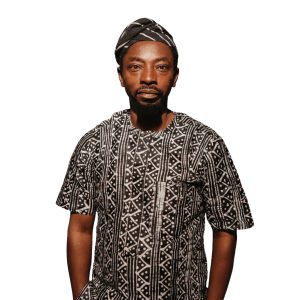
Lanre Tejuoso’s practice is built on something simple but powerful, the wealth of belief. Not as theory, but as a way of working and surviving in art.
Words Ireho Aito | Don’t Keep Your Art in the Finger! Photographs: Lanre Tejuoso Archives/Olanrewajutejuoso.com.ng
This interview did not happen in a studio or across a table. It happened in fragments through voice notes sent across time and distance. Just recorded thoughts exchanged in bits, listened to again and again until the essence became clear. But one curious obsession came over me which is the wealth of belief.
In that same period of listening, another story was quietly playing in the background, although in visuals, a short documentary on one of modern football’s most improbable comebacks.
The stage was the UEFA Champions League semi-final 2019 Liverpool vs Barcelona at Anfield, where Liverpool F.C. overturned expectation against a dominant Barcelona side. I was enjoying the playback as it brought ecstatic memories.
At the centre of that moment stood Jürgen Klopp, speaking not of tactics alone but of something more fragile and more powerful which is the act of belief. Before kick-off, himself and the backroom staff had asked his players to close their eyes for ten seconds and return, in their minds, to their highest moment of performance. It may be a school game or a street match. A forgotten brilliance at a private peak. He asked them to be ready to play the game of their lives. By the third goal, the commentator mentioned in high pitch “and Anfield erupts!”
And somewhere between Klopp’s voice, the wealth to belief documentary and Tejuoso’s recorded reflections, a bridge quietly formed.
Because what was being heard in those voice notes was not just an artist answering questions, it was a practice shaped by endurance. A way of working that insists on imagination even in uncertainty, on clarity even in misunderstanding, on making even when space, scale, and recognition are not guaranteed. But only to have that wealth of belief.
It became difficult to separate the two narratives; the football pitch where belief rewrites probability, and the studio where material, memory, and meaning are constantly renegotiated.
And then the thought arrived with unexpected force.
If a team can rebuild destiny in ninety minutes through belief alone, what sustains an artist building worlds from discarded matter, from abandoned spaces, from resistance itself?
In that question sits Lanre Tejuoso.
Not as spectacle neither as a biography. But as process that is quiet, persistent, and rooted in a rhythm far removed from the urgency of Lagos, yet fully aware of its pull.
And in listening, really listening to those voice notes, something became clear. Before form takes shape, before scale gives it presence, before recognition arrives to name it, there is belief.
That idea of belief does not sit in abstraction for long. It begins to reveal itself in the way a life is arranged, in the choices that are made away from noise and expectation. In Tejuoso’s case, it becomes visible in the geography of his practice.
In an era where many artists gravitate toward the velocity of Lagos, chasing visibility in its galleries and fairs, Lanre Tejuoso decided to choose a different rhythm that hums quietly from the ancient city of Abeokuta. Here, among weathered walls, inherited stories, the famed rocks and the echo of craft traditions, his work unfolds not as spectacle alone, but as a lived conversation between memory, material, and meaning. Lanre Tejuoso must be a certain kind of personality, rare to find but ready to thrive with his kind of special audacity.
How did we encounter him in that great town full of monumental stories of Lisabi Agbongbo – akala and Sodeke. A city where Chief Akin Ogungbe, one of the finest storytellers to emerge from the African continent made a home and produced monstrous classics of Yoruba plays, drama, television drama series and films in revered indigenous Yoruba language from the 60s to the 90s. Akin Ogungbe was one of the proud auteur who laid the foundation of what we enjoy as Nollywood today.
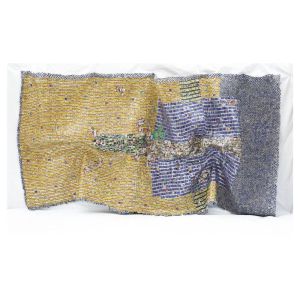
He was born Olanrewaju Ayinla Tejuoso in 1974, his journey into art was never accidental. It was shaped early by environment, a bit of lineage, and by a quiet but persistent curiosity about the life of materials. Today, his multidisciplinary practice spans painting, mixed media, performance, and large-scale installation, yet it is unified by a singular concern of what happens after use. Where others see waste, Tejuoso sees continuity.
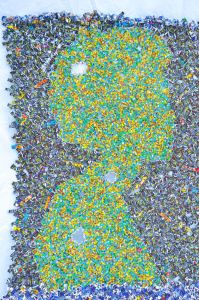
Our first encounter was also in Abeokuta at the retirement celebration and installation of Professor Funke Chris Ifeta at the Alake of Egbaland palace on the 26th of February 2026. It was a landmark event that brought together leading figures from Nigeria’s art community, traditional institutions, academia, and cultural leadership to celebrate Professor Ifeta’s decades of impact in sculpture and art education.
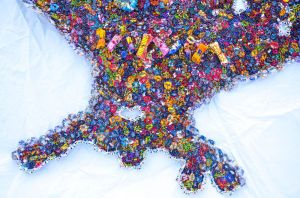
My meeting with Lanre Tejuoso was also facilitated by the sculptor Adeola Balogun, who led a group of dignitaries including Lanre into the palace. It was a brief encounter, but one marked by immediate curiosity, the kind that lingers even after the moment has passed.
That curiosity deepened when one begins to consider his practice more closely.
To encounter Lanre’s work is to step into a narrative shaped as much by reinvention. His surname carries historical weight, but he resists being defined by it. Identity, for him, is not something preserved intact, it is something continuously assembled. On his web, it is stated that he is an environmental evangelist and the tagline has “Discarded materials carry stories we refuse to see.”
That philosophy becomes palpable in moments like his presence at Prof. Funke Chris Ifeta honours inside the Ake palace, a place where history breathes through architecture and ceremony.
The environment does not simply inspire someone but lives in one. I was curious to ask him why the ancient town and not somewhere in Lagos? Lanre was calm in his response, “I got the energy here,” he says. “My creative muses are geared towards my root. Abeokuta is the place for me.”
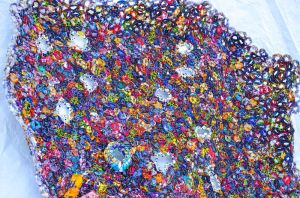
His decision to remain in Abeokuta rather than relocate to Lagos reads less like resistance and more like clarity. Space, both physical and psychological has been central to his evolution.
“What I am doing in Abeokuta, when I started I didn’t see the possibility to get it done anywhere in Lagos,” he reflects.
“I couldn’t have found a big space in Lagos. A flat wouldn’t have been enough.”
That need for space led to an unconventional beginning, acquiring an abandoned building, reclaimed and reimagined. From that raw intervention emerged the Aroko Green Museum, a living, and breathing extension of his philosophy which turned out to be part studio, part museum space, part environmental statement. It is here that Tejuoso’s practice moves beyond object-making and into something more expansive of a dialogue between art and ecology.
Encouraged in part by the late international curator Bisi Silva, who championed the idea that artists could define their own spaces, Tejuoso leaned fully into this independence.
“Her words really spurred me on,” he recalls.
The result was not immediate commercial success, but something deeper with critical attention, curiosity, and a growing recognition of his audacity.
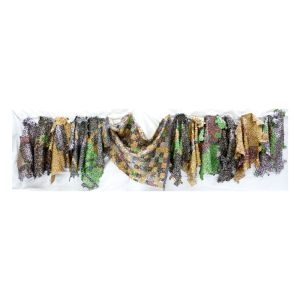
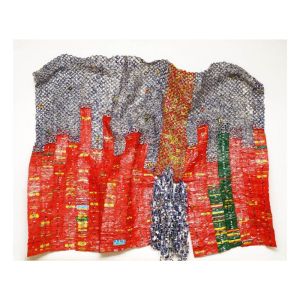
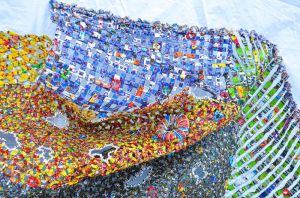
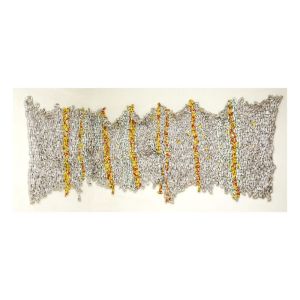
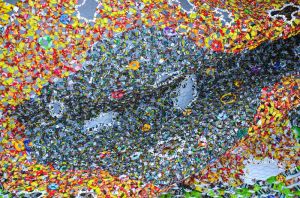
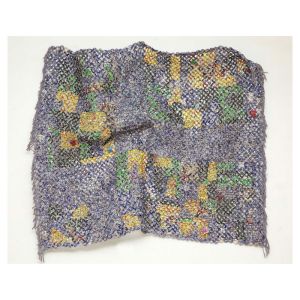
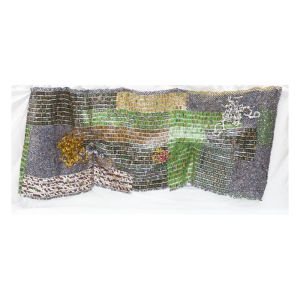
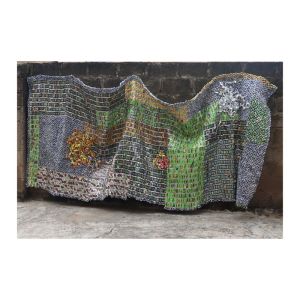
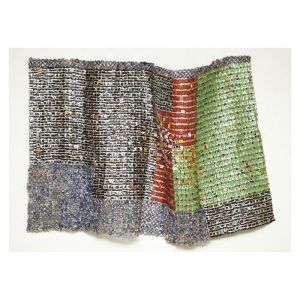
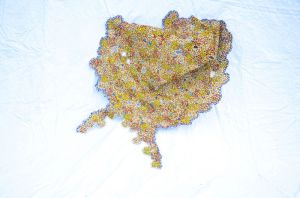
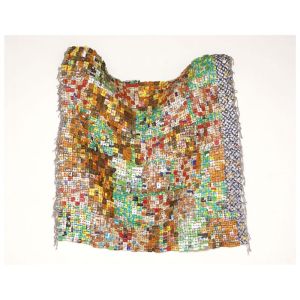
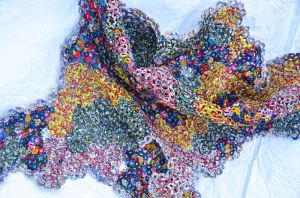
His material language is unmistakable. Water sachets, polythene bags, biscuit wrappers, objects of fleeting utility are gathered from domestic and public waste sites, then subjected to a process that is both meticulous and meditative. They are cleaned, sorted, arranged by colour and texture, then woven, stitched, tied, or wrapped into forms that expand into space.
These works do not sit quietly. They hang, cascade, and sprawl in occupying architecture, confronting viewers, and echoing the very accumulation they critique. They are, in many ways, visual metaphors for excess.
“At first, people see the aesthetics,” he says. “The colours, the arrangement, the scale. But what they are really seeing is time and material.”
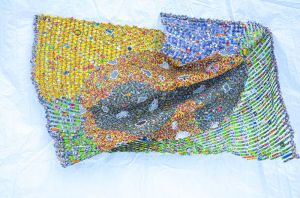
His philosophy is what he describes as “From Waste to Life” that again, is rooted not only in environmental awareness but in a deeper contemplation of transformation. Inspired by the biblical passage 1 Corinthians 1:28, which reflects his interest in redemption, transformation, and overlooked value. In particular, the idea that value often lies in what is overlooked, his work becomes an act of redemption as much as creation.
“Telling stories with my art is an understatement,” he reflects.
“I grew up in an artistic environment.”
That environment began in Ijaye, where craft traditions were embedded in daily life. His grandmother, known as Iya Alaso, was immersed in the textile heritage of Adire, and her influence lingers in his sensitivity to pattern and repetition. His father, a journalist, and his mother, a teacher, ensured that storytelling was not just inherited but practised.
“I was famously known as Omo Iya Alaso,” he says.
“The child of a cloth maker.”
Memory arrives for Lanre Tejuoso not as nostalgia, but as origin. He recalls a moment from childhood, quiet, almost incidental, yet formative.
“I remember growing up and one day I saw this particular print for batik,” he says. “It was an uncle of mine who explained the importance of the print in fashion, known as Adire Eleko.”
What began as curiosity became awareness, pattern as language, fabric as narrative, design as cultural code. In that early encounter with Adire Eleko, the seeds of his visual thinking were already taking root.
“They use it for design,” he adds, simply, yet the understatement carries weight, hinting at a deeper understanding that would unfold over time.
That instinct was later refined through formal education. From the College of Education to the University of Nigeria, Nsukka, where he studied Fine Art Education, Tejuoso sharpened both skill and perspective, guided by mentors who recognised and nurtured his evolving voice.
“I sharpened my talent in schools and meeting the right mentors and teachers,” he reflects.
It is a trajectory that moves seamlessly between the informal and the institutional. Also, between inherited knowledge and structured learning, each layer reinforcing the other, each encounter shaping the artist he would become.
His journey into contemporary art was not without friction. When he moved from painting into installation, acceptance was slow.
“I was called all sorts of names like being a copycat,” he says.
“But I never let it bother me. I focused on making good art.”
His early years in environmental art were marked by a tension that many emerging artists know too well and that is the struggle to be seen on one’s own terms.
“Sincerely, when I started as an environmental artist, maybe because of the materials I was using, people, initially thought I was a copycat,” Lanre Tejuoso recalls.
“They felt I was copying my master. They didn’t see me coming up.”
The misunderstanding, he explains, was rooted less in intent than in perception. Working with unconventional materials placed him in visual proximity to established figures, even when his language was still forming.
“When your master may be using metallic materials and I used soft plastic, we can still have the same characteristics, the same graphics,” he says.
“So no matter how I used it, it would end up looking copied.”
It was a challenge that followed him beyond Nigeria, surfacing even during his time in Europe and which is a reminder that artistic identity, especially within experimental practice, is often negotiated under scrutiny.
But perception was only one layer. Scale presented its own complications. Tejuoso’s instinct has always leaned toward the monumental, yet the art ecosystem was not always prepared to accommodate such ambition.
“Another challenge was the scale of my work,” he explains. “They were big, and people couldn’t get spaces for them.”
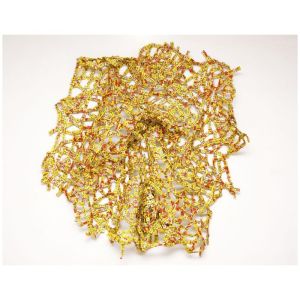
Over time, that gap began to close, as galleries and collectors grew more receptive, and as he himself adapted by introducing smaller works without abandoning the expansive vision that defines his practice.
Production, too, came with its demands. Large-scale installations require not just imagination, but infrastructure, space, labour, and coordination.
“Space to produce the work was very challenging,” he says.
“These are large-scale projects. They need support, I can’t do them alone.”
And then there is the quieter, often unspoken challenge which is the ultimate currency known as value. Not just the pricing of work, but the recognition of its worth.
“Knowing your value and getting clients to appreciate it can be challenging as well,” he adds.
Despite these constraints, or misunderstanding, then limitation, and negotiation, his voice has only become clearer. What was once questioned is now recognised as distinct, a reminder that artistic identity is rarely granted; it is forged, often slowly, in the space between doubt and persistence.
Recognition for him came gradually.
The trajectory, as he tells it, gathered momentum through a series of defining exhibitions and recognitions that gradually shifted how his work was perceived within and beyond Nigeria.
One of the early milestones came with the National Art Competition, Art 21, held in Lagos and sponsored by Nigerian Breweries at Eko Hotels. For him, it was more than participation but an exposure at scale.
“I participated and it was a good one as people saw the kind of scale people never had experience before,” he reflects.
That moment, he says, changed the way audiences engaged with his practice.
“It gave me a kind of respect. People started writing about what I do.”
From there, the practice moved into a wider circuit of residencies, festivals, and solo presentations across different contexts. Each engagement layered new experiences onto an already evolving language of material and scale. Rather than settling into a fixed rhythm, the work continued to respond to opportunity and environment, carrying with it the momentum of those early recognitions while remaining open-ended in its unfolding.
Participation in national exhibitions opened doors, but it was the international stage that amplified his voice.
At the Dak’Art Biennale, he not only exhibited but received the Prix Révélation Silver Prize, a moment that expanded his reach and affirmed his direction.
“Dak’Art gave me more push,” he notes.
Residencies and exhibitions followed across continents with art trips to Senegal, Cuba, Indonesia, Cameroon, Italy, Russia, and the United States, each encounter layering his perspective.
In Philadelphia, he initiated the Osuka project, a body of work that deepened his exploration of material and meaning.
Every sculptor is often defined by a moment or phase that alters the course of their practice. When asked to reflect on his own, Lanre Tejuoso resists the temptation to name a single breakthrough.
“I am still searching for my turning point,” he says with a kind of laugh, an answer that feels less like deflection and more like philosophy, even as his trajectory quietly suggests otherwise.
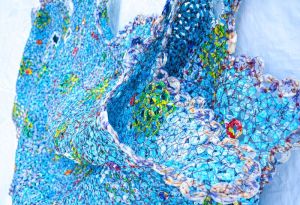
When he returned from the United States, the direction of his practice began to shift in ways even he describes as instinctive rather than planned.
“When I came back from the US, I started working with chewing sticks known as Pako Ijebu,” he recalls. What might appear ordinary at first glance quickly became material for a more profound visual language. In his hands, the chewing stick was no longer just cultural residue. The project became structure, rhythm, and metaphor.
By the time the works were shown at Dak’art, the response was immediate and striking.
“It was what I showed in Dak’art and the response was phenomenal,” he says.
“Purists started making comments that this guy truly has his own identity with the kind of statements he is making.”
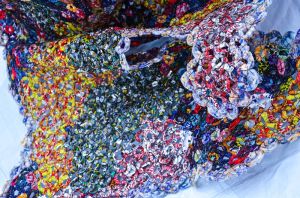
That recognition affirmed something fundamental about the trajectory of his work: it was not attempting to imitate existing visual vocabularies, but to build its own. Still, experimentation remained central.
“I have tried so many other experimentation,” he notes, describing a practice that resists fixation.
His relationship with production is equally unorthodox.
“I don’t really do commissions,” he says.
Instead, his energy moves toward immersion, residencies, international programmes, festivals, and solo presentations abroad.
“Go to festivals and do my solos.”
His works have since entered institutional collections, including the Museum of Black Civilisations and the Yemisi Shyllon Museum of Art, where they exist not just as objects, but as enduring statements on material life and cultural memory.
“Up till today, my work is one of the few retained there,” he says of Dakar, a quiet testament to its resonance.
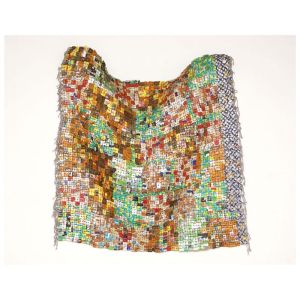
For Lanre Tejuoso, practice extends beyond the studio into a quiet ethic of giving. This is an act that mirrors the same philosophy of transformation that defines his work.
“I donate works to support charitable causes in my own little way,” he says, almost in passing, as though the gesture requires no spotlight.
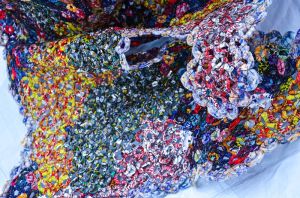
This reveals a dimension of his practice often overshadowed by scale and spectacle. Such is the commitment to impact beyond the market.
That spirit of generosity is not abstract. It is tangible, embedded in collections and institutions. Inside the Yemisi Shyllon Museum of Art, one of his works stands not as a transaction, but as a contribution, an offering to public memory and access.
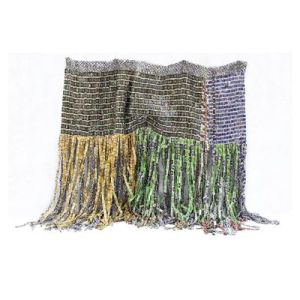
His relationship with institutions, however, is not always defined by intention alone. Sometimes, the work chooses its own permanence.
At the Dak’Art Biennale in 2018, where he emerged as a Silver Prize winner, an unexpected decision altered the afterlife of one of his pieces.
“According to my understanding, they only retained the first prize,” he recalls. “But in my case, the second was retained.”
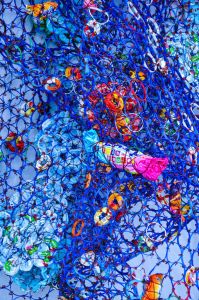
What began as a point of contention eventually settled into acceptance, especially when the work found a permanent home at the Museum of Black Civilisations.
“Up till today, my work is one of the two retained there since 2018,” he notes a quiet distinction that underscores both its resonance and endurance. Lanre’s global image looms all along.
For the uninitiated, there is a certain poetry in that outcome. A practice rooted in reclaiming the discarded now finds itself preserved within global institutions, its materials once overlooked reframed as cultural artefacts.
From Dakar to Indonesia, and across spaces in the United States, his works continue to travel, often remaining behind as part of institutional collections. Not always commissioned, not always planned but always carrying forward his central idea: that value can be found, and shared, in the most unexpected places.
Scale remains central to his practice, often challenging traditional modes of display.
“A collector once told me my works are meant for museums,” he recalls.
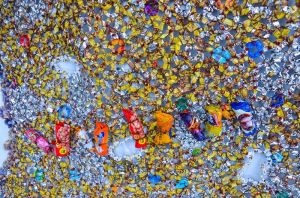
Yet rather than retreat, he expanded, creating both monumental installations and more intimate works, each serving a different kind of engagement.
His relationship with commissioned work is equally deliberate.
“I don’t do much of commissioned work,” he says. “I like inventing my ideas from my studio. If you connect with the story, then we can work.”
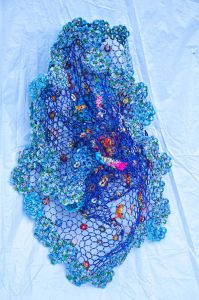
That connection is often deeply personal. One such moment led to Awo Ewa, a piece born from conflict and introspection.
“I smashed a plate of beans out of anger,” he recounts. “Later, I created a work from it.”
The piece resonated with a collector who saw her own story within it, transforming the exchange into something more intimate than transaction. The collector picked the work.
“My story convinces you first,” he says. “Then it becomes yours.”
Challenges have been constant such as space, perception, valuation but each has sharpened his voice rather than diluted it. Large-scale production demands collaboration, patience, and resources.
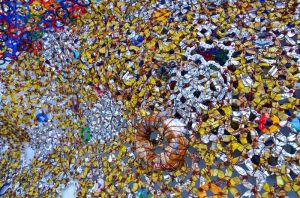
Even in these constraints, Tejuoso finds possibility.
“These works are energetic,” he says. “I cannot do them alone.”
What remains constant is his environment. Abeokuta, with its layered histories and cultural depth, continues to shape his imagination.
“As a Yoruba man living here, this town has added a lot to my journey,” he reflects. “My titles come from Yoruba proverbs and idioms from everyday life.”
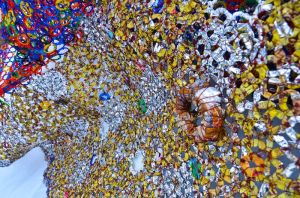
Despite his global presence, there is no sense of departure from home but only extension. His works travel, but they carry with them the textures, stories, and sensibilities of where they began.
“Someone once told me I am an entertainer,” he says, smiling. “That my works entertain people.”
It is a description that captures only the surface. Beneath the visual allure lies a deeper proposition: that what we discard still holds meaning, that what we overlook still carries value, and that transformation whether of material or of self is always possible.
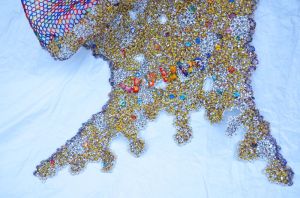
In the stillness of Abeokuta, Lanre Tejuoso continues to shape that idea into form, building a body of work that is at once rooted and far-reaching as a quiet, persistent reminder that art does not simply reflect the world as it is, but reimagines what it can become.
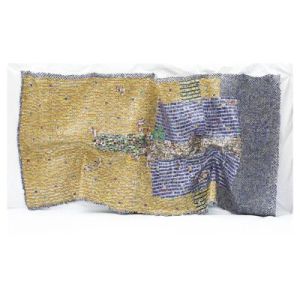
Across materials, cities, and moments of recognition, one thread quietly holds everything together in Lanre Tejuoso’s practice: belief. Not as idea alone, but as method, as movement, as a way of staying with the work even when outcomes are uncertain.
From Abeokuta’s quiet density to Dakar’s global stage, from discarded matter to institutional walls, his work keeps unfolding, refusing to settle into a final shape. Each piece feels less like an arrival and more like a question carried forward.
In the end, what remains is simple to know that before form, before scale, before recognition, there is belief.
Kindly visit Olanrewajutejuoso.com.ng to see more of large scale innovations
iBAND Magazine, Celebrating Visual Arts from the Original.
Africa | Visual Art | Lifestyle | Culture

