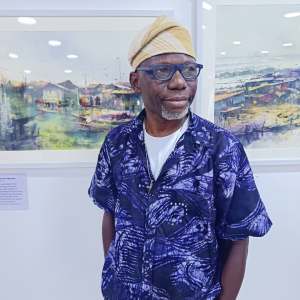
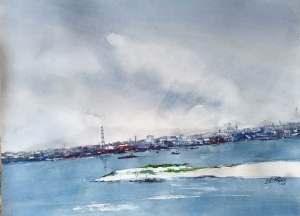
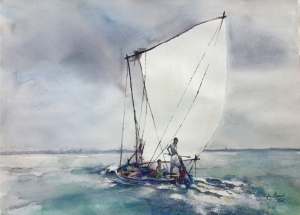
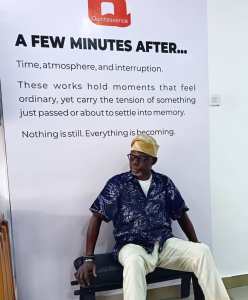
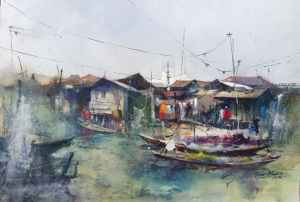
In “A Few Minutes After,” Sola Muyiwa steps firmly into the terrain of contemporary discourse, using painting as a lens to confront one of the most urgent social realities of our time, the sad realities of our time, displacement and the fragile politics of shelter. Showing at Quintessence Gallery, the exhibition reads less like a collection of artworks and more like a visual inquiry into how societies respond when the foundations of everyday life are abruptly erased.
Words Ireho Aito | Don’t Keep Your Art in the Finger! Photographs and images courtesy Sola Muyiwa
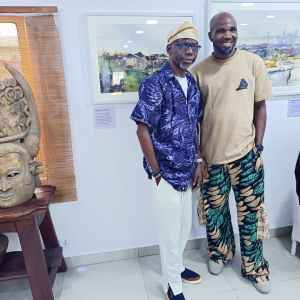
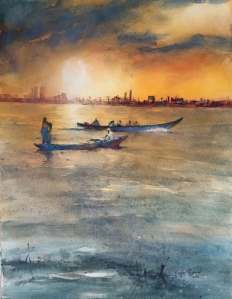
He truly lives his ambassadorial position. Ambassador Olusola Muyiwa is truly a pathfinder. At its core, this is social commentary. Muyiwa’s work interrogates systems urban planning, governance, and the uneven distribution of protection and neglect. His reference points, from Makoko to other vulnerable communities, are not incidental; they are emblematic of a wider pattern where entire ways of life can vanish within moments. Through watercolour’s fluid and unpredictable nature, he mirrors this instability, capturing not just physical demolition but the emotional and psychological aftermath that follows.
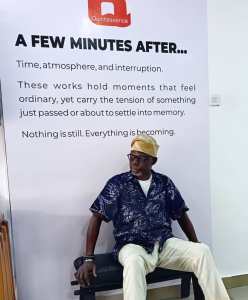
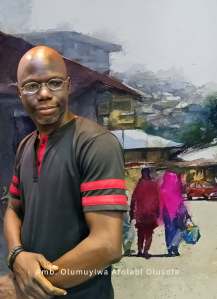
Many of us never quite see what the artist sees. The artist, after all, stands as a mirror to society, reflecting what we overlook, distort, or choose to ignore. Makoko is widely known, almost mythic in conversation, yet in lived reality it remains unseen, even avoided.
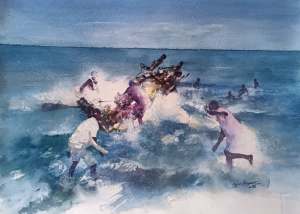
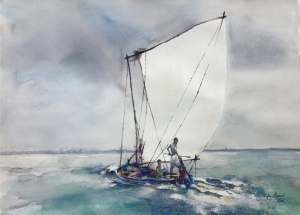
Each day, we glide across the ever-busy Third Mainland Bridge, our gaze fixed ahead but drawn toward the polished promise of the Island. There, in Ikoyi and Victoria Island, the old money and nouveaux riche shape a different narrative of water, wealth, and aspiration. These are the places we aim for, the destinations that define success, the landscapes we are eager to connect with.
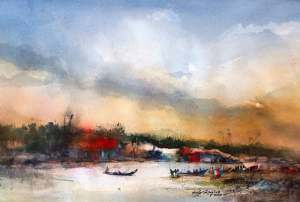
In that forward motion, Makoko slips into the margins. Its presence is swallowed by the dominance of its wealthier neighbours, its geography reduced to a blur between departure and arrival. And yet, there is an irony that lingers beneath it all: Makoko, Ikoyi, and Victoria Island are all built on water.
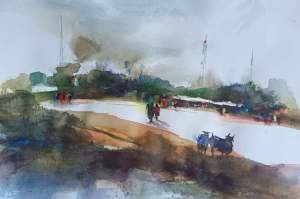
But where two shimmer with curated prosperity and controlled beauty, Makoko tells a more complex, unvarnished story that many would rather speed past than truly see.
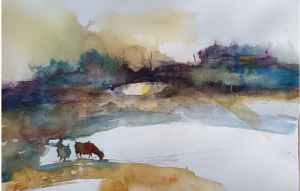
“A Few Minutes After,” at its core, is social commentary. Muyiwa’s work interrogates systems, urban planning, governance, and the uneven distribution of protection and neglect. His reference points, from Makoko to other vulnerable communities, are not incidental to feel on canvas, they are emblematic of a wider pattern where entire ways of life can vanish within moments. Through watercolour’s fluid and unpredictable nature, he mirrors this instability, capturing not just physical demolition but the emotional and psychological aftermath that follows.
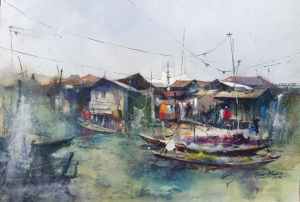
Muyiwa navigates themes of displacement, dignity, and survival, drawing from deeply personal encounters and broader communal histories from the demolition of Makoko to the erasure of spaces like Oko Baba. His paintings do not attempt to reconstruct what was lost, instead, they dwell in what lingers from the silence, the memory, to the unanswered questions.
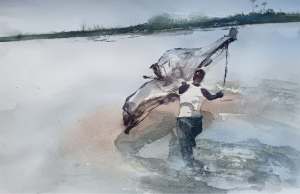
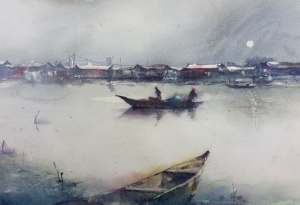
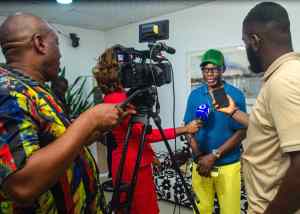
In this conversation, artist Sola Muyiwa reflects on memory, demolition, and the fragile architecture of human dignity in his ongoing exhibition, “A Few Minutes After.”
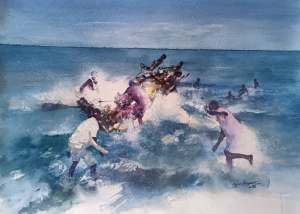
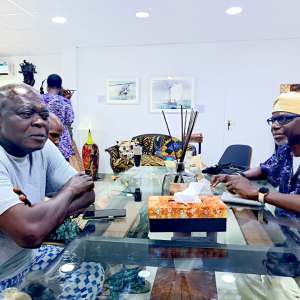
iBAND : The title “A Few Minutes After” feels immediate and unsettling. What does it refer to?
A: It comes from a personal moment. Just a few minutes after I left home, the demolition happened. By the time I returned, everything was gone. That experience shaped the entire body of work. I am not merely painting scenes; I am revealing how life exists, shifts, and survives. The works trace a journey from disruption to emergence through rhythm, reflection, rupture, and memory.
iBAND : You engage deeply with the idea of shelter. As an artist and public intellectual, what does that mean to you?
A: Shelter is not just about buildings. It is about dignity, identity, and belonging. When shelter is lost, it is not only physical displacement, it disrupts memory, stability, and continuity. These are lived realities. My work responds by bearing witness to both rupture and resilience, asking how societies value human life and what happens when systems fail people.
 iBAND : What was going through your mind when you witnessed the demolition of Makoko?
A: It was overwhelming. There was a sense of disbelief mixed with urgency. Watching people lose not just structures but their sense of place is something that stays with you. It is not an image you forget. It becomes a question you keep returning to.
iBAND : How did that experience stay with you emotionally before it became art?
A: It lingered for a long time. These are not events you process immediately. They settle within you, quietly, persistently until they demand expression. Painting became a way to translate that emotional weight into something visible and shareable.
iBAND : Can you describe a specific moment from that day that shaped your work?
A: What stayed with me most was the silence after the chaos. The absence. The sudden erasure of spaces that once held stories. That absence is as present in my paintings as the figures or structures themselves.
iBAND: Why did you choose painting, particularly watercolour, as your medium?
A: Watercolour carries a certain fragility and unpredictability. It resists control in ways that mirror life under pressure. Through its fluidity, I explore how existence adapts and transforms. It allows me to express both vulnerability and resilience at once.
iBAND: Translating such a chaotic event into visual form is complex. How did you approach it?
A: I was not trying to recreate the event literally. Instead, I focused on its emotional and psychological residue. The compositions emerge through layering, erasure, and movement mirroring how memory itself works.
iBAND : What responsibility do artists have when portraying sensitive community experiences?
A: There is a responsibility to be honest and respectful. The work must not exploit but reveal. It should create space for reflection, for empathy, and for deeper understanding of what people go through.
iBAND : Do you see your work as activism or documentation?
A: It exists somewhere in between. It is a form of witnessing. It documents, but it also questions. It invites viewers into a space where they must confront not only what they see, but what they feel and remember.
iBAND : Did creating this body of work bring you any sense of healing or closure?
A: Not closure, but clarity. The process allowed me to engage with the experience in a deeper way. It becomes less about resolving the event and more about understanding its impact.
iBAND : Your work references places like Makoko and Oko Baba. Why are these locations important within your narrative?
A: They represent more than geography. They are sites of memory, labour, survival, and systemic neglect. When places like Oko Baba or Makoko are disrupted, it raises urgent questions: where were the structures meant to protect these communities? What happens when systems fail both land and people? These are the tensions my work seeks to unearth, where responsibility, survival, and memory collide.
iBAND : What do you hope viewers take away from this exhibition?
A: I hope they leave with reflection. With an emotional weight that stays with them. The work is not meant to provide answers but to provoke thought. As I often say, stories do not fade; they stain the silence of time.
iBAND Magazine, Celebrating Visual Arts from the Original.
Africa | Visual Art | Lifestyle | Culture

