
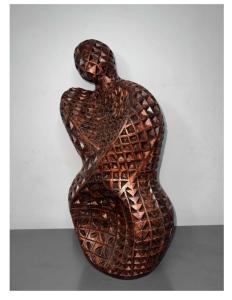
Title: untitled
In a cultural moment increasingly defined by speed, digital consumption, and fleeting trends, the inaugural Lagos Pottery Festival arrives with a slower, deeper proposition with memory shaped in clay. Organised by the Visions in Clay Àrtists Network, VICAN, the festival positions ceramics not at the margins of Nigeria’s art conversation, but at its very centre.
Curated by Chris Ekuafeh, the festival titled Clay as Memory gathers more than twenty ceramic artists and potters whose works explore ancestry, identity, material culture, and contemporary artistic expression. This festival will be hosted at the National Museum Onikan, the festival is both an artistic statement and a cultural reclamation.
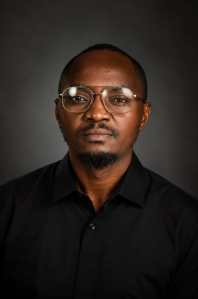
He is the curator of the 1st Lagos Pottery Festival, running 23–29 May 2026 at the National Museum, Onikan, Lagos.”
In this conversation with iBAND Magazine, Ekuafeh reflects on the inspiration behind the festival, the emotional intelligence of clay, the challenges of curating ceramics, and why a new generation of Nigerians is rediscovering the power of handmade art.
Questions and Words Ireho Aito | Don’t Keep Your Art in the Finger! Images and Photographs of exhibiting artists courtesy of Chris Ekuafeh
Q – This is the first Lagos Pottery Festival. What inspired the vision behind creating a festival entirely dedicated to pottery and ceramics in Lagos?
For a long time, ceramics in Nigeria has existed in tiny units of individual artists working in relative isolation, occasional group shows, but no singular moment that said this is a community deserving of its own platform. VICAN was founded precisely to change that. The Lagos Pottery Festival naturally is the next step of declaration that pottery and ceramics are not peripheral crafts in Nigeria’s art story. They are central to it. Lagos being the centre of excellence and one of Africa’s most dynamic creative cities deserves a festival that matched that energy, built specifically around clay.

Q. The theme is Clay as Memory. How did the theme influence your curatorial direction and the kind of works selected for the exhibition?
Clay as Memory gave me a framework that was both personal and expansive. Clay is literally a memory-keeper, it holds fingerprints, fire marks, the pressure of hands that touched it centuries ago. When I approached artists with this theme, I wasn’t looking for literal interpretations. I was looking for works that understood clay as a vessel for something beyond itself, translated through ancestral knowledge, cultural loss, personal history, communal identity. That shaped everything: which works I leaned toward, how I thought about the flow of the exhibition space, which conversations I wanted visitors to have standing in front of a piece.
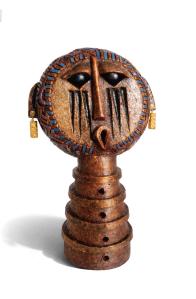
Title: In her Beauty.
Q. How many artists are participating in the festival, and what range of ceramic expressions should visitors expect to see?
We have over 20 ceramicists and potters represented. The range is genuinely exciting to find functional potteries sitting alongside conceptual sculptural works, produced using traditional hand-building techniques in conversation with more contemporary approaches. Visitors should not expect a uniform aesthetic. What ties the works together is not style, it’s intention. Each piece, in its own way, is asking something about what clay remembers and what we choose to pass forward.

Q. What was the selection process like for participating artists? Were you looking more at technical skill, storytelling, originality, or cultural connection?
Honestly, all four made the selection process easy, but the major guide if I had to name it was intentionality. I wanted artists who had something to say beyond technical skills and had chosen clay deliberately as the medium to say it. Cultural connection was important, particularly in relation to the theme, but I was equally open to artists who were interrogating or even complicating their cultural inheritance through their work.
Q Each participating artist submitted works for consideration. Was there a limit to the number of pieces artists could present for selection?
Artists were asked to submit a body of work for consideration. From those submissions, selections were made based on what served the overall curatorial vision of the exhibition. Some artists have multiple pieces in the show, others are represented by a single defining work.
Q. As a curator, what were some of the most challenging moments during the selection process? Were there works you loved but could not accommodate?
There were works I found genuinely compelling that didn’t make it in, not because they were weak but because they didn’t serve the coherence of the exhibition as a whole. Curation is ultimately an editorial act, and editing means loss. Being the first edition means the artists whose work we couldn’t accommodate this year will definitely be shown again. This festival is meant to grow.
Q. Pottery demands patience and precision. Do you think the discipline of working with clay also shapes the personality and mindset of ceramic artists?
Yes and deeply. Clay is a very honest material, it doesn’t tolerate shortcuts or ego. If you rush it, it cracks. If you force it, it collapses. There’s a patience that the practice demands, and over time, it becomes a way of seeing. Personally, I have experienced this and in most ceramic artists I respect, there is a certain groundedness, a willingness to start over without drama, an understanding that the process is as significant as the outcome. Clay teaches you to hold things lightly even as you shape them firmly. That’s not just a studio skill but it turns out to be a life skill.
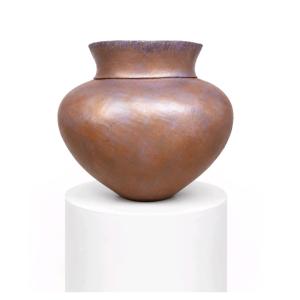
Title: Ladi’s Pot 1
Q. VICAN has built a strong reputation for organisation and consistency. What values keep the association growing and staying active within Nigeria’s art scene?
Community, first. VICAN was built on the belief that ceramic artists in Nigeria are stronger together than in isolation and that belief has been tested and proven repeatedly. Consistency is also vital to us, showing up even when the conditions are not perfect. As a community, what keeps us moving is a genuine shared love for the craft and a conviction that ceramics deserves visibility, institutional respect, and a sustained public audience in this country.

Q. Beyond the exhibition itself, what are the major targets or long-term goals for the Lagos Pottery Festival and the ceramic community in Nigeria?
The goal is to have this festival become an annual fixture, something the Lagos cultural calendar expects and plans around. Beyond the event itself, we want it to generate data: who is collecting ceramics, what stories resonate, where the gaps in public knowledge are. Long-term, we want the Lagos Pottery Festival to be a pipeline for collectors discovering ceramics for the first time, for young artists finding professional community, for institutions beginning to take ceramic art seriously as a collecting category. Nigeria has an extraordinary ceramic heritage. This festival aims to spread this message to traditional and contemporary audience.
Q. After visitors experience this festival, what lasting impression or conversation do you hope remains with them about pottery, heritage, and contemporary African art?
We want them to know that pottery is not a relic. That clay shaped by the hands of Igbo-Ukwu, Abeokuta, Abuja artists years ago were laid down for a tradition closely followed today. I want visitors to leave with a recalibrated sense of what African art means, and what it feels like to stand in front of an object that carries memory in its very material. If someone walks out and looks at a clay pot differently whether in a museum or a market, then it’s safe to say that the exhibition did its work.
Q. Many young Nigerians are becoming interested in handmade art and craft again. Are you seeing a new generation beginning to reconnect with clay?
Oh yes, and this is very exciting to see. There is a genuine movement happening with young Nigerians drawn to handmade things, to materiality, in a world that has become almost entirely digital and disposable. Clay offers them something screens cannot: texture, weight, imperfection, presence. I see it in the ceramic studios that are opening, in the workshops that fill up, in the DMs VICAN receives from people who want to learn. This generation isn’t discovering pottery, they’re returning to it. That distinction matters.
Q. Why did you choose the National Museum for the first edition?
Because it’s a place of memory. The National Museum, Onikan carries the weight of Nigeria’s cultural inheritance. It is a space that already holds history, so bringing the first Lagos Pottery Festival into that space was a deliberate statement: ceramics belongs here. Not as a visitor, not as a novelty, but as part of a continuous conversation this country is having with its own artistic and material culture. The venue earns the theme.
iBAND Magazine, Celebrating Visual Arts from the Original.
Africa | Visual Art | Lifestyle | Culture

