

Djakou Kassi Nathalie has moulded a career defined by resilience, reinvention, and clay. In this iBAND Magazine Cover feature, the celebrated ceramic sculptor reflects on surviving artistic prejudice, rebuilding her practice in Nigeria from almost nothing, documenting African realities through sculpture, and why ceramics remains one of the continent’s most misunderstood yet enduring artistic languages.
Words Ireho Aito | Don’t Keep Your Art in the Finger! Photographs courtesy Djakou Kassi Nathalie, Djakou Kassi Nathalie Cover photo credit: odaartgallery.com

Djakou Kassi Nathalie was spotted granting an interview to a television channel during a commemorative exhibition at the National Museum Lagos, where theatre historian and renowned collector Professor Ebun Clark unveiled yet another treasure from her remarkable private holdings a chest of art collections by Auchi pastel master Jefferson Jonahan. The exhibition presented over ninety works by a single artist, an extraordinary feat that underscored both the depth of Jonahan’s practice and Clark’s lifelong commitment to preserving Nigerian art history.
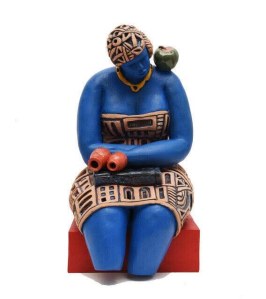
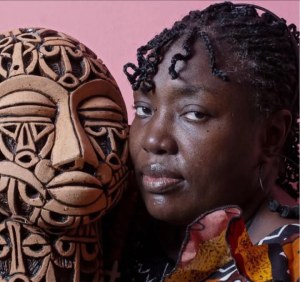
Amid the atmosphere of celebration, conversation, and artistic reflection, Nathalie stood out effortlessly. Dressed elegantly in richly patterned African print fabrics, she carried herself with the quiet confidence of someone who has spent decades shaping earth into memory. There was something regal about her presence, that is poised yet warm, commanding yet deeply grounded. She looked every bit the ceramics queen many within contemporary African art circles have come to recognise: indomitable, resilient, and unmistakably original.
She is from Cameroon, and for many Nigerians, the mere mention of that country immediately awakens memories of one of Africa’s fiercest football rivalries. The Cameroonian national team, famously known as the Indomitable Lions, inflicted some of Nigeria’s most painful football heartbreaks at the Africa Cup of Nations, starting from 1984, 1988, and perhaps most memorably, in 2000. That final defeat at the National Stadium in Surulere still lingers painfully in Nigerian sporting folklore. Stories continue to circulate about devastated fans unable to eat or sleep after Cameroon lifted the trophy on Nigerian soil.
Yet beyond football rivalry, culture has always created another bridge between both countries.
Music, especially the infectious rhythm of Cameroonian Makossa, has long connected Cameroon and Nigeria in ways competition never could. The legendary Roger Milla carried that spirit onto the global stage during the 1990 FIFA World Cup in Italy, immortalising Makossa through his unforgettable sideline dance celebrations after scoring goals. Through music, dance, fashion, and art, both nations have continued to exchange influences across generations.
And today, another Cameroonian force quietly commands attention within Nigeria though not through football, but clay.
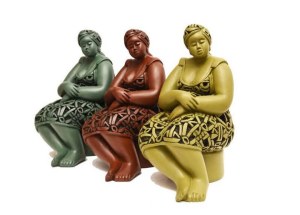
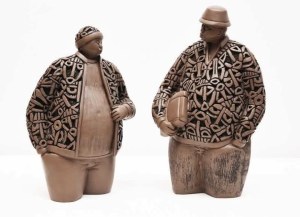
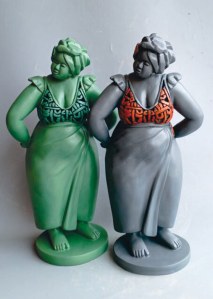
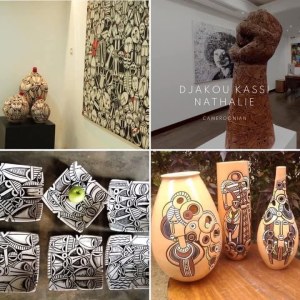
For nearly a decade, Nathalie has been creating sculptural ceramic works in Lagos that merge Central African influences with the restless energy of Nigeria’s contemporary art scene. Her works do not merely occupy gallery spaces; they preserve movement, migration, struggle, memory, and the layered experiences of African identity itself.
She also commands a growing and devoted following on Instagram, where admirers of contemporary African ceramics regularly engage with her evolving body of work. Beyond the polished gallery presentations and exhibition openings, her social media presence offers something more intimate glimpses into the labour, rhythm, and emotional intensity behind the sculptures themselves.
In one particularly striking Instagram story, Nathalie could be seen deeply immersed in the studio while Fela Anikulapo Kuti’s timeless classic Water No Get Enemy echoed in the background. The moment felt symbolic. Much like Fela’s music, her work carries movement, defiance, spirituality, and unmistakable African energy. There was an almost hypnotic relationship between the sound, the clay, and the artist’s concentration as though the sculpture itself was responding to the rhythm.
It is perhaps in such unguarded moments that one truly understands Nathalie’s artistic fire.
She is sure fire.
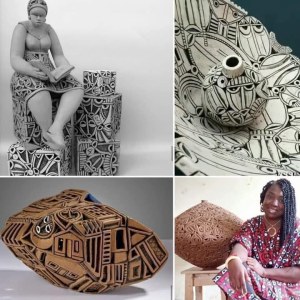
Now living and working in Lagos after years of practice in Cameroon, Nathalie’s artistic journey is one shaped by resilience, reinvention, and an unwavering devotion to clay, the same material she chose long before the world around her fully understood its possibilities.
For Natalie, ceramics was never accidental. It was instinctive.
She recalls becoming fascinated with ceramics as a young girl while flipping through architecture and interior design magazines her father constantly brought home. At a time when many around her dismissed ceramics as little more than pottery or decorative craft, she saw something larger, she saw a language, assured future, and a world she wanted to inhabit.
“When people were laughing about us only creating clay and pottery, I still believed in it,” she reflects. “I knew ceramics before coming to the school. It was the only craft for me.”
That certainty would define the course of her life.
Born into a large artistic family in Cameroon as the first of ten children, creativity surrounded her from childhood. Her father, a teacher with drawing abilities, encouraged intellectual curiosity and exposure to visual culture. Among her siblings are teachers, sculptors, designers, tailors, and creatives working across different forms of expression. Art was not merely a profession within the household; it was embedded in the family’s rhythm of life.
Nathalie became part of the pioneering generation of students at what remains one of Central Africa’s most important art institutions, an art school established in 1988 and officially opened in 1992. She joined the first set of students and immersed herself fully in ceramics between 1992 and 1995 before proceeding to university to further specialise in the discipline.
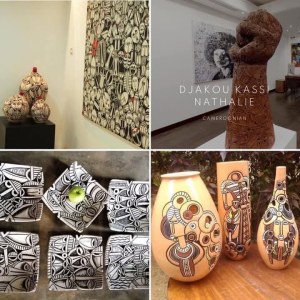
Her training itself reflected a pan-African artistic exchange. Though educated in Cameroon, many of her instructors were Congolese artists brought in through an Italian non-profit organisation with cultural activities extending into Kinshasa. That influence still quietly echoes through her forms today.
“You will notice Congolese movement in some of my sculptures,” she says. “You will also see traces of Cameroonian culture and Nigerian energy. My work is a mixture of influences from one part of Africa to another.”
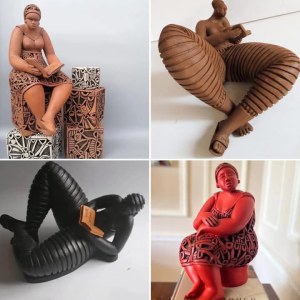
This layered identity became one of the defining strengths of her practice. Rather than confining herself to a single national aesthetic, Natalie absorbed visual languages across the continent from Senegal and Mali to Gabon and beyond, allowing African visual traditions to converse freely within her sculptures.
Her works today carry a universality rooted deeply in African consciousness.
But the road toward recognition was not smooth.
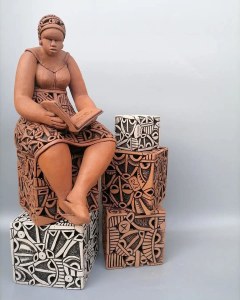
At a time when ceramics remained misunderstood within many African societies, Nathalie and her classmates endured ridicule for pursuing the discipline. People questioned whether ceramics could sustain a meaningful career. Others reduced it to flower pots or ritual objects. Some openly mocked them.
Yet she persisted.
Even as a young student, she had already developed the fierce determination that would later sustain her through far greater challenges.
After years of studio practice in Cameroon, Nathalie relocated to Nigeria nearly a decade ago a move that would dramatically reshape both her career and artistic language. But the transition was anything but easy.
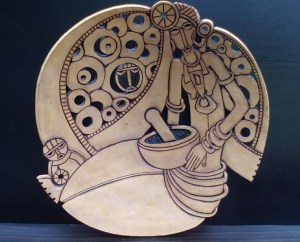
She initially settled in Port Harcourt, where access to ceramic materials and firing facilities proved extremely difficult. Clay was scarce. Equipment was unavailable. The village where she fired works was plagued by violence, gang conflicts, and recurring curfews. Travelling to the studio often felt dangerous.
At one point, she spent months wondering whether she could continue making ceramics at all.
Yet adversity forced invention.
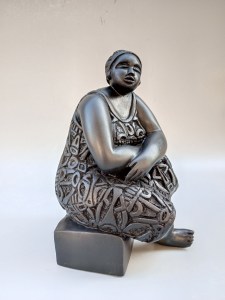
Without access to the materials and tools she had relied on for over two decades in Cameroon, Nathalie began experimenting with alternative processes and adapting her methods. Slowly, a new visual language emerged that would later become central to her artistic identity in Nigeria.
“It was not easy to change styles,” she explains. “But the challenges forced me to rethink everything.”
That reinvention would eventually lead to a breakthrough.
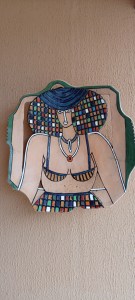
Her first exhibition in Lagos became a turning point. Supported in part by acclaimed Nigerian artist and sculptor Ato Arinze, who helped guide her into Nigeria’s ceramic networks and artistic spaces, Nathalie’s work quickly attracted attention. Lagos audiences responded enthusiastically to her sculptural forms, especially the ambitious scale of her pieces.
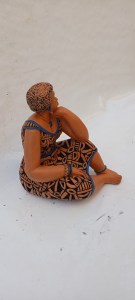
The city itself also transformed her perspective.
Unlike Cameroon’s relatively limited gallery infrastructure, Lagos offered constant artistic stimulation with galleries, museums, studios, collectors, collaborations, and endless visual encounters.
“Lagos is one of the biggest art cities in Africa,” she says. “You meet artists quickly, connect quickly, and get inspired constantly.”
That energy seeped into her work.
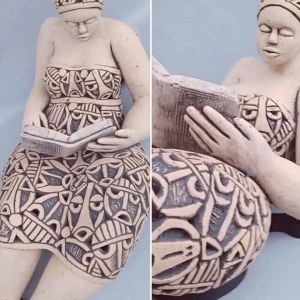
Today, Natalie’s sculptures move fluidly between personal memory, collective documentation, and social commentary. She treats her art as a living archive of her time, documenting themes such as domestic violence, child abuse, and social unrest, including reflections inspired by Nigeria’s EndSARS movement.
“All my work is documentation,” she explains.
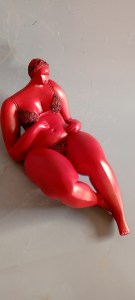
That philosophy gives her sculptures emotional gravity. Many of her pieces appear almost archaeological, as though carrying embedded traces of migration, conflict, resilience, and cultural survival across their textured surfaces.
Yet despite her growing acclaim, Djakou Kassi Nathalie remains deeply committed to educating audiences about ceramics itself, a medium she believes remains widely misunderstood.
“Ceramics is still underrated,” she says firmly. “People only focus on fragility, but ceramics can outlive generations.”
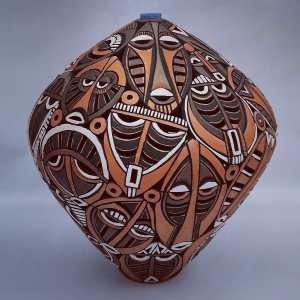
She points to centuries-old Japanese ceramic traditions as evidence of clay’s permanence and cultural importance. For her, ceramics is not secondary to painting or sculpture. It is foundational and one of humanity’s oldest artistic mediums, also one still deeply woven into everyday life through architecture, cosmetics, engineering, and industrial design.
Her mission therefore extends beyond creating artworks. She also seeks to dismantle misconceptions surrounding ceramic practice and encourage younger generations to take the medium seriously.
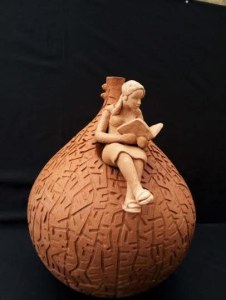
Having once returned to teach at her alma mater in Cameroon, Nathalie contributed to curriculum development and educational reforms that helped strengthen formal art education within the institution. Her role as both artist and educator reflects her belief that knowledge must circulate alongside creativity.
Today, after decades of persistence across multiple countries, Djakou Kassi Nathalie stands as more than a ceramic sculptor. She represents a generation of African artists redefining material traditions through movement, adaptation, and cross-cultural dialogue.
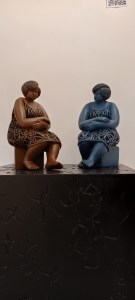
Her sculptures may be formed from clay, but they carry the weight of continents.
And perhaps that is the true power of her work: the ability to make earth remember.
iBAND Magazine, Celebrating Visual Arts from the Original.
Africa | Visual Arts | Lifestyle | Culture

