
What happens when a photographer turns his lens towards Africa and refuses to see only what everyone else sees? That is where the story of Nseabasi Akpan begins. His name, Nse-Abasi, carries the meaning “I look upon the Lord” is a spiritual gift to cherish. But the real gift may be what he chooses to see, preserve and reveal through his camera.
Words Ireho Aito | Don’t Keep Your Art in the Finger! All Photographs courtesy Nseabasi Akpan
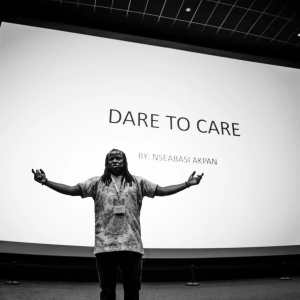
For more than two decades, Nseabasi Akpan has travelled with photography as both companion and language. His journey has taken him from the streets and communities of Ibadan across West Africa and into East and Southern Africa, and further to countries including Ethiopia, Tanzania, Namibia, Croatia, the Netherlands, Finland, Turkey and the Czech Republic. His travels have not simply been about crossing borders. They have been opportunities to encounter people, cultures, landscapes and stories, and to understand how photography can build connections across them.
In 2018 and 2019, his Open Africa photography road trip took that philosophy further. Beginning from Ibadan, Akpan travelled through major cities across Africa, working with local artists, schools, NGOs and youth centres through workshops, photowalks, artist talks, exhibitions and collaborations. The journey was as much about people as it was about photographs.
That spirit of movement remains central to his practice.
Akpan describes photography as a means of giving society a voice. Over the years, while speaking about his work, he explained that he had always seen photography as a tool to “voice” society’s plight. That conviction has remained visible in a practice that moves comfortably between street photography, reportage, documentary and social storytelling. His subjects have included politics, football, religion, culture, migration, the environment and the intimate realities of everyday people.


Very memorable for him while on a telephone conversation with iBAND Magazine, as he was preparing to open his new group exhibition “Everyday Life,” coming up on the 19th of August 2026, Nseabasi recalled how his photography submission won an entry for West Africa in 2011 and he found himself exhibiting in the presence of African Presidents and leaders at African Union Summit.
“A poor Ibadan-brought-up boy like me finding myself exhibiting in the hall during the African Union Summit in 2011, with African leaders listening to me, remains a mystery still unresolved in my life,” Akpan stated.
“As my voice trembled and my hands kept shaking while I took the African leaders round the exhibition, it was a flight that opened my eyes and taught me never to seal my lips again. Sealed lips are sealed destinies,” he concluded with strong conviction.

One of his earliest journeys into photography was itself an act of defiance. After completing his apprenticeship in a photo studio in Ibadan, he travelled to Accra, Ghana, in 2004. His parents had hoped he would become a banker and did not initially regard photography as a serious career. Akpan, however, had already discovered something they could not easily persuade him to abandon: photography had been his childhood dream.
The camera eventually took him much further than Accra. In Cotonou, Benin Republic, he photographed children navigating floodwaters in a makeshift jerrycan boat. The image got a unique recognition and 3rd Place Prize in the Mo Ibrahim Foundation’s Snapping Cities photography competition. Explaining his motivation for entering such competitions, Akpan said he wanted platforms to always showcase his work, advocate for art as a tool for youth development and empowerment, and “communicate and express myself for the better of Africa.”

That photograph also revealed something fundamental about his eye. He was not merely looking at flooding Nseabasi was looking at resilience. Where another person might see a problem, his camera found ingenuity, determination and the human instinct to keep moving.
This ability to look beyond the obvious has remained a defining feature of his practice. His photographs of child soldiers in Sierra Leone are among the most powerful expressions of this instinct, confronting the viewer with the human reality behind conflict and compelling the world to look beyond the headlines to see the children, their vulnerability and the lives caught in the machinery of war.

Rwanda, too, has passed through Akpan’s lens, documented in his own way as he looks at a country whose contemporary landscape continues to carry the echoes of its past. His photographs do not merely record places, they reflect on memory, resilience and the human stories beneath the surface. In his hands, photography becomes a quiet act of witnessing and looking at what history leaves behind by allowing the image to ask its own questions.

Nseabasi Akpan has been an advocate for young people to always invest in networking to upskill themselves. “If I did it, many of them can do it,” he revealed.
For him, education without further strive for success is like living in vain. “After travelling extensively, I discovered that young Africans still don’t know where to go for opportunities to enhance their careers. I have the opportunities several times to share forms for them to fill only to meet a certain resistance from the same young people that they don’t know the process or how to fill such forms to access grants for projects. This always sounds disgusting for me to hear. I am also a product of humble begining from Ibadan where I have lived all my life as a native of Akwa Ibom,” he says.

His photography has earned international recognition, including the One World Media Prize, European Union/African Union Photography Prize, BBC Focus on Africa Photo Essay Prize and Fearlessly Inspirational Photography Award. His work has been exhibited or presented in Nigeria, Ghana, Uganda, Ethiopia, Syria, Croatia, India, South Korea, Turkey, Norway, the Netherlands and the United States, among other places.
Yet perhaps the more revealing measure of Akpan’s journey is not the number of countries he has visited or awards he has received. It is what he has done with the access those journeys have given him.
He has consistently created room for other photographers with his Open Africa yearly series.
His annual photography exhibitions Open Africa have developed into international platforms, bringing photographers from different countries together around stories of humanity, culture and lived experience. By 2025, the exhibition had showcased photographers from countries across Africa, Europe and beyond.
And now comes Everyday Life 2026, another photography exhibition that is very dear to his heart.

This exhibition, opening on the 19th of this month is curated by Akpan and presented at the National Museum of Unity in Ibadan. It brings together established and emerging photographic voices from Nigeria, Africa and beyond.
The exhibition premise is deceptively simple: there is poetry in the familiar. A face, a street, a marketplace, a landscape, a fisherman returning from the water or an apparently insignificant encounter can become a record of a time and place. It is only photographs that gives these moments another life.
Among the participating photographers are Abel Oluwole, Ademola Bamigbẹlu, Antonio Aragon Renuncio, Caleb Ishaya Oseshi, Jacqueline Dersjant, Jude Hindan, Juliet Ebute, Katarina Radovic, Laurence Moorcroft, Maingaila Muvundika, Rob Godfried, Asamoah William, Silvia & Massimo, Stan Lafleur, Thadeus Adeyemi Omotoyinbo, Filip Wierzbicki-Nowak,
Kitty Vlaanderen and Victor Oluwayoju. Everyday Life is sponsored by the African Culture Fund.

It is noteworthy to know that this exhibition presence in the ancient city feels particularly appropriate. Ibadan has long been associated with intellectual life, literature, publishing and cultural memory. Akpan’s Everyday Life adds another form of storytelling to that tradition and that is the visual story of how people live, move, work, dream and survive. The exhibition runs until September 2.

For Akpan, bringing international photographers to Ibadan is also part of a larger cultural mission. During his earlier Eyes of Hope exhibition, he explained that his work was driven by a desire to bring artists together so they could “meet, relate, educate, empower and inspire people through their works.”
He also sees such exchanges as a way of changing how Nigeria is perceived internationally.
“When artists from around the world come to the country and see how lovely, sociable and accommodating we are as a people,” he said, “they will begin spreading the message in their own little way that Nigerians are not who they are being negatively painted,” he remarked.
It is a powerful position for a photographer to occupy. Especially when the camera becomes both witness and bridge. In Amsterdam, his practice took another turn. During his BijlmAIR residency, Akpan explored the Nigerian community in Amsterdam, connecting Nigerians living in the diaspora with Nigerians who had returned home after living abroad. The resulting research forms part of Voices of Silence, a continuing project examining migration, identity, expectation and the realities behind the dream of travelling to Europe.
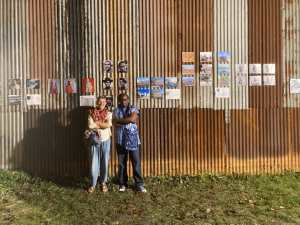
His work has always been interested in those spaces where personal experience meets wider social questions. Whether photographing communities, migration, religion, politics, sexuality, football or everyday life, he repeatedly returns to the same fundamental question: what happens to the stories of people who are rarely given the opportunity to speak for themselves?
His answer is often the camera.
One of the encounters that would leave a deeper impression on Nseabasi Akpan was his experience with Don Bosco Child Protection Centre. It brought him closer to the realities of vulnerable children and made him look beyond photography as an artistic practice. The camera, he began to understand, could become an instrument of attention, compassion and change.
That experience strengthened a conviction that would increasingly shape his own journey that art should not only document society but should also contribute to improving it. In his own words, he wanted to “advocate for art as a tool to develop and empower youth, communicate and express myself for the better of Africa.”

Such thought would become more than a statement. It would become a direction and that would see Akpan use photography to engage young people, create platforms for photographers and tell stories that place human dignity at the centre of the frame.
Perhaps this is where the meaning of Nseabasi begins to resonate most deeply: he looks upon the Lord, and then looks upon humanity through his lens. Akpan has spent years doing precisely that. He has taken photography across borders, brought photographers into conversation, mentored young people, created platforms for international exchange and continued to document the present with the understanding that today’s photographs may become tomorrow’s history.
His own description of his practice remains perhaps the simplest way to understand his journey: “storytelling” and “documenting the present for the future.”
That sentence could almost serve as the philosophy of his career because Nseabasi Akpan is not only photographing what Africa looks like; he is photographing what Africa feels like.

For the Ibadan-born photographer, there is fulfilment in recording the people behind the headlines, the ordinary moments behind extraordinary narratives and the quiet human experiences that can disappear when nobody stops to look.

And perhaps that is the true gift in the name Nseabasi: looking up to God, looking through his lens, and finding in Africa countless stories still waiting to be seen, preserved and told.
Everyday Life photography exhibition opens at National Museum of Unity, Ibadan. The exhibition starts on the 19 of August ends September 2, 2026
iBAND Magazine, Celebrating Visual Art from the Original.
Africa | Visual Art | Lifestyle | Culture

