
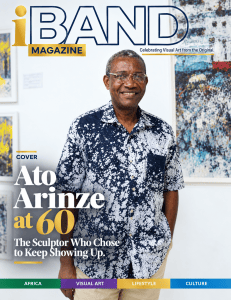
At 60, Ato Arinze continues to show that an artist’s journey is built not only on talent, but on commitment and consistency. From sculpture to the many lives his work has touched, his story is one of purpose, persistence and showing up.
Words Ireho Aito | Don’t Keep Your Art in the Finger! Photographs Credit: Elizabeth Ekpetorson and Temitope Oladeji. Additional photograph credit: Okotiti Joseph
My first encounter with Ato Arinze did not begin with a handshake, neither a studio visit nor an exhibition opening. It began from a distance, through Artzero, the platform he spearheaded through Facebook. Before I eventually met the man, I had already encountered something of his thinking, his interest in artists and his determination to create conversations around art. Our physical meeting would come later at Freedom Park on Broad Street, Lagos, during a Nigerian and South African event. By then, Ato had become familiar to me through his work and his kind of movement, but apparently I was not quite what he had imagined. “I was expecting to see a giant of man,” he jokingly said when he discovered the character behind the stories. What I came to know over time was a man whose influence is found less in physical stature than in the spaces, people, conversations and opportunities he has helped to shape.
Duke Asidere sees that influence from another angle. In a recent telephone conversation with me, the leader of the Guild of Fine Artists spoke about Ato’s character, recalling his almost legendary punctuality at Guild meetings. “Imagine, I lead the Guild of Fine Artists, on our meeting days, you won’t believe the kind of punctuality Ato possesses. He gets to our venue before anyone, all the way from Ayobo where he lives,” Duke recalls.
Then there is Francis Denedo, who knew Ato much earlier. In 1991, as a third-year sculpture student at Auchi Polytechnic, Denedo encountered Ato as a young NYSC member who introduced the department to fibreglass. Watching him work, he remembers, was an education in itself. He recalls Ato’s calm manner, deliberate use of words, perfectionism and the spirituality he brought into his art.
Three encounters, from different periods of Ato’s journey, but each pointing to something beyond the sculptures themselves. Even the Society of Nigerian Artists has composed a song celebrating Ato Arinze and what he has given to the profession.
On September 23, 2026, Ato Arinze clocked 60, and iBAND Magazine marks the occasion with more than a birthday greeting. For us, sixty years provides an opportunity to look at the journey of a Nigerian artist who has spent decades making sculpture, creating platforms, mentoring younger artists, organising exhibitions and asking difficult questions about the place of art in Nigerian society. It is also an opportunity to listen to the man himself.
In a special conversation with iBAND this week, Ato looked back at the young man who entered the art world, the rejections that confronted him, the mentors who influenced him, the lessons he learned and the ideas that continue to drive him. “I entered the art world with lots of rejections because I refuse to play to the gallery demands,” he says. But rejection, rather than becoming the end of his story, became part of the education. “Early rejections brought out the philosopher in me,” he explains, while acknowledging that early acceptance can bring happiness and comfort, but without discipline, “one can be trapped.”
Looking at the distance between then and now, Ato sees a different landscape. “Much has changed, those days we were many, chasing few opportunities, today those of us who keep showing up and who never gave up are enjoying the fruit of that resilience.” In many ways, those words capture the man we have continued to encounter as Ato Arinze keeps showing up.
iBAND: Ato, you are 60 this week. Looking back at the young man who first entered the world of art, what do you think has changed most about you?
ATO ARINZE: I entered the art world with lots of rejections because I refused to play to the gallery’s demands. Early rejections brought out the philosopher in me, while early acceptance comes with happiness and comfort, but without the necessary discipline, one can be trapped. Much has changed. In those days, we were many, chasing few opportunities. Today, those of us who kept showing up and never gave up are enjoying the fruits of that resilience.
iBAND: Sometime ago, you once told iBAND that your first freelance job was at Koko Ayi’s studio and that his advice was very valuable to you. At 60, what part of that advice is still living with you?
ATO ARINZE: The Sculptor, Mr Ekpeyong (Koko) Ayi’s advice still lives with me, and I never cease to pass it down to any young artist who comes to my studio. The advice was, “Never spend all the money you were paid because your client promised you another job.”
At that point, I didn’t take the advice seriously. As I was going home, I entered a bookshop and invested the whole money in books and a few art materials. Two weeks after, when I came back to ask him about the next project, that was when I realised the weight of the advice because the project never came.
Though I didn’t regret not heeding the advice, the books I bought that day are the reason I’m still in practice today.
iBAND: Ato has spent many years not only making art but also helping younger artists. After 25 years of nurturing young ceramicists and sculptors, what keeps you interested in the next generation?
ATO ARINZE: What I received, I gave back, and what I’m expecting to get, I give out first. Giving and sharing are the keys to happiness and long life.
In Africa, we attach more importance to the past than the future, to the dead than the living. We live in the fear of the unknown. We outsource the occult energies within us to other things in nature. The power we seek in the trees, rivers, the sun and all the imaginary fairies is within every individual.
We waste resources on honouring what we call our ancestors, not knowing that our children are our ancestors. The only thing we owe our so-called imaginary ancestors is to use the wisdom and knowledge they left behind to make the world a better place for their coming back.
We are degenerating as people because all we do today is consume, celebrate, fight and kill ourselves. We don’t care about the future of our children. Personally, as an atheist and an artist, I choose the living. I would rather die helping a young person than celebrate in front of a river, big tree or in a religious centre in the name of worshipping the dead. We don’t owe them anything; they don’t have power over the living.
iBAND: In your conversation with iBAND about ORI, you said you wanted artists to think and research instead of bringing familiar works to exhibitions. Has that expectation changed after seeing what ORI has become?
ATO ARINZE: Thematic exhibition is what will make artists more creative. It’s very easy for us to be trapped in the commerce of producing what is selling in the market. As artists, we must know when we are creating and when we are producing.
Creativity comes before production. Thinking is creativity, and the reward of producing is comfort. ORI Exhibition is designed to make the sculptors think and research. So far, the works exhibited in the second edition are far better than the ones in the first exhibition.
iBAND: You have made sculpture your major artistic language, while also creating platforms such as ArtO Studio and ORI. At what point did you realise that your work had to go beyond your own studio?
ATO ARINZE: Every artist is an industry, an institution. Whether we run our studios as a business or as a sanctuary for peace or learning, it’s important that we create responsibilities by developing programmes and activities to help fellow artists and to popularise the arts.
As artists, we must learn and be ready to organise ourselves, organise events and activities instead of waiting for outsiders to run our lives. From day one, I knew there was more to being an artist. We are, first and foremost, mystics. If, as an artist, you are lucky to come to that realisation, it becomes your responsibility to create opportunities for others, like Paul Klee said, “Art is a gift for those who know they have to those who do not have.”
iBAND: You have always spoken strongly about mentorship, saying that “mentorship is the key to greatness.” Who are the people you feel you must acknowledge when you look at the Ato Arinze of today?
ATO ARINZE: I have been blessed with good and great mentors, starting with my parents, my teachers and lots of artists, the ones I met through the pages of books and the ones who opened their studios for me.
Finally, my collectors. Their advice on financial intelligence and how to run a business is very useful. I’m grateful to many of them, just to mention a few: Mr Olisa Nwadiogbu, Mr Emma Mbanefo, Mr Olu Amoda, Mr Chike Ebebe and Prof Abayomi Barber.
iBAND: You have repeatedly argued that sculpture needs greater visibility in Nigeria. After ORI I and ORI II, do you feel the conversation around Nigerian sculpture is changing, and what still needs to be done?
ATO ARINZE: The impact is there and it’s still growing. What needs to change is the sculptors’ attitude to the profession. They should know, first, the importance of sculpture in every civilisation. They should be more open to collaborations, sharing knowledge and opportunities.
iBAND: At 60, what does success mean to you now: the works you have created, the exhibitions you have organised, the artists you have influenced, or something else?
ATO ARINZE: At the early stage, I was so ambitious to succeed, but along the way, I got to know that being successful is better than just succeeding. So I started being open, started giving, sharing and also receiving.
Success for me means service and acceptance.
iBAND: You keep laying emphasis on artists having the value of contentment and not being overzealous in their ambitions. Can you take us through the lessons we need to learn from this assertion?
ATO ARINZE: The artist who must be great, the painter or sculptor who must transform to become an artist, should always strive for comfort, not luxury. Luxury is an illusional existence above what you can afford, and this stifles creativity.
Creativity is what makes the difference between a good artist and a great artist.
iBAND: What does taking Nigerian sculpture and Nigerian art beyond Nigeria mean to you at this stage of your life?
ATO ARINZE: Taking our art outside is meaningless and useless if we are not making an impact locally. Nigerians don’t know us as artists; our works are not part of their conversations, so we have a big problem.
We should all learn from the life and works of Fela, the Afrobeat King. He became popular and remained popular within Nigeria before going abroad.
Sculptors and other visual artists should know that art is created for three people, namely, the artists, the patrons and the masses. Among the three, the masses are the most important.
Collectors here delude themselves by believing they have treasures in their collections. An art piece is a treasure only when it’s popular among the masses.
iBAND: If the Ato Arinze of 60 could sit down with the young Ato Arinze who was just beginning, what would you tell him about art, life, people and the journey ahead?
ATO ARINZE: To my younger self, I would not bother going to higher school after secondary school. Passing through apprenticeship is the best way to go. I would devote more time to reading, particularly occult books.
Apprenticeship and occult knowledge with the hidden wisdom are all we need to be successful in life.
iBAND Magazine, Celebrating Visual Art from the Original.
Africa | Visual Art | Lifestyle | Culture

