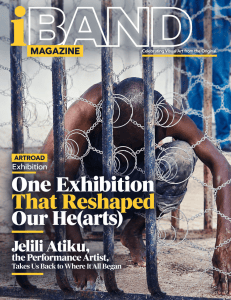
From the iron coils of Ẹ Wó to the haunting ritual of Araferaku, Jelili Atiku has made the body a language for memory, protest and identity. In this personal reflection, Ireho Aito revisits an encounter with the artist while Jelili takes us back to where his performance journey began.
Words Ireho Aito | Don’t Keep Your Art in the Finger! Jelili Atiku’s Facebook account, published with his permission. Photographs courtesy of Jelili Atiku.
Working with the illustrious masquerade of Africa, Jelili Atiku, would remain one of the most interesting moments in my journalistic sojourn. It was Araferaku – A Part of Me Is Missing that started at the Centre for Contemporary Art in Lagos and took us down to his Ejigbo ancestral home for a command performance. I saw the true nature of a man. He approached me to document it for him and there could be no mistakes. “Aito, this is my performance and nobody can direct me. This is not a stage drama or Nollywood,” he affirmed at CCA. I understood the warning. Jelili was not looking for a performance that could be staged, rearranged or made to fit somebody else’s idea. He knew what he wanted the camera to see. “My projects are in raw format,” he remarked.
At Ejigbo, Jelili became a different personality, almost a mystic figure that one could barely get across to. Olabisi Silva, then Executive Director and curator of the Centre for Contemporary Art, and her curatorial assistant, Taye Idahor, could hardly believe what they were witnessing as the room gradually turned into something like a sanctuary. Welcome to Araferaku.
For three days, Jelili brought us into what performance meant to him. We were all stunned. The Ejigbo community stood still. This was a performance in honour of his late father, a man he never met, yet whose absence had remained a presence in his life. He became consumed by his Bami — “my father” and from that deep personal encounter came “Letter to Bami,” literally a letter to his father, exhibited at CCA. Jelili turned CCA into a macabre venue and Ejigbo into the place where memory, mourning and performance met. It was iconic.
iBAND Magazine has previously written about Araferaku as an excavation of identity, tracing the work to the discovery Jelili made as a young boy about his father and the later burial rite he created for the father he never knew.
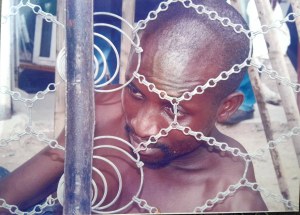
But reading Jelili Atiku’s own recollection of his first performance this week on his Facebook page entitled – “Coils of the Unmaking : When the Cradle Becomes a Trap” brought me back to the beginning.
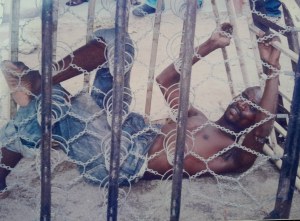
Before performance art became the language through which many of us came to recognise him, there was a Friday morning at the University of Lagos on November 19, 2004. Jelili remembers it vividly: “I do not remember applause. I remember the raw, unyielding heat of the University of Lagos concrete pressing against my bare skin.” He remembers “the smell of oxidised iron,” the rising dust and looking up from the ground to see “a shifting, detached sea of human feet.”
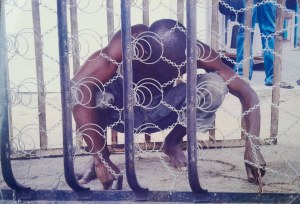
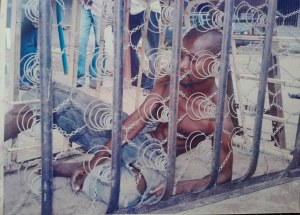
Those feet belonged to passers by who stood over him, looking down into an improvised cage made from cold steel rods and stripped, interlocking mattress coils abandoned by students. That was Ẹ Wó – Nigerian Prisoner, which Jelili describes as his “foundational entry into live art and performance.”
He explains the title himself. Ẹ Wó is the Yoruba imperative: “Look!” or “Behold!” And he was not making a polite invitation. “I intended to make that looking away physically and psychologically impossible,” he writes.
At the time, he was deep into his Master’s research, which would later become his 2006 thesis, An Expository Analysis of Sculpture as Awareness and Advocacy Tool for the Protection of Human Rights. But the research had moved from the page to the body. The artist was no longer simply examining oppression. He was placing himself inside an image of it.
“I built that enclosure myself,” Jelili recalls, describing the rusted iron rods, chains and exposed spiralling springs of a stripped mattress core that became his prison. The mattress was not an accidental material. “A bed is inherently designed as a sanctuary,” he explains, a place of rest, comfort, safety and rejuvenation. Yet he dismantled that sanctuary and turned it into a cell.
“The tools constructed to hold us up are inverted to hold us down.” That sentence perhaps says more about the work than any elaborate explanation could.
Jelili was also beginning to question the distance between the Western sculptural tradition in which he had been trained and the living artistic traditions around him.
“My formal university training had steeped me in Eurocentric, classical sculptural traditions,” he writes, traditions that treated art as a static object for contemplation within institutional spaces. He wanted to break out of that enclosure.
“I returned to the indigenous soil of my ancestors,” he says, looking towards Yoruba traditions in which art could be lived through the body, ritual and communal participation. “The human body is reclaimed as the primary, sacred material of creative expression.”
That decision would become one of the defining threads of his practice. “By stripping away the artificiality of Western marble or bronze, I offered my own flesh as the medium through which the community’s collective pain could be physically felt,” he writes.
The body was no longer merely carrying the artist. The body was carrying the message. He was not acting out an aesthetic role. He was making himself the evidence.
In Ẹ Wó, that evidence was tied to the experience of Nigerians caught in the criminal justice system through holding charge. Jelili writes that he became “a living sculpture,” using his own physical confinement to make visible the condition of people trapped in legal limbo. The cage therefore became more than a structure of iron and mattress springs. It became an image of a society where institutions designed to protect people can also become instruments of confinement.
He remembers the stillness of the performance. There was no theatrical rage, no screaming for effect. “There was only a dense, contemplative, and heavy stillness.” His fingers gripped the rusted rods above his head. He describes that physical suspension as simultaneously “a prayer, a total surrender, and a rigorous evaluation of my limits.” And then comes the question that sits at the heart of the performance: “How long can a person hold on in limbo, and do you truly see us?”
Jelili himself recognises what Ẹ Wó changed in him. “It permanently severed my ties to traditional studio art,” he writes. The experience convinced him that sculpture could not remain “a passive, decorative commodity” but could become “an unyielding, confrontational witness to historical trauma.” Looking back, he calls Ẹ Wó “the authentic crucible of my language as an artist-advocate.” It taught him “to utilise the flesh to manifest the invisible,” to occupy public spaces and allow local materials to speak.
That language has continued to travel. iBAND Magazine has followed Jelili through works including Aragamago Will Rid This Land of Terrorism, Eegun Alare, Coronation of a Mock King, Victim of Political Assassination, Arise O Compatriots and Earth Rising, performances that have taken him through questions of terrorism, politics, patriotism, environmental concerns and social injustice while remaining deeply connected to Yoruba cultural thought.
Today, in 2026, it is therefore difficult to be surprised by the level to which Jelili Atiku has taken performance art. The international recognition is there. He has received support from the Prince Claus Fund, and his work has continued to attract attention beyond Nigeria. His inclusion in Fifty Key Performance Artists, edited by T. Nikki Cesare Schotzko and Adriana Disman and published by Routledge, is another significant point in a journey that began with a young artist lying on concrete at Akoka, asking people to look.
Yet what interests me most is not simply how far Jelili has travelled. It is that the young man in the cage and the man I encountered at Ejigbo are recognisably the same artist. The materials changed. The wounds changed. The locations changed. The audiences became larger. But the insistence remained. Look at this. Do not turn away. Stay here. Witness this.
And that is why seeing Jelili return to Facebook this week to share his first performance is such a privilege. He has allowed us to see the beginning again, not through somebody else’s interpretation, but through his own memory.
There is something beautiful about an artist being able to look back at the first place where his language found its voice and still recognise himself.
And after all these years, the first command remains the same.
“Ẹ Wó.”
iBAND Magazine, Celebrating Visual Art from the Original.
Africa | Visual Art | Lifestyle | Culture

