
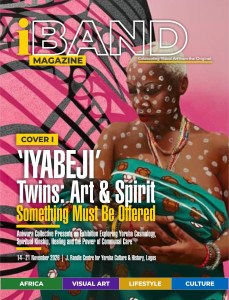
In Iyabeji: Mother of Twins, Angie Aniwura explores the relationship between motherhood, spirituality and artistic expression through a deeply personal journey. Bringing together ritual, painting, photography, sculpture and collaboration, the exhibition offers an intimate encounter with the spiritual obligations and relationships that inform her understanding of creation. For Orphée Kashala, looking closely at Aniwura’s practice means considering not only the artworks themselves but also the experiences, intentions and processes through which they come into being.
Words Orphée Kashala | Photographs credit: 14×14/ Angie.: Photographed by Dotun Adeleye: A2: Jelili Atiku photographed by Benedicte Kurzen: Paintings images: Painted by Lucy SM Johnston & Angie Aniwura. iBAND Magazine Cover Graphics Credit: Adewale Oseni
At one point in our conversation, Angie Aniwura pours water onto the ground. We have been speaking about the Mothers, the spiritual energies through which she understands creation and her own relationship to motherhood. Speaking of them, she explains, is already an invocation. Something must be offered. I find myself returning to this moment when considering Aniwura’s practice, to the crossing between spiritual experience and the physical production of an artwork, and to the obligations that continue through its making.
Aniwura’s earliest remembered encounter with art takes place in a theatre courtyard at the University of Ife. As a child accompanying her father, she watches performers move between pillars and hears voices whose force she still recalls physically. Before she could identify the discipline or understand the production, she felt its presence. This memory offers an entry into a practice that moves across media while remaining attentive to what each encounter between the viewer and the work sets in motion. Aniwura’s art begins before the object, in a body already listening and responding.
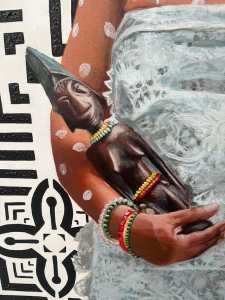
In Iyabeji, Mother of Twins, that call and response becomes inseparable from a deeply personal negotiation with motherhood. Following a hysterectomy in 2013, Aniwura began experiencing dreams and visions of twins whom she understood as her spirit children. Within her account of Yorùbá spirituality, these encounters recalled an agreement made before birth as a promise to bring them into the physical world. The impossibility of fulfilling that promise required a process through which their relationship could be acknowledged and its obligations reconsidered. Across the project, the maternal holds this difficulty within it. The act of carrying the twin figures gives physical expression to a bond undergoing transformation, as separation becomes a way of honouring the children and allowing their journeys to continue.
The photographs documenting ceremonies and sacred rites place the work within the unfolding of that separation. They carry moments from a process whose purpose extends beyond the production of images, bringing its lived duration into the exhibition. In Aniwura’s practice, spiritual experience and artistic production occupy a shared chronology as her art emerges within the ritual experience itself. Aniwura’s Iyabeji gathers artworks through which this alchemical process can be witnessed, while retaining the sense that much of what sustains it takes place beyond the frame.
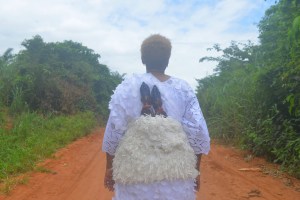
This gives particular weight to the relationship between material and process in her practice. Her art participates in an act of devotion while retaining a different status from objects prepared for ritual use. Reading the works requires attention to those differences, to the spiritual intentions carried through their production and to the specific processes through which sacred authority is established.
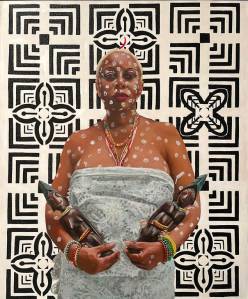
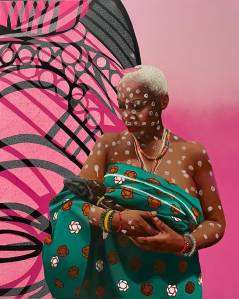
The paintings made with Lucy SM Johnston bring another dimension to this relationship between intention and form. As collaborative self-portraits, they distribute the work of self-representation across two artists. Johnston paints Aniwura’s body, while Aniwura develops the abstraction around it, bringing her own spiritual vocabulary into the construction of her image. The delicate balance between figuration and abstraction opens a gateway between the body available to sight and the relationships through which that body understands its existence.
This gives Aniwura’s abstraction a particular force. She depicts forms resembling bicycle-chain links, evocative of iron and Ogun, the guiding deity within her paternal lineage. Birds carry associations with the Mothers. Elsewhere, floral forms draw on her interest in the medicinal knowledge of plants. Her use of pattern articulates a spiritual genealogy, extending self-portraiture beyond physical likeness.
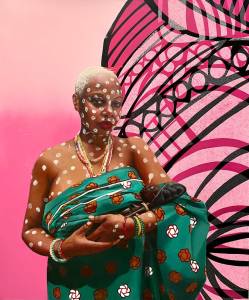
Her collaboration with Johnston also unsettles the expectation that self-portraiture should originate from the subject. Aniwura entrusts her figure to another artist while participating in the conditions through which it becomes legible. Their exchange makes room for a self whose expression depends upon relationship with others, with community.
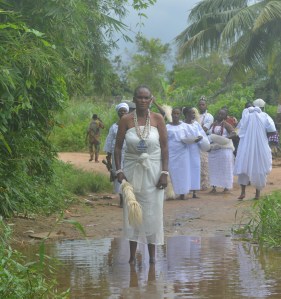
Within the wider project, the contributions of the collective extend this principle across photography, moving image and sculpture. Ẹgbẹ́, the spiritual community within Aniwura’s understanding of existence, offers a way of approaching this collective dimension. The individual belongs to relationships that precede birth and continue throughout life; guidance and obligation move between physical and spiritual realms. Here, collaboration gives a material structure to that understanding. The work develops through an accompanying presence, through what another person can perceive, contribute or help bring into form. This artistic methodology makes visible something of the interdependence that Aniwura’s practice is built on.
As Iyabeji enters the J. Randle Centre for Yoruba Culture & History in Lagos, this conversation takes a new dimension. The exhibition addresses a public whose relationships to Yorùbá knowledge will be varied, lived and sometimes contested. Aniwura points towards a continuity which resists the suggestion that tradition must remain materially unchanged to endure. In this body of work, adaptation occurs through knowledge and intention, with an understanding of where substitution is possible and where an obligation is exact. Her practice carries that discernment into the tensions between spiritual practice and contemporary art.
Orphée Kashala is a Congolese independent curator and writer based in London. His practice explores how artists construct visual language through process, materiality and subject matter.
‘IYABEJI’
Aniwura Collective Presents an Exhibition Exploring Yoruba Cosmology, Spiritual Kinship, Healing and the Power of Communal Care opens from 14 to 21 November 2026 at J. Randle Centre for Yoruba Culture & History, Lagos.
iBAND Magazine, Celebrating Visual Art from the Original.
Africa | Visual Art | Lifestyle | Culture

