
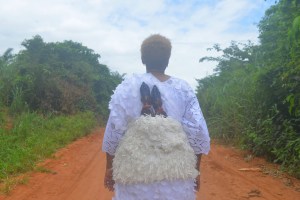
From the songs of folklore musicians to the stories passed down through generations, including food and ornaments, twins hold a special place in Yoruba culture. But what of the women who give birth to them? With Iyabeji, artist Angie Aniwura turns our attention to the mothers, exploring womanhood, spirituality, memory and the unseen through art.
Words Ireho Aito | Don’t Keep Your Art in the Finger! Photographs credit: 14×14/ Angie.: Photographed by Dotun Adeleye A2: Jelili Attiku photographed by Benedicte Kurzen: Paintings images: Painted by Lucy SM Johnston & Angie Aniwura
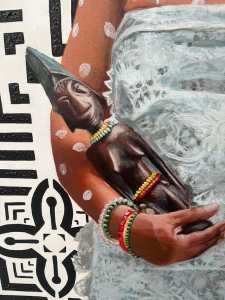
In Nigeria, particularly among the Yoruba, the birth of twins is rarely treated as an ordinary family event. There is usually excitement, celebration and a special kind of attention that follows the arrival of two children at once. Their names, Taiwo and Kehinde, are familiar to many of us, as are the songs of folklore musicians who praise twins, celebrate their parents and sing about the blessings associated with their birth. In the stories passed down through generations, Ìbejì are surrounded by beliefs about spiritual connections, mysterious relationships and a bond that is often considered deeper than the ordinary relationship between siblings.
Some of these stories speak of twins sensing one another’s experiences, sharing an unusual closeness or remaining spiritually connected even after death. Whether heard through traditional songs, family accounts or cultural practices, these stories have helped shape the special place twins occupy in Yoruba imagination and cultural memory.
But what about the women who give birth to twins? What does their experience mean within this spiritual and cultural understanding? And what happens when an artist turns her attention from the twins themselves to the women who bring them into the world?
These are some of the questions that give Angie Aniwura’s forthcoming exhibition, Iyabeji, its distinctive direction.
Before exploring the exhibition, it is worth meeting the woman behind it. Angie’s story begins in Fredericton, New Brunswick, Canada, where she was born to an Igbo mother and an Ijebu father. Her childhood and upbringing took her across three countries: Canada, Nigeria and the United Kingdom. Her late father was a chartered surveyor, while her mother was a businesswoman.
Her education also followed an international path. She attended St. Mary’s Primary School in Lagos and spent the first two years of her secondary education at Holy Child before completing secondary school in the United Kingdom. She later earned her bachelor’s degree in the United States, followed by a Master of Arts in Textile Design and an MSc in Commercial Real Estate Development.
Today, Angie works full-time as a surveyor in the United Kingdom while maintaining her studio practice. It is an interesting combination of professional and creative worlds, and one that gives her journey an additional dimension. Art is not the only part of her working life, but it remains an important space through which she explores ideas, experiences and questions that matter to her.
Her creative journey has also been shaped by an interest in Yoruba culture, indigenous spirituality and the knowledge carried by traditional communities. This interest eventually led to the creation of Aniwura Collective, although Angie explains that the collective did not begin as a grand plan.
“It started quite organically, to be honest,” she says.
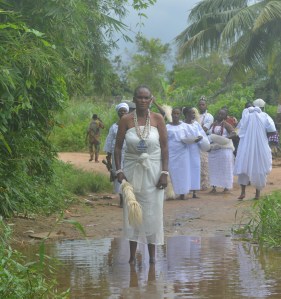
In 2019, she set out to visit rural and urban communities to research female priests and divinities associated with Obatala. During this journey, she invited a French photographer friend, who shared an interest in indigenous Yoruba priesthood, to accompany her to Shagamu. The trip resulted in a series of photographs from the cloister of Orisa Yemowo.
For Angie, the experience also revealed something about the possibilities of working with other creative minds. She enjoys working independently, but believes collaboration can produce something beyond what an individual might achieve alone.
“As it is said, the whole is often greater than the sum of its parts,” she explains, describing the energy of collaborative work as something that develops from individual viewpoints into a collective visual “eye”.
That idea is important to understanding Aniwura Collective and the exhibition now taking shape under its name. It is not simply a platform for presenting the work of one artist. It creates room for different creative voices, experiences and interpretations to meet.
For Angie, however, the journey towards Iyabeji is also deeply personal. Her life has included experiences that have changed how she understands the body, spirituality, memory and the relationship between what can be seen and what cannot.
Following a hysterectomy in 2013, she has spoken of dreams, visions and spiritual experiences that she associates with Ìyàbéjì. Her spiritual journey developed over the years through Ifá initiation in 2015, experiences associated with Osun and Odua in 2019, Egbe in 2021, and her membership of the Gelede society of Ilaro in 2023, where she holds the title Iya Egbe Oni Gelede.
Then came another major challenge. In 2023, Angie was diagnosed with breast cancer. Her experience of illness, treatment and recovery became another significant part of the journey that informs the exhibition.
Asked how these experiences have changed her outlook on life and her approach to art, she offers a striking response:
“The veil has thinned; between the seen and unseen, between the past, present and future, the essential and the trivial, it has thinned.”
She goes further to describe this change as being able to remain “hyper-focused while still maintaining a panoramic viewpoint”.
It is a revealing statement. It suggests a woman whose experiences have brought a different kind of attention to the world around her: an awareness of the immediate, while remaining conscious of the larger picture. For an artist working with spirituality, memory and the unseen, this perspective becomes especially significant.
But what exactly does Iyabeji mean to Angie?
Her explanation offers a different way of approaching a subject many people believe they already understand.
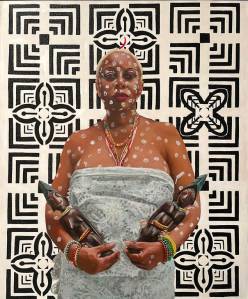
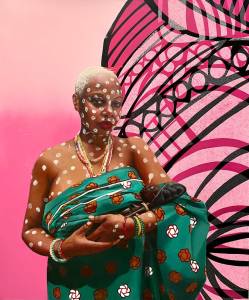
“Twins (Ibeji) are considered to be part of the Yoruba spiritual pantheon of deities. Iyabeji shifts the focus from the twins to the women who birth them, that is, the women who birth deities.”
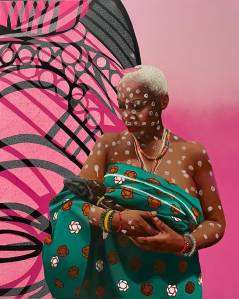
That shift is central to the exhibition. Rather than concentrating only on the twins and the familiar stories surrounding them, Angie directs attention towards the mothers. The women become the starting point for another conversation about birth, spirituality, womanhood, identity and the place of the maternal within Yoruba cosmology.
It is a perspective that invites visitors to look again at a familiar cultural subject. The celebration of twins is well known, but the experience and significance of the women who give birth to them deserve attention too. Through Iyabeji, Angie opens that conversation using her own experience as well as her artistic and spiritual interests.
Her collaboration with Lucy SM Johnston adds another personal dimension. What began as a photographic homage to Ìyàbéjì developed into a closer creative relationship, with the two artists eventually painting together. Their relationship grew through shared artistic practice, trust and the support they offered one another during Angie’s breast cancer diagnosis and recovery.
This is where the exhibition’s ideas extend beyond spirituality and cultural memory. It also speaks to the value of companionship and the importance of having people who stand with us through difficult moments. Creative collaboration can become more than an exchange of ideas or techniques; it can provide a space for listening, encouragement and shared strength.
The exhibition brings together painting, photography, moving image, installation, performance and spoken word. Contributors include Peju Alatise, who brings storytelling and recitations, as well as Jelili Atiku, Angie’s mentor, alongside Bénédicte Kurzen, Adegoke Adedotun and Anthony Adélẹ́yẹ Ọlájídé.
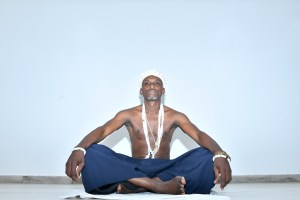
Jelili Atiku also directs A Separation from My Unborn Twins, a film that forms part of the exhibition. The production brings together Bashiru Aminu Peter, known as BAP, and Rasaq Kazeem, known as ROCKSON, with Luke Schiller as editor and Angie Aniwura as producer. Its inclusion gives the project another way to explore the personal experiences and questions that inform the exhibition.
Lison Sabrina Musset, a UK-based curator, joins Angie as co-curator. Together, they have shaped an exhibition that brings different artistic approaches into conversation while allowing the personal and cultural ideas behind the project to remain at the centre.
The choice of the J. Randle Centre for Yoruba Culture and History in Lagos is also significant. The venue provides a cultural setting for an exhibition drawing on Yoruba spirituality and contemporary artistic expression. It gives visitors an opportunity to engage with the subject through a range of creative forms, rather than relying on a single explanation or interpretation.
For the public, the exhibition programme offers several opportunities to meet the artists and engage with the ideas behind the works. The opening takes place on Saturday, 14 November 2026, from 3 pm to 6 pm. An artist talk follows on Sunday, 15 November, at 3 pm, featuring Angie Aniwura, Lucy SM Johnston, Anthony Adélẹ́yẹ Ọlájídé and Adegoke Adedotun, with Lison Sabrina Musset as host.
The exhibition closes on Saturday, 21 November, with a special lecture at 5 pm featuring Araba Ifayemi Elebuibon and Qudus Onikeku, alongside a screening of A Separation from My Unborn Twins.
Visitors can see the exhibition daily from 10 am to 6 pm, except Sunday, 15 November, when the hours are noon to 6 pm.
With Iyabeji, Angie Aniwura brings attention to a subject familiar within Yoruba culture but approaches it from a less frequently explored direction. Her story, her artistic practice and her collaborations give the exhibition a personal foundation, while its wider themes invite conversations about women, motherhood, spirituality, memory and the unseen.
The most interesting part is that the exhibition does not ask visitors to arrive with all the answers. It invites them to look beyond what they already know about twins and consider the women behind the stories, the experiences behind the artworks and the relationships that continue to shape our understanding of life.
iBAND Magazine, Celebrating Visual Art from the Original.
Africa | Visual Art | Lifestyle | Culture

