From plastic upcycling and aluminium foil to community art workshops at the Herbert Art Gallery and Museum in Coventry, Nigerian-born artist Yusuf Seidu Okus continues to explore how unconventional materials can carry powerful artistic and social messages. He features on our edition of Don’t Keep Your Art in the Finger!
Words Ireho Aito | Don’t Keep Your Art in the Finger! Photographs and images courtesy Yusuf Seidu Okus
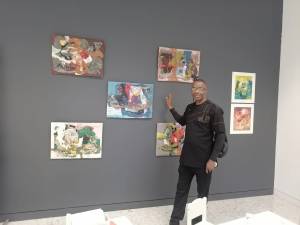
What happens when materials we ordinarily discard become the starting point for artistic expression? Can a piece of plastic, aluminium foil, abandoned tyres, trashed news and tabloid papers, or an everyday object become something worth looking at, interpreting and appreciating? For Yusuf Seidu Okus, these questions are part of an artistic journey that continues to challenge conventional ideas about materials, creativity and the purpose of art. Yusuf has become the symbol for recycling what we keep discarding. In his hands, they breathe and grow again making them very useful.
Early this morning, while getting ready for my morning walk, I decided to check the label on my new T-shirt. What I discovered caught me by surprise: the outfit was made from recycled material. Goodness! A fresh sense of appreciation immediately enveloped me as I looked at what I was wearing. Something I had taken for granted suddenly carried a deeper meaning.
As I walked through the estate gates, exchanging pleasantries with the security personnel, I noticed a scavenger already at work, gathering discarded cans, bottles and other recyclable materials to sell for money and earn a living. It was a simple but powerful reminder that recycling is not just an environmental conversation; it is also part of everyday life, livelihood and survival.
Indeed, we live in a world where the value of discarded materials is being rediscovered. In Nigeria, artists such as Yusuf Seidu Okus, Adeola Balogun, Yusuf Durodola and Dotun Popoola, among others, have made the transformation of discarded and unconventional materials an important part of their artistic expression. Through their creativity, what might ordinarily be regarded as waste becomes a medium for communicating ideas, challenging perceptions and encouraging a more thoughtful relationship with our environment.
In their different ways, these artists are doing more than making art. They are drawing attention to the need to care for the planet we inhabit and the future we hope to build. They are, in a sense, peacemakers: using creativity to encourage environmental responsibility, human connection and a world where people and nature can live in greater harmony.
It is within this wider conversation that we turn our attention to Yusuf Seidu Okus and his workshops and exhibition at the Herbert Art Gallery and Museum in Coventry, where discarded materials find new life through art on our weekly edition of Don’t Keep Your Art in the Finger!
He was born in Sapele, Nigeria, and as we all know from previous iBAND Magazine features of him, Okus has developed a multidisciplinary practice through which he communicates ideas using acrylic on canvas, oil on canvas, aluminium foil, plastic collage and mixed media. His interests extend beyond the visual possibilities of these materials to include migration stories, mental health advocacy and environmental sustainability. He regards art as a religion, a means of communicating ideas and giving visual expression to issues that matter to society.
His last engagement with the Herbert Art Gallery and Museum in Coventry, United Kingdom, brings these interests together in an interesting way. Through two community art workshops and a subsequent exhibition of his original works, Okus has continued to demonstrate how artistic practice can extend beyond the studio and create opportunities for participation, learning and cultural engagement.
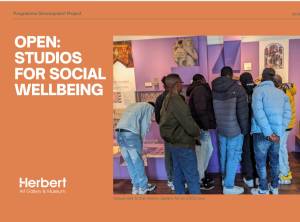
On 25 March and 25 April 2025, he facilitated two workshops at the Herbert Art Gallery and Museum: Plastic Upcycling: Studio for Social Wellbeing and Extraordinary Junk Chicken Collage Creating. Both formed part of the museum’s Open: Studios for Social Wellbeing Programme Development Project 2025/26, a collaboration between the Herbert Art Gallery and Museum (HAGM) and Warwickshire Virtual School (WVS).
The project was developed as an action research initiative, co-produced with Unaccompanied Asylum-Seeking Children (UASC), to help the museum understand how its public programmes could become more inclusive, accessible and supportive of social wellbeing. Supported by Arts Connect and the Mighty Creatives, the initiative sought to create opportunities for young people to explore art, develop confidence, build relationships and become more comfortable accessing cultural spaces.
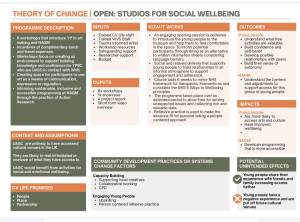
For the first two sessions, the museum engaged Okus because of his experience working with repurposed materials, his background in facilitating art activities for mental wellbeing and his experience with refugee and migrant communities. The choice of materials was deliberate. Repurposing offered an inexpensive and accessible way for participants to explore creativity, with enough freedom for individual interpretation and imagination.
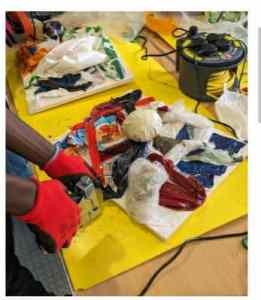
The first workshop, Plastic Upcycling: Studio for Social Wellbeing, introduced participants to the artistic possibilities of discarded plastics. Materials that might ordinarily find their way into waste bins became resources for creative exploration. Through arranging, combining and transforming these materials, participants were encouraged to look beyond their everyday uses and discover new possibilities.
The second workshop, Extraordinary Junk Chicken Collage Creating, offered another opportunity to experiment with collage and creative construction. Here, ordinary materials became part of an imaginative process in which participants could explore shapes, forms and personal interpretations.
What makes these workshops particularly interesting is the environment in which they took place. The young people involved were not simply being introduced to art-making techniques. They were participating in a wider programme that considered how creative activities could support social connections, confidence and a sense of belonging.
The museum’s research explored an important question: how could working directly with unaccompanied asylum-seeking children inform public programming and community engagement in ways that support social wellbeing and encourage the development of social bonds?
For young people navigating unfamiliar environments, language differences and the experience of displacement, opportunities to participate in cultural activities can be significant. The project therefore placed emphasis on practical engagement, informal interaction and creating a welcoming atmosphere. Art provided a means through which participants could communicate and express themselves without depending entirely on spoken language.
The programme also considered the importance of accessibility. Sessions were designed to be self-contained, allowing participants to join without having attended earlier workshops. Participants were provided with transport support and refreshments, while the museum and Warwickshire Virtual School worked together to make the experience as welcoming as possible.
The findings have continued to inform the museum’s wider programming, including its Sketchbook Socials and developing Arts for Wellbeing outreach activities. These initiatives provide opportunities for young people to explore creativity, meet others and engage with art without the pressure of producing polished or finished work.
For Okus, the connection between art and wellbeing is not new. His approach to creative engagement reflects a continuing interest in how artistic activities can provide opportunities for expression and personal exploration. His work with repurposed materials also introduces an environmental dimension, encouraging people to reconsider the value of objects and resources that are often overlooked.
The exhibition at the Herbert Art Gallery and Museum extends this conversation from the workshop environment to the gallery space. Presented as part of the legacy of the community engagement project, it brings together a selection of his original works, demonstrating the range of materials and processes that inform his artistic practice.
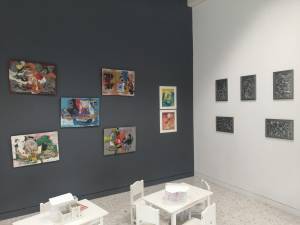
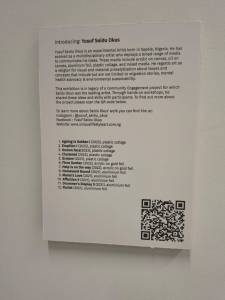
Among the exhibited works are Ageing is Golden I (2023), Eruption I (2023), Known Face (2023), Clustered (2023) and Scream (2023), all created through plastic collage. These works demonstrate his continuing interest in the possibilities of discarded plastics as an artistic medium.
His exploration of surfaces and material combinations is also evident in Flora Garden (2022) and Help is on the Way (2022), both executed in acrylic on gold foil. The reflective quality of the foil offers another dimension to his artistic expression, allowing the material itself to become part of the visual experience.
Earlier works such as Homeward Bound, Mama’s Love, Affection 5, Drummer’s Display 5 and Flutist (2021) were created using aluminium foil. Together, these works reveal an artist who has continued to investigate the possibilities of unconventional materials, moving between different surfaces and techniques while maintaining an interest in the stories and ideas that art can communicate.
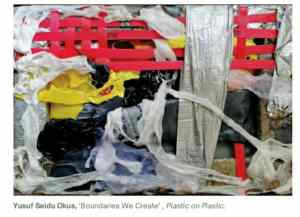
Another work identified in the museum’s programme documentation is Boundaries We Create, described as plastic on plastic. The title offers an interesting point of reflection within a wider body of work concerned with the relationship between materials, human experiences and the environments we inhabit.
Looking at the collection, it becomes clear that Okus is not simply interested in finding alternative materials for conventional artistic processes. He is exploring how those materials can influence the character, texture and meaning of an artwork. Plastic, aluminium foil and gold foil each offer different possibilities, and his willingness to experiment with them has become an important part of his practice.
The relationship between his workshops and exhibition is therefore worth considering. In the workshops, participants were encouraged to discover what they could create from accessible and repurposed materials. In the exhibition, visitors encounter the artist’s own interpretation of those possibilities through a selection of completed works. Both experiences invite a reconsideration of materials that might otherwise be overlooked.
For a Nigerian artist working within the British cultural environment, this engagement also provides an opportunity to bring different experiences and perspectives into conversation. His interests in migration, mental wellbeing and environmental sustainability speak to concerns that extend across geographical and cultural boundaries.
The Herbert Art Gallery and Museum project demonstrates that the relationship between artists and cultural institutions need not be limited to exhibitions and the presentation of finished artworks. Artists can also contribute their knowledge, methods and experience to programmes that bring new audiences into contact with art. In this instance, Okus’s participation formed part of a wider institutional effort to understand how creative activities could make cultural spaces more accessible to young people.
There is something particularly worthwhile about an artistic practice that finds possibilities in what others might discard. Beyond the finished compositions, Yusuf Seidu Okus continues to explore the value of creativity as a means of expression, environmental awareness and human connection.
From plastic collage to aluminium foil, from the individual artwork to the shared experience of a community workshop, his work reminds us that art does not always begin with expensive materials or conventional expectations. Sometimes, it begins with the ability to see something differently.
And that is where the artist’s imagination makes the difference.
Follow Yusuf Seidu Okus on his social media handles.
Instagram: @yusuf_seidu_okus
Facebook: Yusuf Seidu Okus
Website: http://www.uniquelifestyleart.com.ng
iBAND Magazine, Celebrating Visual Art from the Original.
Africa | Visual Art | Lifestyle | Culture

