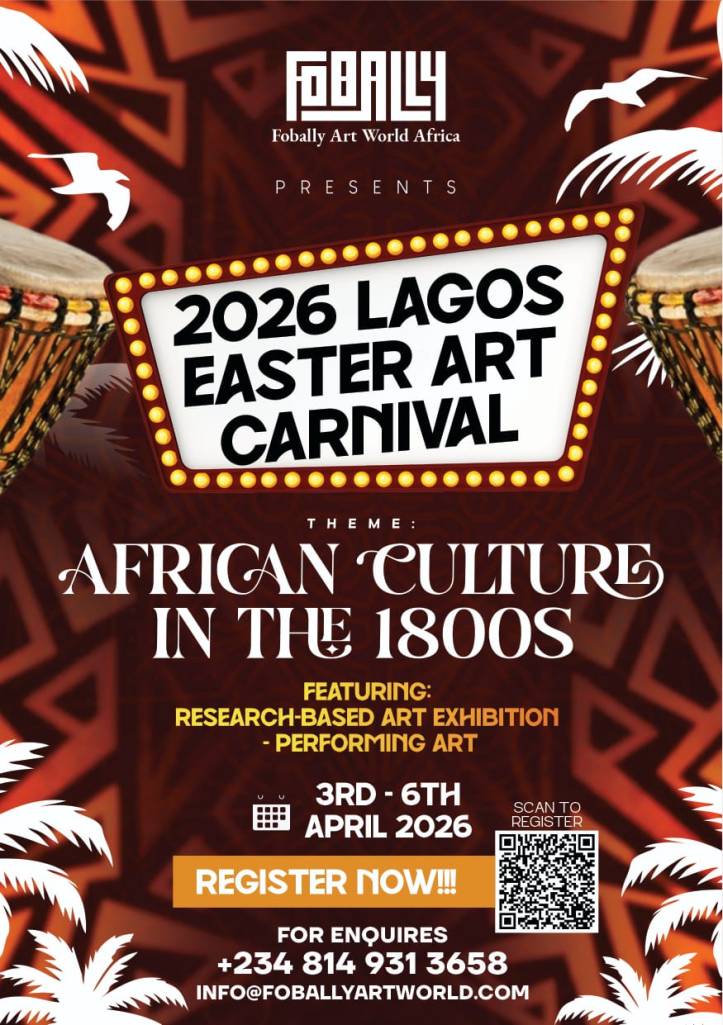
Easter in Lagos is often marked by travel, family gatherings, and celebration, but in 2026, the season will carry an added cultural resonance. Fobally Art World Africa is set to convene artists, historians, performers, and culture enthusiasts for the Lagos Easter Art Carnival, an immersive exploration of “African Culture in the 1800s.” Rather than a conventional festival, the gathering is envisioned as a thoughtful reconstruction of memory where scholarship meets creativity and heritage becomes a shared, living experience.
Words Ireho Aito | Don’t Keep Your Art in the Finger!
From April 3rd to 6th, the upscale enclave of Lekki will transform into a living museum where memory, movement, and material culture converge. More than an event, the carnival promises a dialogue between centuries, inviting modern Africa to rediscover its roots through research-based art exhibitions and performing arts that resurrect the spirit of a transformative era.
A Century Reimagined Through Art
Just when you think Fobally has paused for a breather, the team continues to evolve by reshaping our world through their creative vision.
It is on record that the 1800s were a defining epoch across the African continent. It was a time of thriving kingdoms, complex trade networks, spiritual traditions, and artistic mastery. In Yorubaland for instance, regal courts flourished with beadwork, bronze casting, and indigo-dyed textiles. While across the Sahel, trans-Saharan commerce carried not only goods but ideas. In Central and Southern Africa, oral traditions preserved genealogies and cosmologies that continue to shape identity today.
At the carnival, these histories will not sit behind glass. Instead, they will breathe as visitors will encounter curated installations that reconstruct palace courtyards, market scenes, and sacred groves spaces where artisans, traders, hunters, and griots once shaped community life. Performers will animate these worlds through drum languages, masquerade traditions, and theatrical storytelling, revealing how art functioned as archive, scripture, and social contract.
Beyond the spectacle of the Easter carnival, Fobally Art World Africa has steadily built a legacy of cultural stewardship. The Lekki-based institution is known for its year-round commitment to promoting and preserving African history, art, and culture through:
Highly regarded as one of the established galleries with most curated exhibitions that spotlight both historical narratives and contemporary African artistic voices since its inception. The culture power house has organised and played host to cultural festivals and heritage events that revive indigenous traditions for modern audiences. Not to forget its yearly school art competitions and youth programs designed to nurture creativity and instil cultural pride in the next generation. Fobally Art World Africa has invested in community engagement initiatives that make art accessible beyond gallery walls, fostering dialogue across ages and social backgrounds.
These efforts position Fobally not merely as an event organiser, but as a cultural ecosystem, the one that bridges scholarship, creativity, and public participation.
A bit of digression, the cultural resurrection envisioned by Fobally calls to mind the pioneering work of the Johnson brothers—Samuel Johnson and Obadiah Johnson whose seminal book A History of the Yorubas (1921) preserved the political structures, wars, migrations, and spiritual systems of a people navigating colonial disruption.
Were they alive today, one imagines the brothers standing quietly in the exhibition halls, watching history on canvas and installations. Their scholarship, once confined to print, now finds new expression in pigment, rhythm, and performance. Through this carnival, history steps out of the archive and into the public square.
https://www.facebook.com/share/v/186SzSYNyH/
The Vision Behind the Carnival
At every given time, the convener and visionary personality behind needs to step out for commendable recognition. And at the helm of this cultural renaissance is the amiable and visionary Mrs. Folasade Abiola, whose leadership continues to position Fobally Art World Africa as a custodian of heritage and a catalyst for contemporary creativity. Situated in Lekki, the organisation has built a reputation for promoting and preserving African history through exhibitions, cultural events, and school art competitions that nurture the next generation of storytellers.
The Easter season, often associated with renewal, becomes in Fobally’s hands a metaphor for cultural rebirth. Also an opportunity for Africans to rediscover narratives interrupted by colonialism and globalisation.
https://www.facebook.com/share/v/189SmAd6Hk/
Why the 1800s Matter Today
To revisit the 1800s is to confront a paradox: it was both an era of profound cultural vitality and one of external pressures that reshaped African societies. By revisiting this century, the carnival invites reflection on resilience while looking into how communities adapted, preserved identity, and transformed adversity into artistic expression.
In a global age where cultural homogenisation threatens local identities, such remembrance becomes an act of sovereignty. The motifs of adire cloth, the authority of talking drums, the symbolism of masks, and the choreography of communal dances all assert a truth that Africa has always been a continent of sophisticated civilisations and enduring creativity.
The 2026 Lagos Easter Art Carnival is more than a spectacle; it is an invitation to scholars, families, artists, and the diaspora to witness heritage not as nostalgia but as living knowledge. It is a place where a child may see a masquerade for the first time, where a researcher may find visual context for oral histories, and where elders may recognise fragments of stories told by their grandparents. At Easter, let the past not feel distant but beautifully alive with us.
iBAND Magazine, Celebrating Visual Arts from the Original.
Africa | Visual Art | Lifestyle | Culture

