
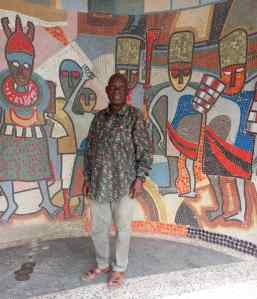
From the cool highlands of Jos comes a painter whose canvases breathe with colour, culture, and memory. For over five decades, Ezekiel Emealareta Udubrae has quietly built a remarkable artistic legacy, capturing dancers, drummers, families, and everyday life with textured strokes that celebrate the spirit of Nigerian heritage. In this Cover feature, Ireho Aito explores the life, inspiration, and enduring creative journey of a master painter whose work continues to preserve culture while inspiring a new generation of artists.
Words Ireho Aito | Don’t Keep Your Art in the Finger! Photographs and images credit: Ezekiel Udubrae
There is something about Jos that quietly nurtures creativity. Perched on the cool Plateau highlands and surrounded by rolling hills, the city moves at a gentle, reflective pace. Unlike the rush of Nigeria’s megacities, Jos is a place where ideas mature slowly, where culture breathes freely, and where artists find space to explore deeply.
For decades, the city has quietly given rise to some of Nigeria’s most enterprising creative pioneers from filmmaking and documentaries to music and fine arts. Television dramas such as Cockcrow at Dawn, Behind the Clouds, and Supple Blues were born here. Dan Maraya Jos, a folklore star, left an indelible mark on music. Innocent Idibia, known worldwide as 2Baba, brought Afrobeats to the global stage. Gospel genius Panam Percy Paul remains a music behemoth.
Amidst this rich abundance of talent, Jos has also been home to one of Nigeria’s most dedicated painters, Ezekiel Emealareta Udubrae. For more than fifty years, he has told visual stories about people, heritage, and memory, capturing everyday African life while preserving cultural traditions that might otherwise fade away.
“My paintings are about people and their culture. I want viewers to see the beauty in our traditions and the stories that live within them,” Udubrae says.
Born on April 19, 1952, in pre-independence Nigeria, Udubrae belongs to a generation of artists who came of age during a crucial period of cultural development. His journey began in the 1970s, as Nigeria’s contemporary art scene was gaining confidence. What started as youthful passion grew into a lifetime of painting, museum education, mentorship, and cultural advocacy.
His academic path mirrors this dedication. He studied Fine Arts at the College of Education, Benin City, earning his NCE in 1982. He later expanded his expertise with a Postgraduate Diploma in Management at the Institute of Archaeology and Museum Studies, Jos, before earning a Master’s in Public Administration from Ambrose Alli University.
Professionally, Udubrae served the National Commission for Museums and Monuments from 1975 until his retirement in 2010, rising to Assistant Director (Education). He also lectured at the Institute of Archaeology and Museum Studies in Jos, mentoring generations of museum professionals and cultural scholars. Retirement, however, did not slow him down. He founded the Udubrae Art Gallery within Jos Museum, transforming it into a studio and creative haven for younger artists.
The Language of Texture, Colour, and Motion
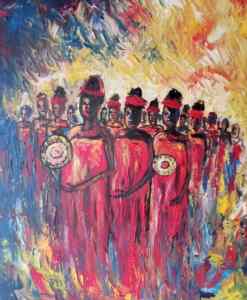
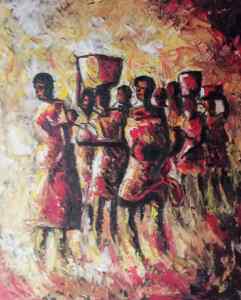
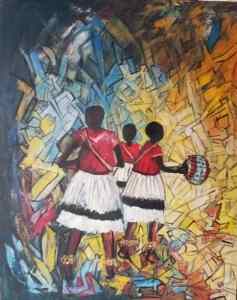
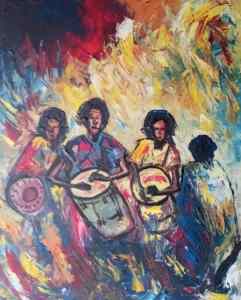
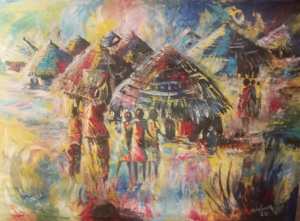
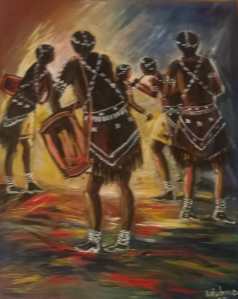
Udubrae’s paintings are unmistakable. Bold colours, heavy brushstrokes, and energetic palette knife movements give his canvases a tactile, almost sculptural presence. Central to his style is the scrollmatic technique. This technique is short, broken lines that flow rhythmically across the surface, creating a musicality that mirrors the cultural scenes he depicts in drummers beating ancient rhythms, dancers swirling in ceremonial costumes, and families gathering in celebration.
“I started experimenting with acrylic in this scrollmatic style around 2010. The short broken lines help me express movement and rhythm, especially when I paint dancers and drummers,” he explains.
Udubrae also experiments with materials. He often incorporates sawdust to give his paintings depth and texture, adding a tactile dimension that makes the works almost leap off the canvas.
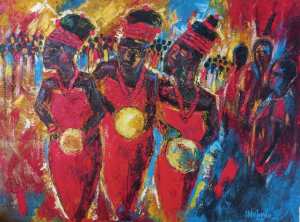
Medium: mixed media, acrylic on canvas.
Size: 36/47 inches
Year: 2026.8. Artwork credit: Ezekiel Udubrae
His recent works, including Ibo Dancers (2025), The Drummers (2025), and Benin Dancers (2026), celebrate the vibrancy of Nigerian cultural heritage. Other pieces, like Motherhood (2025) and Search for Water (2025), highlight quieter, yet powerful, themes of African life and resilience.
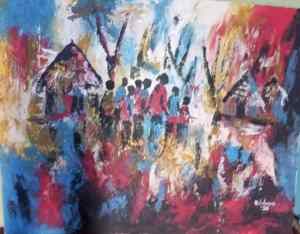
“My recent paintings celebrate Benin culture and its people. I like to show the dance steps and costumes because they are part of our identity.”
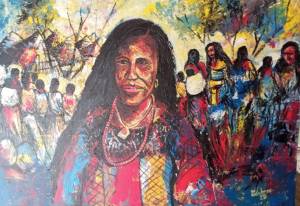
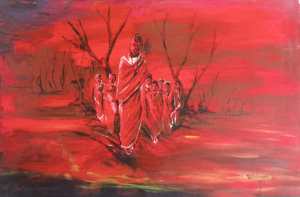
Two of his latest mixed-media works—Back Home (2026) and Arrival of the Family (2026)—blend memory, movement, and belonging, layering acrylic with materials like sawdust to create textured, living surfaces. Arrival of Chiefs (2026) portrays traditional authority figures with dignity and ceremony, capturing the essence of African leadership.
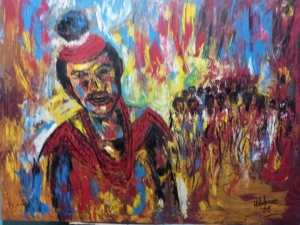
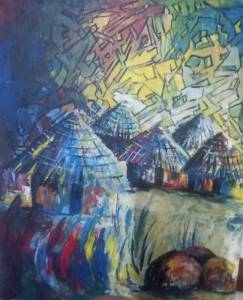
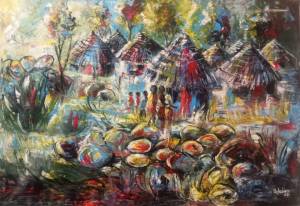
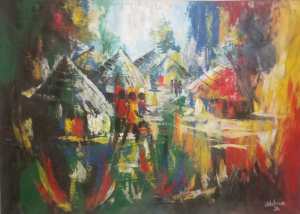
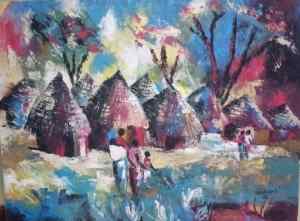
Beyond figures, Udubrae’s canvases often echo traditional architecture: grass-thatched huts and mud walls reminiscent of Nigeria’s North Central region. These forms preserve cultural memory in a rapidly modernizing world.

“Our forefathers lived in huts, not under rocks and trees,” he reflects. They lived in huts built with grass and sand mixed together. I like to return to those forms in my paintings because they remind us of where we come from.”
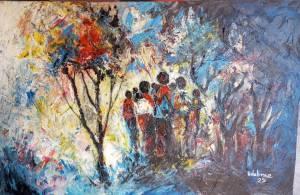
With such illustrious dedication, at the moment he deserves the recognition he is getting. Udubrae’s legacy stand strong. He has been driven by passion and purpose driven mission. Not forgetting that for over fifty years, Udubrae has mounted over 30 solo exhibitions and participated in more than 45 group shows in Nigeria and abroad.
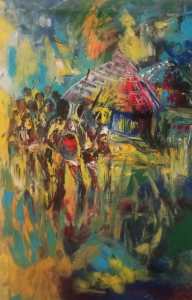
His volume of works reside in institutional and private collections worldwide. He is a Fellow of the Society of Nigerian Artists, former Chairman of its Plateau State chapter, and currently Vice President for the North Central zone. His awards include the NYSC Chairman’s Award (1983), the Society of Nigerian Artists Chairmanship Award (2012), and the Best Pavilion Design Award at the Africa Arts and Crafts Expo (2013).
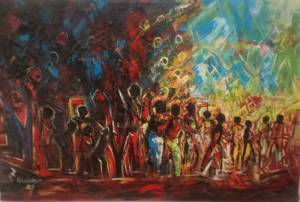
Art is also a family tradition. It runs in the family. Udubrae’s wife, Christiana, is a respected textile artist specialising in Adire and Batik. Together, they have raised six children, nurturing creativity at home. One of their children, Usiwoma Udubrae, continues the artistic legacy.
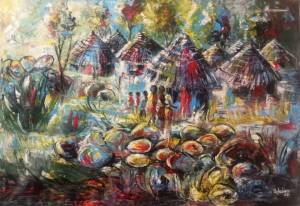
Today, in his Jos studio, Ezekiel Udubrae’s canvases continue to grow under his patient hand. The colours remain bold, the textures rich, and the stories deeply rooted in culture. In a world rushing forward, he paints with the calm assurance of someone who knows the value of memory.
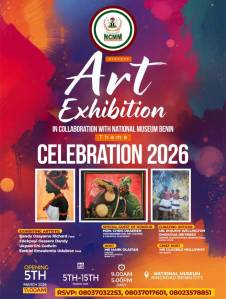
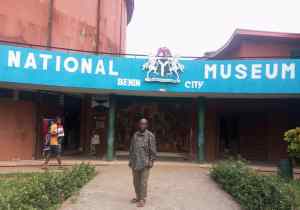
Ezekiel Udubrae’s work continues to reach audiences beyond Jos. He recently joined a four-man exhibition at the National Museum in Benin City alongside fellow artists Dandy Osayamo Richard, Edokpayi Osasere Dandy, and Ukpalo Ehi-Godwin. The exhibition, titled Celebration 2026, opened on March 5th and will run until March 15th, offering visitors a chance to experience the vibrant interplay of tradition, memory, and movement that defines Udubrae’s art. This participation reflects not only his enduring relevance but also his commitment to sharing Nigeria’s rich cultural heritage with the wider public.
“As long as I can hold a palette knife, I will continue painting. Art is how I document the life and culture of my people.”
iBAND Magazine, Celebrating Visual Arts from the Original.
Africa | Visual Art | Lifestyle | Culture

