
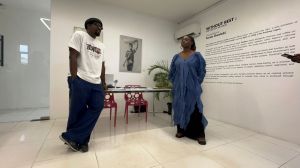
There was hardly a dull moment during the recent Artist Talk and Exhibition walkthrough with Tunde Owolabi at No Parking Lagos. Between reflections on art, photography and sculpture, the artist revealed deeply personal stories that turned the afternoon into something warm, humorous and profoundly human.
Words Ireho Aito | Don’t Keep Your Art in the Finger! Photographs credit June Creative Art Advisory
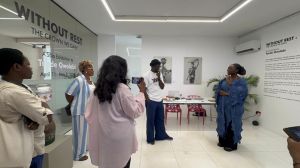
Our friends at June Creative Art Advisory invited us for an intimate afternoon with Tunde Owolabi, whose ongoing exhibition Without Rest: The Crown We Gain runs from April 11 to May 9. What unfolded was far removed from the familiar artist talk weighed down by academic “isms,” rehearsed curatorial jargon, and endless references to critics. Instead, the room loosened up. People settled into conversation. Music influences came up. Italian and Scottish wines were made available. Laughter travelled easily across the gallery. Everyone, in one way or another, contributed their own stories about labour, Lagos, ambition and survival.
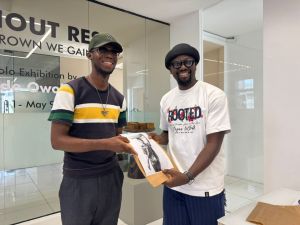
And before departure came a small thrill was unveiled, a raffle draw. Yours truly went home with a print.
By the time we arrived at No Parking, Lagos had already done what Lagos does best on the people which to overwork the body before noon. Faces had surrendered to the weather. Trust the city, people are still interested in polished appearances which makes Lagosians unique, even when the city had equalised everyone under the same aggressive sunlight.
Inside the gallery however, faces are lifted almost instantly. Air-conditioning, soft conversations and carefully arranged works offered the kind of relief Lagosians rarely admit they desperately need.
I was told I became the very first guest to step into No Parking for the artist talk.
Dressed in a hood with effortless pop-culture flair, Tunde Owolabi carried the presence of someone who could easily pass for an A&R executive at a music label.
During the conversation, he revealed that his brief foray into advertising was short-lived. Boredom arrived quickly, so did larger aspirations. One gets the sense that his artistic language emerged from refusing confinement whether professional, social or aesthetic.
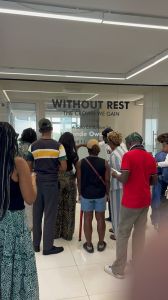
That refusal echoes throughout the exhibition itself.
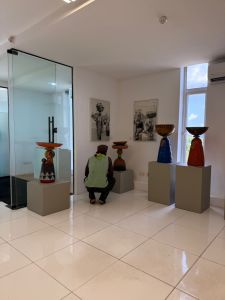
The works move between photography, painting, printmaking and mixed media, documenting the emotional architecture of everyday labour across Nigeria’s informal economy. Traders, hawkers, food sellers and market women become more than subjects, they emerge almost as urban monuments.
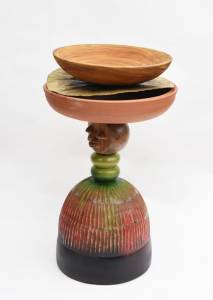
Titles like Ki le n ta Mama (Mama What Are You Selling?), I Get Fish Na Bread Remain, Mai Fura, Iya Kemi Eleko, Ewa Agoyin, Mama Nkem and Falilat Alagbo – Falilat the Herb Seller read like fragments of overheard Lagos conversations. The materials such as wood, terracotta, brass, charcoal, coffee, aluminium and acrylic, also deepen the tactile quality of the stories being told.
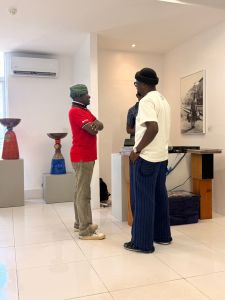
During the session, Seun Alli walked guests through the evolution of the collaboration that culminated in Without Rest: The Crown We Gain. She spoke about Owolabi’s movement across photography, painting and mixed media, and how observation itself became one of his strongest artistic tools. She emphasised on how collaboration made everything possible.
At one point during the afternoon, I found myself peering nearly sixty feet below from the gallery floor onto the next building outside. There, two women worked relentlessly washing reclaimed bottles gathered from around Lagos. There was no visible pause, no sign of fatigue, despite the heat and the distances they must have covered scavenging and hawking through the city.

It felt almost cinematic, as though the exhibition had quietly spilled out of the gallery walls and continued below in real time.
That perhaps is the lasting power of Without Rest: The Crown We Gain. The exhibition does not romanticise labour, yet it refuses to strip dignity from it. Instead, Tunde Owolabi frames everyday survival as its own kind of crown that is worn not in comfort, but earned through endurance.
One of the most memorable moments came when Owolabi spoke about his mother’s dream for him to become a medical doctor. In what he described as a typical Surulere mother’s ambition, she longed to proudly answer “Mama Doctor” among friends and colleagues. To her disappointment, young Tunde seemed far more interested in sketching cartoon characters across his notebooks and textbooks than paying attention in class. And this brought constant rift at home.
Teachers reportedly complained constantly about his lack of commitment to school work, except whenever drawing was involved. While his mother worried over the future of her dream child, one family friend saw something else entirely. “Don’t listen to your mom, my dear,” the mother’s friend encouraged him, a recollection that instantly sent the room into laughter.
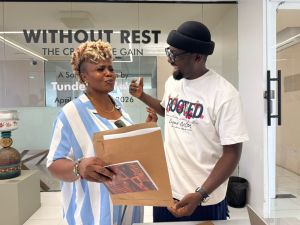
The laughter only deepened when Owolabi narrated his unforgettable Joint Admission and Matriculation Board popularly known as JAMB experience.
He revealed that he once sat for the examination hoping to study Medicine at the University of Ibadan. But upon checking the results and realising he had failed, his immediate reaction was not heartbreak but relief. “Ope o!” he exclaimed dramatically during the talk, recreating the moment with theatrical humour that left guests roaring with laughter. According to him, another applicant standing nearby could hardly understand why someone reacting to failure looked so genuinely happy.
Life, however, had already begun redirecting him toward art.
Owolabi later gained admission into the University of Lagos to study Creative Arts as part of the institution’s early generation of students in the programme. Still eager to deepen his artistic foundation, he eventually continued his academic journey at Yaba College of Technology, further shaping the multidisciplinary practice audiences now recognise today.
The conversation also opened up fascinating insights into the making of his photographic and sculptural works. Speaking about the photography series within the exhibition, Owolabi explained that gaining access to some of his subjects required patience, trust and genuine human connection. In certain cases, he deliberately patronised market traders and communities first before introducing the camera, allowing familiarity to replace suspicion.
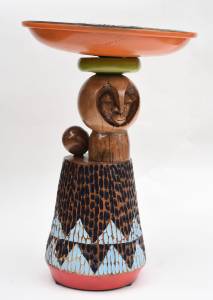
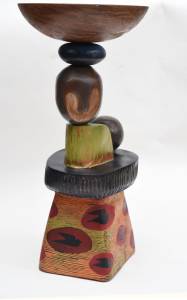
Perhaps the most joyful revelation of the evening came during his discussion of the now-iconic Eledere stools. Owolabi described the creative process as playful, immersive and emotionally freeing. Rather than approaching the works with rigidity, he allowed experimentation, instinct and humour to guide their formation. The result is a body of sculptural pieces that audiences continue to interpret differently as symbols of labour, balance, identity, resilience or even spiritual endurance.
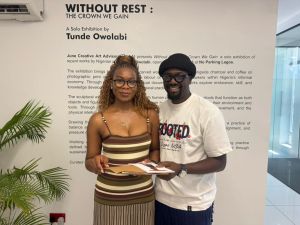
That openness may well be the true strength of Owolabi’s practice. His works resist fixed meanings. Instead, they invite viewers into conversation, memory and personal reflection much like the artist himself did throughout the evening.
The event also reflected the growing role of Lagos as a city where contemporary art conversations are becoming more accessible, relaxed and socially engaging. Guests exchanged interpretations openly, laughed easily and lingered long after the walkthrough ended.
Before the evening closed, a raffle session added a light celebratory touch, with selected attendees receiving prints from the artist’s collection and that is a fitting end to an afternoon built around connection, exchange and shared appreciation for contemporary African art.
iBAND Magazine, Celebrating Visual Arts from the Original.
Africa | Visual Art | Lifestyle | Culture

