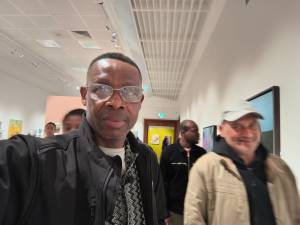
Growing up in the Niger Delta, Yusuf Seidu Okus who was born in Sapele, Delta State, Nigeria with Auchi root from Edo State, encountered both the beauty and the painful contradictions of an oil-rich region deeply affected by environmental degradation. Across many communities, polluted rivers, damaged farmlands and neglected landscapes became part of everyday reality, while mothers, grandmothers and children often carried the burden of worsening health conditions and the gradual loss of traditional means of livelihood. These experiences quietly shaped Okus’ understanding of the relationship between people, land, survival and emotional wellbeing.
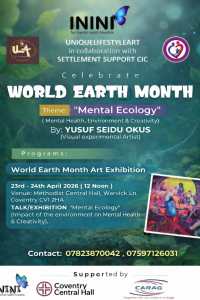
Perhaps this is why his participation in the Earth Month programme in the United Kingdom felt especially significant. For Okus, conversations around climate, mental wellbeing and environmental responsibility are not abstract global ideas. They connect directly to lived experiences and memories rooted in the Niger Delta landscape that formed part of his early life and artistic consciousness.
Words: Ireho Aito
Don’t Keep Your Art in the Finger! Photographs courtesy Yusuf Seidu Okus
There are artists who create for galleries. There are artists who create for collectors. And then there are artists like Yusuf Seidu Okus, whose work increasingly feels rooted in something more deep, such as, social commentary, subtle protest, people, healing and human connection.
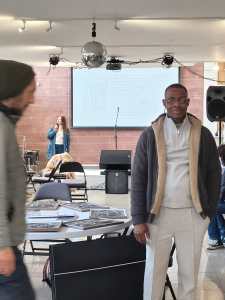
Lately, the Nigerian-born artist has been moving quietly but steadily through community spaces in the United Kingdom, building creative encounters that blur the boundaries between exhibition, therapy, education and social engagement.
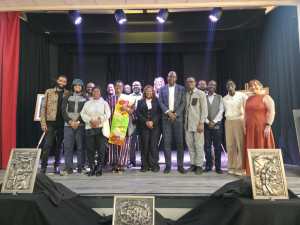
One of the recent moments came during the exhibition of the Coventry and Warwickshire Society of Artists, where one of Okus’ works received commendation from the Mayoress. For many artists, recognition at an exhibition is often framed around prestige. But for Okus, whose practice continues to evolve around emotional wellbeing and inclusion, the moment felt symbolic of something broader, bringing the growing visibility of socially conscious art within mainstream cultural spaces.
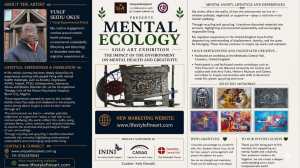
Yet perhaps more revealing than the commendation itself was everything surrounding it.
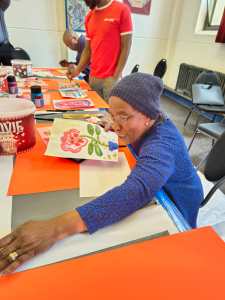
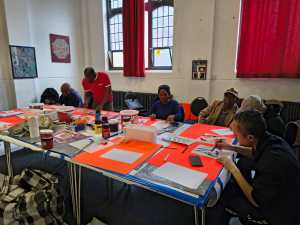
Around the same period, Okus participated in a wide-ranging Earth Month programme that unfolded less like a formal art event and more like a community gathering stitched together through creativity. There were art workshops, reflective conversations, guided art walks and an exhibition opening attended by community leaders and advocates.
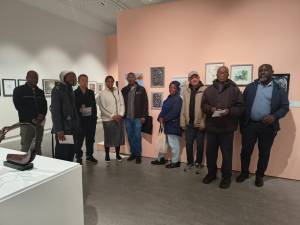
Participants moved through the city toward the Herbert Art Gallery and Museum to experience the CASE Exhibition together, transforming the traditional gallery visit into a shared social experience rather than a quiet, isolated viewing ritual.
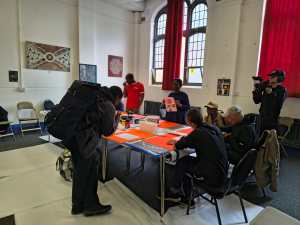
But it was the conversations around mental health and the environment that gave the programme its emotional heartbeat.
During the Art Talk segment, discussions explored the relationship between environment, emotional wellbeing and creativity. It was a subject deeply aligned with Okus’ long-standing interests. His work has often examined how surroundings, either physical, emotional and social, do shape human behaviour and inner life.
Interestingly, Earth Song by Michael Jackson, released in 1995, spent six weeks at number one on the United Kingdom pop charts. Its haunting meditation on climate destruction, war, environmental degradation and human suffering carried by the unforgettable refrain, “What about us?” remains one of popular music’s strongest artistic appeals for collective responsibility. One imagines that Yusuf Seidu Okus may have encountered the song’s emotional resonance at some point, especially given how closely its themes mirror the reflective conversations around environment, mental wellbeing and humanity that continue to surface within his Earth Month engagements and wider creative practice.
For people navigating stress, displacement, loneliness or anxiety, creativity can become a stabilising force. Sometimes it offers reflection. Sometimes release. Sometimes simply a reason to gather with others.
That sensitivity to emotional atmosphere has become one of the defining features of Okus’ practice.
Those familiar with his journey know this did not emerge accidentally. He has been on the journey of trainings and constant investment in international workshops and exhibitions, his early artistic experiences in Nigeria were already connected to communal learning and emotional awareness.
Equally and will remain significant was his period working within the Occupational Therapy Unit of the Federal Neuro-Psychiatric Hospital in Benin City, where he observed firsthand the relationship between creativity and mental wellbeing. Those experiences quietly continue to echo through his present-day projects.
That same spirit resurfaced during the Earth Month programme when an award was presented to Dr. Last Mafuba in recognition of her advocacy for mental health and wellbeing. Presented by Seyi Agbola on behalf of UNIQUELIFESTYLEART and Settlement Support, the gesture reflected the collaborative ecosystem Okus increasingly operates within where artists, health advocates, educators and community organisers intersect.
In many ways, this collaborative instinct defines his current chapter.
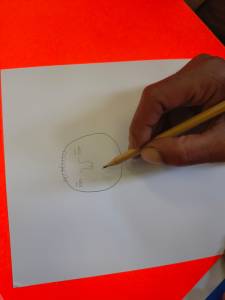
Rather than positioning himself solely as a studio artist, Okus appears more interested in building encounters. Workshops where participants feel seen. Conversations where mental health is approached gently. Exhibitions that invite dialogue rather than intimidation.
Even the launch of his website Lifestyle Fine Art feels connected to that wider vision. The platform is not merely a portfolio but an extension of an evolving philosophy that see art as lifestyle, healing practice and social connection.
What makes Okus particularly compelling is that his work rarely announces itself loudly. There is no excessive spectacle. No dramatic performance around activism. Instead, there is consistency. Quiet engagement. Repeated acts of cultural and emotional care.
In an era where many people are overwhelmed by noise, speed and uncertainty, artists like Yusuf Seidu Okus remind us that creativity can still slow people down long enough to reconnect with themselves and others.
And perhaps that is where the true power of Yusuf Seidu Okus’ work quietly lives. Not only in the paintings displayed on gallery walls, but in the human connections formed around them, moving to the conversations they inspire.
Visit Yusuf Seidu Okus official websites and know more about this extraordinary artist
http://www.uniquelifestyleart.com.ng
http://www.lifestylefineart.com
iBAND Magazine, Celebrating Visual Arts from the Original.
Africa | Visual Art | Lifestyle | Culture

